
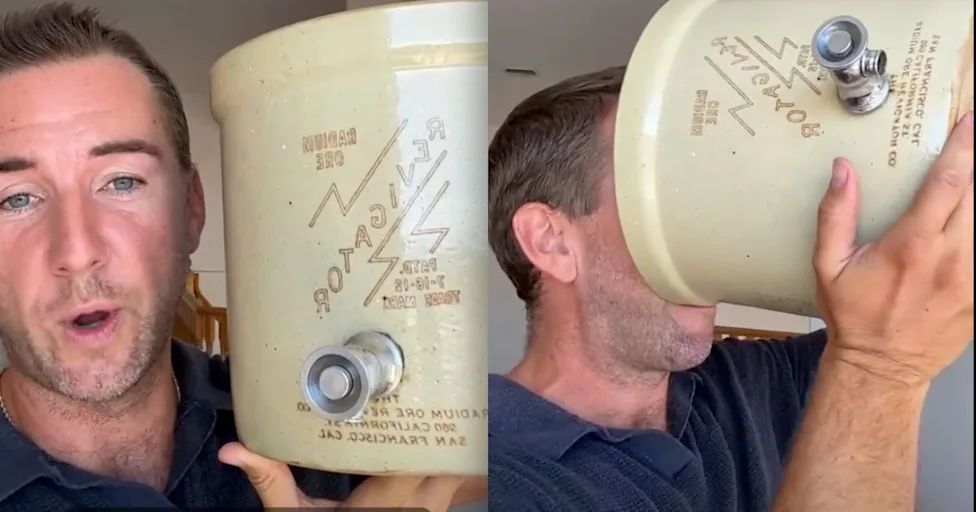
A health influencer has revived a century-old and thoroughly discredited wellness idea by claiming that he drank water from a radioactive ceramic jug for 250 consecutive days.
Matt Roeske, who runs the wellness brand Cultivate Elevate, recently posted a video on Instagram in which he appeared to drink from a vintage vessel identified as a Revigator. A radiation detector also appeared to register activity from the container.
Roeske presented the practice as evidence that so-called radium water is harmless and potentially beneficial. His claims have drawn renewed attention because radioactive drinking products were once promoted as miracle remedies before their dangers became impossible to ignore.
There is no established health benefit from drinking radium-contaminated or otherwise radioactive water. Radium is radioactive, and prolonged exposure can cause serious health problems, including an increased risk of certain cancers.
Most importantly, Roeske’s claim that he has consumed the water for 250 days does not demonstrate that the practice is safe. His video does not establish what radioactive material was present in the container, the activity level of the water or how much radiation he may have received.
What is the radioactive jug Roeske used?
The vessel shown in reports appears to be a Revigator, a type of ceramic water crock marketed in the United States during the 1920s.
The Revigator was part of an era when radioactivity was often portrayed as a source of vitality rather than a serious health hazard. Its interior incorporated uranium ore. Water left inside the vessel could absorb radon produced during radioactive decay, resulting in water that was intentionally made radioactive.
The Museum of Radiation and Radioactivity says Revigator products were sold in large numbers during the 1920s and were promoted as providing supposedly healthful “radioactive” water.
The Smithsonian’s National Museum of American History also describes the Revigator as a ceramic jar containing uranium and radium in its liner. Users were instructed to fill it with water, leave it overnight, and drink the resulting water the following day.
The historical object therefore was not simply an ordinary jug made from radioactive ceramic. It was specifically designed to expose drinking water to radioactive material.
Was radium water really marketed as medicine?
Yes.
During the early 20th century, radioactivity was surrounded by considerable scientific excitement, and entrepreneurs quickly turned that interest into commercial products.
Radioactive water and radium-containing products were marketed for an extraordinary range of supposed health benefits. The Revigator was promoted as a way of making ordinary water more healthful through radioactivity.
The problem was that these claims were not supported by reliable evidence.
A 1925 article in the Journal of the American Medical Association criticized the Revigator’s medical claims and said there was no scientific foundation for its supposed therapeutic effects.
The Federal Trade Commission also pursued the Radium Ore Revigator Company over allegedly false and misleading claims that water stored in its jars could benefit or cure dozens of diseases and that the US government approved the products.
That history matters because Roeske is effectively resurrecting a medical concept that was already facing regulatory scrutiny nearly a century ago.
What happened to people who actually drank radioactive products?
One of the most notorious examples was Eben Byers, a wealthy American businessman and former amateur golf champion.
Byers became a prominent consumer of Radithor, a commercially sold radioactive tonic containing radium and mesothorium. According to testimony recorded during the Federal Trade Commission’s investigation, he had consumed roughly 1,300 to 1,400 bottles.
The consequences were catastrophic.
Byers developed severe radiation poisoning and extensive damage to his bones, including his jaw. He died in 1932 at the age of 51.
The case became one of the most infamous examples of the dangers of radioactive quack medicine. It also helped expose the limitations of US consumer-protection law at the time.
The FTC had already taken action against the manufacturer of Radithor. In December 1931, the commission ordered Bailey Radium Laboratories to stop making therapeutic representations about the product and from claiming that it was harmless.
Did the FDA ban radium water in 1933?
This is one of the major claims that needs correcting.
Roeske reportedly linked the suppression of radium water to the Rothschild family and claimed that a supposed “Rothschild FDA” intervened in 1933.
There is no credible evidence supporting that conspiracy theory.
The history of the FDA also does not match the claim.
The federal agency’s regulatory roots go back to the 1906 Pure Food and Drugs Act, and the agency did not even begin using the name Food and Drug Administration until 1930.
The broader Food, Drug, and Cosmetic Act was enacted in 1938, expanding federal authority and strengthening protections against false therapeutic claims.
In the case of Radithor, the FTC played an important role before that law was passed. The FDA’s own historical account notes that Radithor was extremely dangerous but remained legally marketable under the older 1906 framework because it was accurately labeled as radioactive water.
In other words, the history is much less mysterious than the conspiracy suggests. Regulatory powers evolved as scientific understanding and federal law changed.
Why is radium dangerous?
Radium is a naturally occurring radioactive element. When it decays, it produces radiation and can also generate radon.
The health risks become particularly serious when radioactive material enters the body.
Because radium behaves chemically in ways that can cause it to accumulate in bone, internal exposure can damage surrounding tissue over time. The US Environmental Protection Agency says chronic exposure to high levels of radium can increase the incidence of bone, liver and breast cancers.
EPA drinking-water standards also treat radium as a contaminant that presents an increased cancer risk.
That is fundamentally different from the idea that radioactivity somehow makes water more “alive” or healthful.
Does the radiation detector prove that Roeske’s water was dangerous?
Not by itself.
A radiation detector can indicate that radiation is being emitted by an object, but a video showing a detector responding does not provide enough information to determine the health risk from drinking the water.
A proper assessment would require identifying the radioactive isotopes involved, measuring their activity and determining the level and duration of human exposure.
This distinction is important because the container itself can be radioactive without proving exactly how radioactive the water was.
The available reporting also does not establish through independent laboratory testing what was in the liquid Roeske drank.
Therefore, his assertion that he has been drinking it for 250 days should be treated as a personal claim, not as evidence that the practice is safe.
What is Roeske claiming about radium water?
Roeske has promoted the idea that radioactive water has health benefits and has suggested that historical restrictions on such products were part of a broader effort to conceal their supposed usefulness.
In his recent social-media content, he also made a claim connecting the suppression of radium water to the Rothschild family.
That is a conspiracy theory, not an established explanation of US regulatory history.
The documented record points instead to growing scientific evidence of harm, regulatory investigations into deceptive medical claims and, eventually, major changes in federal consumer and drug-safety law.
Is this a new health trend?
Not exactly. It is an old pseudomedical idea wearing new social-media clothes.
Radioactive products were once sold as fashionable health treatments because radioactivity was poorly understood and commercially exploited. The Revigator belongs to that period.
What has changed is the way the claim can spread.
A century ago, manufacturers relied on newspaper advertisements, brochures and sales representatives. Today, an influencer can present a vintage medical device to hundreds of thousands of followers within seconds, potentially making a discredited practice appear novel or rebellious.
Roeske’s Cultivate Elevate account has been reported to have more than 500,000 Instagram followers, giving the claims a potentially large audience.
What does science say about drinking radioactive water?
There is no credible evidence that intentionally drinking radium-contaminated water provides a health benefit.
The fact that naturally occurring radionuclides can sometimes be detected in drinking water does not make deliberate radioactive exposure therapeutic. Public-health standards instead aim to limit exposure.
The EPA regulates combined radium-226 and radium-228 in public drinking water because of the associated cancer risk.
The historical record offers another warning. Radithor was marketed as medicine, but a leading consumer suffered devastating radiation poisoning after prolonged use, and federal regulators eventually acted against its promotional claims.
That episode should not be interpreted as proof that every exposure to any level of radioactivity produces immediate illness. Radiation risk depends on the isotope, dose, route and duration of exposure.
It does, however, provide no scientific basis for turning radioactive exposure into a wellness practice.
The real danger of the radioactive-jug claim
The most concerning part of the story may not be whether one influencer experienced an obvious health problem after 250 days.
It is the suggestion that surviving a period of exposure proves that the exposure is beneficial or harmless.
Many radiation-related health effects are not immediate. Long-term exposure can increase cancer risk without producing dramatic symptoms after every individual exposure.
That is why laboratory measurements, toxicology and epidemiological evidence matter far more than an influencer’s personal experiment.
A vintage Revigator may look like an intriguing relic from an earlier era of medicine, but its history is better understood as a warning about what happens when scientific novelty outruns evidence.
The internet has now given that old idea a fresh microphone. The underlying science, however, has not changed.