
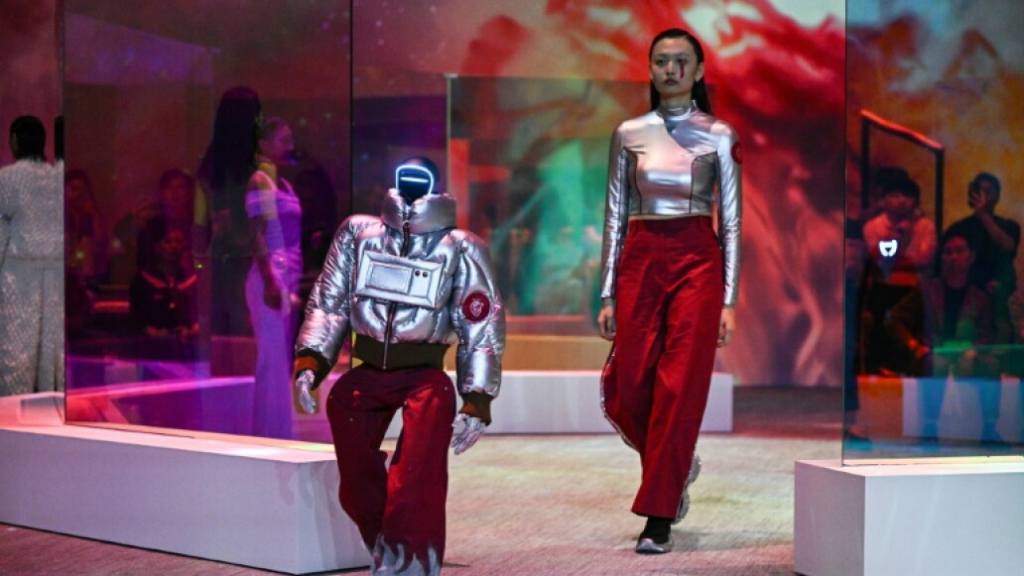
The future of fashion may not belong exclusively to humans. At a runway show in Seoul, South Korea, humanoid robots walked alongside human models wearing coordinated designer outfits, offering a glimpse into a world where artificial intelligence-powered machines are not just tools but participants in everyday social and cultural life.
The event, called “Mach33: Physical AI Fashion Show,” blended fashion, robotics, and technology to explore a question that is becoming increasingly relevant as AI advances: What happens when robots become part of daily human experiences?
While the show featured eye-catching designs and futuristic aesthetics, its larger purpose was to spark conversation about how humans and machines may coexist in the years ahead.
What was the Seoul robot fashion show?
The fashion event brought together human models and humanoid robots on the same runway, each wearing matching or complementary outfits.
The robots moved alongside their human counterparts in carefully choreographed presentations, demonstrating how technology and fashion can intersect in unexpected ways.
Organized by South Korean technology company Galaxy Corporation, the show was designed to imagine a future where robots are integrated into social settings rather than confined to factories, warehouses, or laboratories.
A runway built around human-robot partnerships
Instead of treating robots as props, the event positioned them as runway participants.
Each robot was paired with a human model, creating visual partnerships that emphasized cooperation rather than competition between humans and machines.
The concept reflected a growing trend in robotics development, where engineers and designers are increasingly focused on making robots capable of functioning in human-centered environments.
Why were robots wearing designer clothes?
The idea may sound unusual today, but organizers argued that fashion could eventually become an important part of robot design.
According to Galaxy Corporation CEO Choi Yong-ho, the concept emerged from a simple observation: if robots are expected to interact with people in public spaces, they may require forms of personal expression similar to humans.
His argument was straightforward.
“Robots need clothes too.”
The statement was not simply about aesthetics. It reflected a broader discussion about how machines might fit into social norms, workplaces, entertainment venues, and public life.
Designing clothing for machines
Creating robot fashion presented unique challenges.
Unlike human bodies, humanoid robots have:
- Exposed mechanical joints
- Rigid frames
- Different proportions
- Distinct movement patterns
Designers had to adapt each garment to fit robotic structures while maintaining visual harmony with the human outfits.
The result was a collection that balanced functionality with style.
What did the fashion collection look like?
The runway showcased a blend of futuristic and retro-inspired designs.
Highlights included:
- Metallic jackets with space-age styling
- Flowing silk dresses
- Oversized trousers inspired by 1970s fashion
- Cowboy-themed outfits complete with miniature robot hats
- Coordinated ensembles designed specifically for human-robot pairs
The collection created an atmosphere that felt part science fiction, part high fashion.
Celebrating individuality among robots
One of the event’s more surprising themes was individuality.
Organizers emphasized that future robots may not all look or behave the same way.
Just as humans express personality through clothing, future robots could potentially be customized with distinct appearances, functions, and identities.
That philosophy inspired designers to create unique looks for each robotic participant rather than dressing them as identical machines.
Why does this matter beyond fashion?
The show was about far more than clothing.
It reflected changing attitudes toward robotics worldwide.
For decades, robots have primarily been associated with industrial manufacturing, logistics, and repetitive tasks. Increasingly, however, developers are building humanoid machines capable of social interaction, communication, and customer-facing roles.
Companies across Asia, Europe, and North America are investing heavily in humanoid robotics aimed at:
- Healthcare assistance
- Elder care
- Hospitality services
- Retail support
- Education
- Entertainment
As robots move into these environments, questions about appearance, social acceptance, and human interaction become increasingly important.
South Korea’s growing role in humanoid robotics
The fashion show also highlights South Korea’s ambition to become a major player in advanced robotics.
The country has invested heavily in:
- Artificial intelligence
- Semiconductor manufacturing
- Robotics research
- Automation technologies
South Korea is already one of the world’s most automated economies and has embraced robotics in both industrial and public settings.
Events like the Seoul fashion show demonstrate how the country is also exploring the cultural and social dimensions of emerging technologies.
Could robots become part of everyday life?
Humanoid robots remain relatively rare today, but many technology companies believe that will change over the next decade.
Advances in AI, sensors, computer vision, and machine learning are making robots increasingly capable of navigating human environments.
Supporters envision robots assisting with:
- Household chores
- Customer service
- Medical support
- Physical labor
- Personal assistance
Critics, however, raise concerns about privacy, employment disruption, safety, and the ethical implications of integrating machines into daily life.
The Seoul fashion show did not attempt to answer those questions. Instead, it offered a visual experiment exploring what coexistence between humans and robots could look like.
The bigger question: How will humans and robots coexist?
At the heart of the event was a broader societal question.
As artificial intelligence becomes more sophisticated and humanoid robots become more common, communities will need to decide how these technologies fit into public life.
Will robots remain specialized tools?
Or will they become visible participants in workplaces, entertainment venues, homes, and social spaces?
The Seoul runway suggested a future where the line between technology and culture becomes increasingly blurred.
Whether that future arrives in five years or twenty, the conversation has already begun.
TL;DR
- Humanoid robots joined human models at Seoul’s “Mach33: Physical AI Fashion Show.”
- The event featured matching outfits designed for both humans and robots.
- Organizers said the show explored how humans and robots may coexist in everyday life.
- Designers adapted garments to fit robotic frames and movement patterns.
- The collection combined futuristic fashion with retro influences.
- The event reflects growing global interest in humanoid robots beyond industrial applications.
- South Korea continues to position itself as a leader in AI and robotics innovation.