
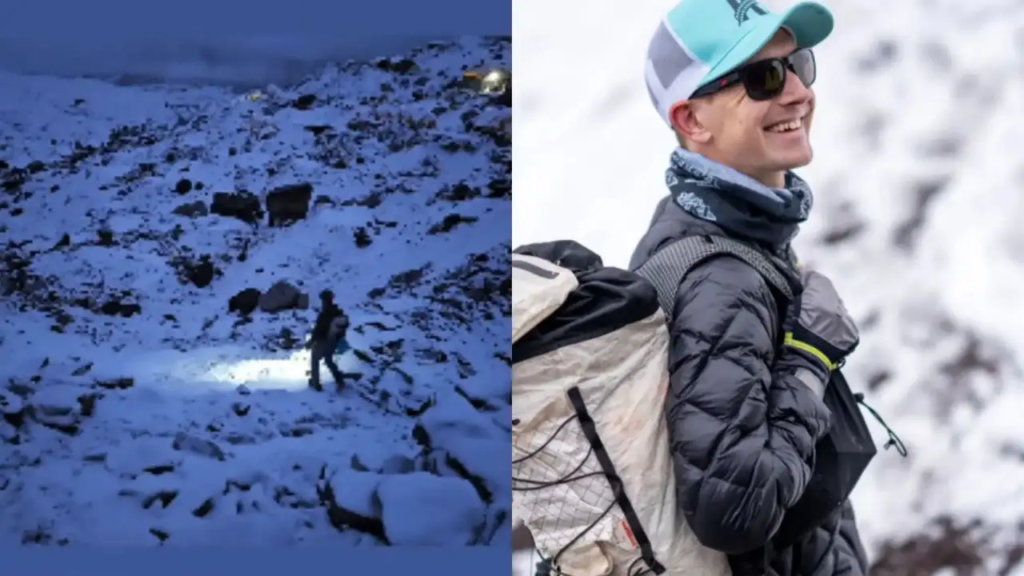
Tyler Andrews, a US climber and cancer survivor, has reportedly set a new speed record for summiting Mount Everest using supplementary oxygen, reaching the world’s highest peak in just 9 hours and 55 minutes.
If officially verified by Nepali authorities, Andrews’ ascent would break a record that had stood for more than two decades.
The previous fastest Everest summit using supplemental oxygen was reportedly held by Nepali climber Lhakpa Gelu Sherpa, who completed the climb in 10 hours and 56 minutes in 2003.
For perspective many climbers spend several days moving between Everest camps before their final summit push.
Andrews essentially compressed what is already one of Earth’s harshest endurance tests into something resembling an alpine speed run performed in the planet’s least forgiving oxygen setting.
How fast was Tyler Andrews’ Everest climb?
According to Andrews’ expedition team at Asian Trekking, he reached Everest’s summit in 9 hours, 55 minutes. Team leader Dawa Steven Sherpa confirmed the timing to AFP. The climb used:
- supplementary oxygen
- logistical support
- hydration and food assistance
- ascent monitoring
The timing now awaits formal verification from Nepal’s mountain authorities.
Even with oxygen support, climbing Everest at that pace is considered extraordinarily difficult because of:
- altitude
- terrain
- freezing temperatures
- thin air
- exhaustion risk
Near Everest’s summit, oxygen levels drop to roughly one-third of what humans experience at sea level. The mountain does not care about motivational speeches. It cares about lungs.
Who is Tyler Andrews?
Tyler Andrews is an endurance athlete known for:
- marathon running
- mountain racing
- high-altitude endurance events
He is also a cancer survivor, making the achievement especially notable within endurance sports circles.
Before Everest, Andrews built a reputation through extreme mountain running and ultra-endurance training.
According to interviews, he trained extensively in Wellesley. He described Everest as “the pinnacle” of years of athletic preparation stretching back to his school running days.
Andrews had already attempted another Everest record
Earlier this month, Andrews reportedly attempted an even more difficult challenge: breaking the speed record for climbing Everest without supplementary oxygen.
That attempt targeted the 22-hour, 29-minute benchmark. However, he was forced to turn back before completing it.
Climbing Everest without supplemental oxygen dramatically increases danger because the human body struggles to function in the so-called:
“death zone” above 8,000 meters.
At those altitudes:
- cognitive function declines
- reaction times slow
- altitude sickness risk spikes
- physical exhaustion accelerates rapidly
The margin for error becomes terrifyingly small.
Why is Everest speed climbing so dangerous
Traditional Everest expeditions focus on gradual acclimatization over several weeks.
Speed climbing changes the equation completely.
Athletes push:
- cardiovascular endurance
- oxygen efficiency
- technical climbing ability
- mental resilience to extreme limits.
The risks include:
- pulmonary edema
- cerebral edema
- frostbite
- exhaustion
- oxygen system failures
- falls during descent
Many Everest fatalities occur during descent, when climbers are physically depleted, and judgment becomes impaired.
One of the mountain’s most feared sections remains the Hillary Step, a steep and historically dangerous area near the summit.
Everest’s deadly 2026 climbing season
Andrews’ record attempt comes during another crowded Everest climbing season.
Reports indicate:
- More than 950 climbers successfully summited this season
- Five climbers have reportedly died
- Two victims were Indian climbers
- Three were Nepali climbers
The weather window for Everest ascents is typically narrow, often lasting only a few weeks before dangerous conditions return.
In 2023, Everest saw 18 climbing deaths, one of the deadliest seasons on record.
That growing congestion has sparked recurring concerns about:
- overcrowding
- safety standards
- commercialization
- environmental strain
At peak times, summit lines can resemble traffic jams at nearly 29,000 feet. The traffic jam can kill people.
Andrews is also raising money through the climb
According to reports, Andrews is using the expedition to raise funds for young athletes in:
- Ecuador
- Nepal
The initiative aims to support athletes who lack access to:
- coaching
- training
- equipment
- sports infrastructure
That charitable angle has added another layer of public attention to the climb.
Why Everest records still fascinate the world
Despite decades of expeditions, Everest continues to hold a strange grip on the global imagination.
Part of that fascination comes from the mountain’s symbolic status:
Everest remains shorthand for the absolute limit.
Records on the mountain are often measured not just against other climbers but against:
- physiology
- endurance
- fear
- survival itself
In the modern era, speed climbing has become one of mountaineering’s most controversial frontiers.
Supporters view it as the evolution of elite endurance sport. Critics argue it can encourage excessive risk-taking on an already deadly mountain.
The bigger picture: endurance sports are entering a new era
Athletes like Andrews represent a broader shift in extreme sports: Modern training science, altitude preparation, nutrition, and performance tracking are reshaping what humans can accomplish in hostile environments.
Today’s elite climbers often train like hybrid combinations of:
- ultramarathon runners
- mountaineers
- data-driven endurance athletes
That evolution is steadily pushing boundaries once considered impossible.
Yet Everest remains uniquely humbling because records there always exist beside mortality statistics.
The mountain celebrates achievement sparingly and unpredictably.