
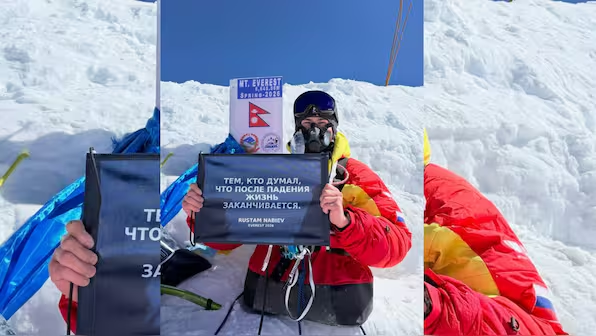
When Mount Everest draws headlines, it is usually because of record-breaking speed, extreme weather, or overcrowding on the mountain. This week, the spotlight shifted to something far more personal and powerful: human endurance. Russian mountaineer Rustam Nabiev has become the first double amputee to summit Everest without prosthetic legs, climbing largely with the strength of his arms and upper body. The achievement places him in a rare category of climbers who have reached the world’s tallest peak despite life-altering disabilities. Still, his route to the summit tells an even larger story about recovery, resilience, and redefining physical limits.
Nabiev reached Everest’s summit, which stands at 8,848.86 meters (29,031 feet), on May 20 during the 2026 spring climbing season. According to Nepal officials, he successfully began his descent shortly afterward.
His accomplishment is already being called one of the most remarkable feats in modern mountaineering.
Who is Rustam Nabiev?
Rustam Nabiev is a former member of the Russian Airborne Forces who survived a catastrophic collapse of a military barracks in 2015.
The accident happened in Omsk, Russia, while soldiers were asleep inside the facility. The collapse killed multiple servicemen and left Nabiev critically injured. Doctors performed 16 surgeries before amputating both of his legs.
For many people, that would have marked the end of an athletic life. For Nabiev, it became the beginning of a completely different chapter.
After rehabilitation, he entered professional sledge hockey and later built a large following online as a fitness coach and motivational speaker. Over time, he became known in Russia for documenting his training, climbs, and recovery journey across social media.
He was also appointed to the Human Rights Council in Bashkortostan, his home region.
How did Rustam Nabiev climb Everest without prosthetic legs?
Unlike many adaptive climbers who use specially designed prosthetic limbs, Rustam Nabiev completed the ascent primarily using his arms and upper body to pull himself upward across snow, rock, and ice sections.
That detail is what makes the climb historically significant.
Everest is physically punishing even for fully able-bodied climbers. Oxygen levels near the summit fall dramatically, weather conditions shift without warning, and climbers must cross steep ice walls, crevasses, and unstable terrain.
For Nabiev, every meter required extra physical effort.
In an Instagram post announcing the achievement, he wrote:
“For the first time in the history of mountaineering, for the first time in human history, I reached the summit of Everest using only my arms.”
The climb required months of altitude preparation, technical coordination, and endurance training focused heavily on upper-body strength.
Why Everest is considered one of the toughest climbs on Earth
Mount Everest is not simply a hiking challenge with a dramatic view at the top.
Climbers face:
- Temperatures that can plunge far below zero
- Thin oxygen levels in the “death zone”
- High avalanche risk
- Frostbite dangers
- Severe exhaustion and dehydration
- Long exposure to extreme altitude
Even experienced mountaineers sometimes fail to complete the ascent.
That context makes Nabiev’s achievement especially striking. He did not just overcome disability. He overcame one of the harshest physical environments on the planet without prosthetic assistance.
Has anyone with amputations climbed Everest before?
Yes. Adaptive athletes have reached Everest before, but Nabiev’s climb introduced a major first.
In 2006, Mark Inglis became the first double amputee below the knee to summit Everest using prosthetic legs.
Since then, a small number of climbers with amputations or disabilities have also completed the climb. Nabiev is now recognized as the first person to do so without prosthetic limbs.
That distinction changes how mountaineering experts may discuss adaptive climbing in the future.
It also expands public understanding of what adaptive athletes can accomplish in extreme sports.
Rustam Nabiev’s mountaineering record before Everest
Everest was not Nabiev’s first major climb.
Over the past several years, he steadily built experience on some of the world’s most demanding peaks.
Major mountains climbed by Rustam Nabiev
- Mount Elbrus in 2020
- Mount Manaslu in 2021
- Mount Kilimanjaro in 2021
- Mount Kazbek in 2021
- Aconcagua in 2022
- Mount Everest in 2026
The list shows that Everest was not an isolated publicity stunt or symbolic attempt. Nabiev spent years building technical climbing experience at high altitudes before attempting the summit.
Why Rustam Nabiev’s Everest climb matters beyond sports
Stories like this tend to travel far beyond the mountaineering community because they challenge assumptions about disability and athletic performance.
Adaptive sports have gained greater visibility over the past decade, but mainstream coverage still often focuses on participation rather than elite-level achievement.
Nabiev’s climb shifts that conversation.
His success demonstrates that adaptive athletes are not only entering extreme environments but also setting entirely new standards inside them.
It also arrives during a period when Everest itself is increasingly debated. Critics often argue that commercial expeditions have turned the mountain into a guided tourism industry. Nabiev’s ascent cuts through that conversation because the focus returns to raw physical endurance and mental determination.
The role of social media in his rise
Part of Nabiev’s influence comes from how openly he has documented his recovery and training online.
Instead of presenting himself only as an athlete, he built a public identity around persistence, rehabilitation, and fitness after trauma. That approach helped him attract a large digital audience long before the Everest climb.
In many ways, the summit became the culmination of a story people had already been following for years.
What happens next for Rustam Nabiev?
For now, the immediate priority is descending safely from the mountain, which many climbers say can be more dangerous than the ascent itself.
Beyond Everest, Nabiev’s achievement is likely to place him at the center of global conversations around adaptive sports, disability representation, and endurance athletics.
It may also inspire more investment and visibility for adaptive climbing programs worldwide.
Whether viewed as a mountaineering milestone, a sports story, or a human endurance story, Nabiev’s ascent stands apart because it reshapes what many people thought was physically possible.
TL;DR
- Rustam Nabiev became the first double amputee to summit Mount Everest without prosthetic legs.
- He lost both legs after a Russian military barracks collapse in 2015.
- Nabiev reached Everest’s summit on May 20, 2026.
- He previously climbed peaks including Mount Elbrus, Mount Manaslu, and Aconcagua.
- His achievement is being viewed as a landmark moment for adaptive sports and mountaineering.