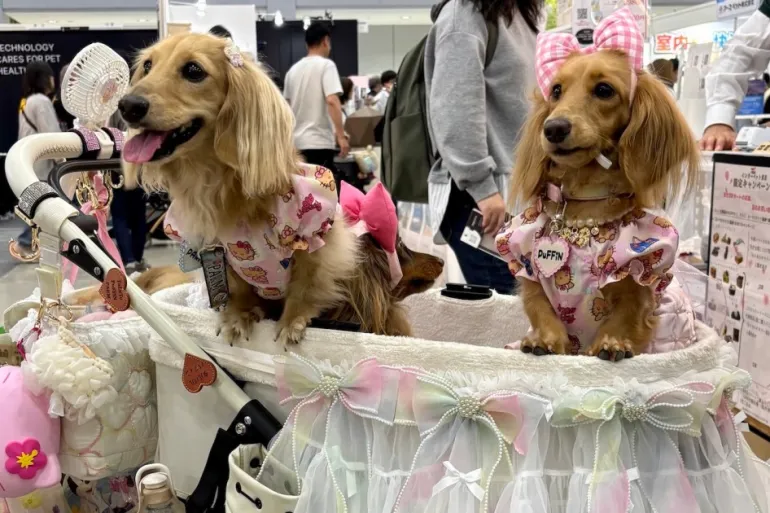
Japan is experiencing one of the world’s most striking demographic shifts. For the first time, the country’s registered pet dogs and cats now outnumber children under the age of 15, highlighting the combined effects of a record-low birth rate, an aging population, and changing social priorities. The trend is reshaping not only Japanese society but also its economy, as companies that once specialized in baby products are increasingly redesigning their offerings for pets.
From luxury pet strollers to ergonomic dog carriers and disposable pet diapers, businesses are adapting to what many analysts call the rise of the “multi-species family”—households where pets are increasingly treated as family members.
Why do pets now outnumber children in Japan?
Japan has struggled with declining birth rates for decades.
Several factors have contributed to fewer people having children:
- Rising living costs.
- Expensive childcare and education.
- Long working hours.
- Delayed marriage.
- Greater career focus among younger adults.
- An aging population.
At the same time, pet ownership has remained strong, with many households choosing dogs or cats as companions instead of expanding their families.
The result is a demographic milestone that reflects broader social and economic changes rather than a sudden increase in pet ownership alone.
What is driving Japan’s declining birth rate?
Japan consistently records one of the world’s lowest fertility rates.
Experts point to several structural challenges:
Rising cost of raising children
Housing, education, childcare, and healthcare expenses have made parenthood increasingly expensive, particularly in major cities.
Work-life balance
Many young adults cite demanding work cultures and limited time for family life as reasons for postponing or avoiding having children.
Later marriages
People are marrying later than previous generations, reducing the number of childbearing years.
Economic uncertainty
Concerns about long-term financial stability continue to influence family planning decisions.
These factors have contributed to a shrinking population that policymakers have struggled to reverse.
How are companies adapting?
The demographic shift has forced many traditional baby-product manufacturers to rethink their business models.
Rather than competing in a shrinking infant market, companies are expanding into premium pet care.
Several well-known Japanese brands have already made the transition.
Baby carriers become pet carriers
Lucky Industries, known for infant carriers, introduced Nu-i, an ergonomic carrier designed specifically for small dogs.
The product was reportedly developed with veterinary input to ensure proper support and comfort.
Premium pet strollers
AirBuggy, originally recognized for high-end baby strollers, has expanded its pet stroller lineup.
These products feature:
- Shock-absorbing suspension.
- Lightweight frames.
- Designs suitable for elderly or small pets.
Pet diapers
Consumer goods company Unicharm has expanded its Mannerware line of disposable pet diapers and training pads.
According to the company, its pet-care business now represents a significant share of overall revenue, reflecting strong consumer demand.
What is the “multi-species family” trend?
Sociologists increasingly use the term “multi-species family” to describe households where pets occupy roles traditionally associated with children.
Many owners now invest in:
- Premium healthcare.
- Gourmet pet food.
- Customized clothing.
- Luxury accessories.
- Professional grooming.
- Birthday celebrations.
- Specialized travel equipment.
This shift reflects changing definitions of family rather than simply increased spending on pets.
How large is Japan’s pet economy?
Japan’s pet industry has grown into a multibillion-dollar market.
Industry estimates value the sector at more than 880 billion yen (approximately $5.4 billion), covering products and services such as:
- Pet food.
- Veterinary care.
- Grooming.
- Insurance.
- Accessories.
- Boarding services.
- Luxury products.
Because many owners are willing to spend generously on aging pets, the industry has proven relatively resilient even during periods of slower economic growth.
Is this trend unique to Japan?
Japan is one of the clearest examples, but similar patterns are emerging elsewhere.
Countries experiencing declining birth rates—including South Korea, Italy, Germany, and parts of China—have also seen increased spending on companion animals.
In many developed economies, younger generations are delaying parenthood while investing more in pets.
However, Japan remains among the most advanced examples because of the speed and scale of its demographic transition.
What does this mean for Japan’s future?
The growing pet economy cannot offset the broader economic challenges posed by population decline.
A shrinking number of children eventually affects:
- School enrollment.
- Workforce growth.
- Tax revenues.
- Healthcare systems.
- Pension sustainability.
While companies may successfully adapt by targeting pet owners, policymakers continue searching for ways to encourage higher birth rates through childcare support, housing assistance, workplace reforms, and financial incentives.
Why this matters
Japan’s demographic transformation offers a glimpse into challenges many developed countries may face in the coming decades.
Businesses are responding by innovating for a changing consumer base, while governments continue grappling with the long-term consequences of population aging.
The country’s booming pet economy reflects both changing lifestyles and deeper demographic realities, illustrating how shifts in family structure can reshape entire industries.
TL;DR
- Registered pet dogs and cats now outnumber children under 15 in Japan.
- Declining birth rates, high living costs, and changing lifestyles have driven the demographic shift.
- Baby-product manufacturers are increasingly developing products for pets, including carriers, strollers, and diapers.
- Japan’s pet-care industry is now worth an estimated 880 billion yen (about $5.4 billion).
- The trend reflects broader changes in family structures and consumer spending while highlighting Japan’s ongoing demographic challenges.