
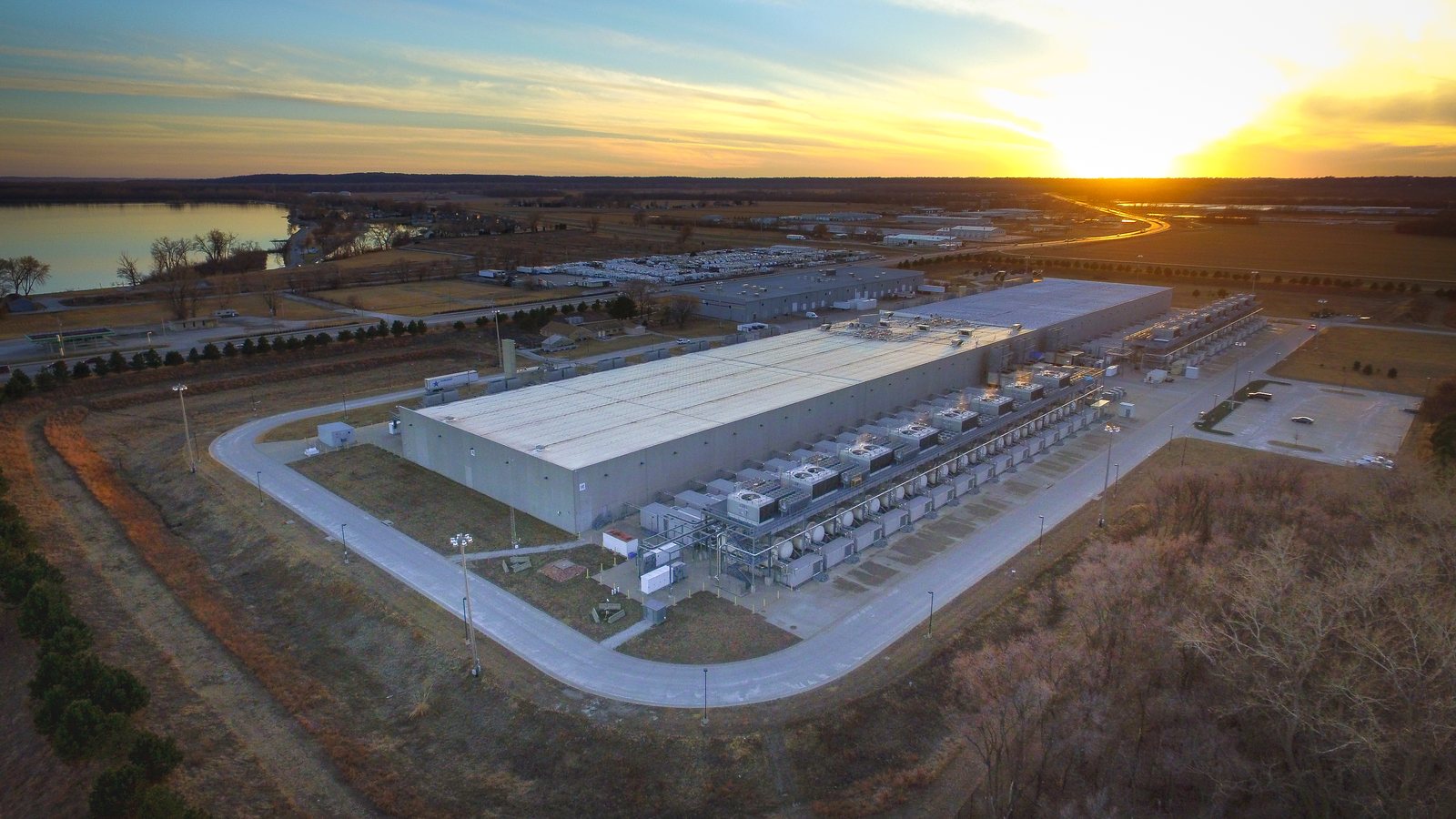

If the AI bubble bursts, the damage lands first on stock prices and on the debt behind new data centers. The chatbots on your phone are the least likely casualty. Thursday’s sell-off showed where the pressure sits: the gap between Big Tech’s AI spending and what it earns so far.
That gap matters to far more people than tech investors. If your 401(k) holds an S&P 500 index fund, you own a big slice of the AI trade.
Meta’s bigger budget set off Thursday’s sell-off
The Nasdaq Composite fell 694 points, or 2.6%, to 26,008.86 on Thursday, October 22, Reuters reported. It was the index’s biggest one-day percentage drop since early June.
The S&P 500 lost 1.2%, while the Dow ended slightly higher. Chip stocks fell 6.7%, and Meta dropped 7%.
The trigger came from Meta’s third-quarter results the evening before. Revenue rose 26% to $64.6 billion.
But it spent $34.91 billion on capital projects in the quarter. It also raised the bottom of its 2026 spending range, now $135 billion to $145 billion. Its free cash flow, the money left after that spending, came out negative $2.12 billion.
Debt worries spread too. CoreWeave, which rents out AI chips in its data centers, sank 10%, Yahoo Finance reported. The world’s six richest people lost about $130 billion on paper, according to Forbes estimates cited by IBTimes UK.
Big Tech’s AI spending is growing faster than its cloud sales
The bubble argument boils down to one comparison: spending versus payback. We pulled capital spending from each company’s own earnings release for April to June 2026. That money goes mostly to data centers, chips and servers. It’s the latest quarter all four big spenders have reported.
| Company | Capital spending, Apr–Jun 2026 | Same quarter 2025 | Change | Cloud revenue, Apr–Jun 2026 |
|---|---|---|---|---|
| Amazon | $54.2B | $32.2B | +68% | AWS: $42.2B (+37%) |
| Alphabet | $44.9B | $22.4B | +100% | Google Cloud: $24.8B (+82%) |
| Microsoft | $35.8B | $17.1B | +110% | Intelligent Cloud: $39.3B (+32%) |
| Meta | $30.1B | $16.5B | +82% | No cloud unit; total revenue $60.8B (+28%) |
| Total | $165.0B | $88.2B | +87% | About $106B from the three cloud units |
Capital spending here is “purchases of property and equipment” (Microsoft calls it “additions”), taken from each cash flow statement.
In three months, the four companies spent $165 billion, up 87% from a year earlier. Their cloud units, where most AI sales to outside customers show up, brought in about $106 billion. Those sales grew 32% to 82%.
Spending is growing faster than the revenue meant to pay for it, and the cash strain shows. Alphabet’s free cash flow turned negative $5.9 billion in the quarter. Amazon reported a 12-month outflow of $7.6 billion, which it tied “primarily” to AI investment.
The companies argue the payback has started. Meta says its AI investments “are already delivering substantial incremental advertising revenue.” Amazon CEO Andy Jassy said its AI business alone passed an annual run rate of more than $25 billion.
About 27 cents of every S&P 500 dollar sits in six AI names
This is the part that reaches ordinary savers. We added up the holdings of the SPDR S&P 500 ETF, the biggest fund tracking the index. The source is State Street’s holdings file for October 22.
Nvidia is the largest holding at 7.8%. Add Microsoft, Alphabet, Amazon, Broadcom and Meta, and AI spenders and chipmakers make up about 27% of the index. The top 10 companies make up about 39%. In July 2025 the top 10 stood at 37.3%, near a record in S&P Dow Jones Indices data going back to 1975, Reuters reported.
“Every index on the planet is basically an AI index,” Matt Miskin of Manulife John Hancock Investments told Yahoo Finance. J.P. Morgan found that 42 AI-related companies drove about two-thirds of the index’s gains since early 2024, NPR’s Planet Money reported.
Fitch Ratings has modeled a worst case. If US stocks fell 35%, US output would shrink 0.6% in 2027. Fitch called that a “what-if,” not its forecast.
None of this is investment advice. It’s a description of what a standard index fund holds today.
Data-center debt is where a bust would bite first
Big Tech pays for most of its building from profits. Smaller players lean on borrowing.
CoreWeave’s bonds fell to distressed levels last week. The selling then hit SoftBank, OpenAI’s biggest outside backer, whose market value has halved since June.
Even Alphabet sold $49.6 billion of new shares and preferred stock in June. Part of it will fund “AI infrastructure and global compute.”
The International Monetary Fund flagged the risk in its October 13 financial stability report. AI firms often act as each other’s investors, lenders and customers, so one company’s trouble could spread, The Register summarized. The IMF also said its stress tests suggest banks could withstand a severe downturn.
What about ChatGPT and other AI apps getting pricier? A falling share price doesn’t switch off a chatbot. Google’s Gemini app, with 950 million monthly users, and Microsoft’s Copilot sit inside very profitable companies. Microsoft alone earned $35.8 billion last quarter.
ChatGPT’s maker, OpenAI, is private and leans more on outside backers such as Microsoft and SoftBank. That makes it more exposed if investors pull back.
Price pressure may even run the other way. Technology analyst Benedict Evans has warned that competition among similar models could push prices down and squeeze profits, NPR noted.
Jobs, and the case that this isn’t a bubble
The jobs risk comes from a recession, not from the stock drop itself. Planet Money’s Greg Rosalsky points to research by economists Nir Jaimovich and Henry Siu. From 1990 to 2017, 88% of the decline in automation-prone jobs came during recessions or the months around them.
So a bust could speed up the replacement of workers, especially if a price war makes AI tools cheaper. That’s a possibility Rosalsky raises, not a forecast.
Citadel founder Ken Griffin said on October 20 that investors are “almost certainly” in an AI bubble, 24/7 Wall St. reported. He added that “any radical transformation of our economy is generally intertwined with a bubble.” The companies that survive, he said, “are the market leaders for decades to come.”
Goldman Sachs sees it differently. Ben Snider, its chief US equity strategist, wrote that “near-term valuations show no hint of a bubble,” according to Financial Express. His reason: stock prices have lagged surging profits. In early October the index traded at about 19 times expected earnings, its 10-year average. Snider also conceded that “even an ‘average’ multiple may be expensive if current earnings are unsustainable.”
The next test arrives within a week. Microsoft reports after the close on Wednesday, October 28. Amazon holds its earnings call on Thursday, October 29. Both reports will show whether cloud sales are catching up with the spending.