
TLDR
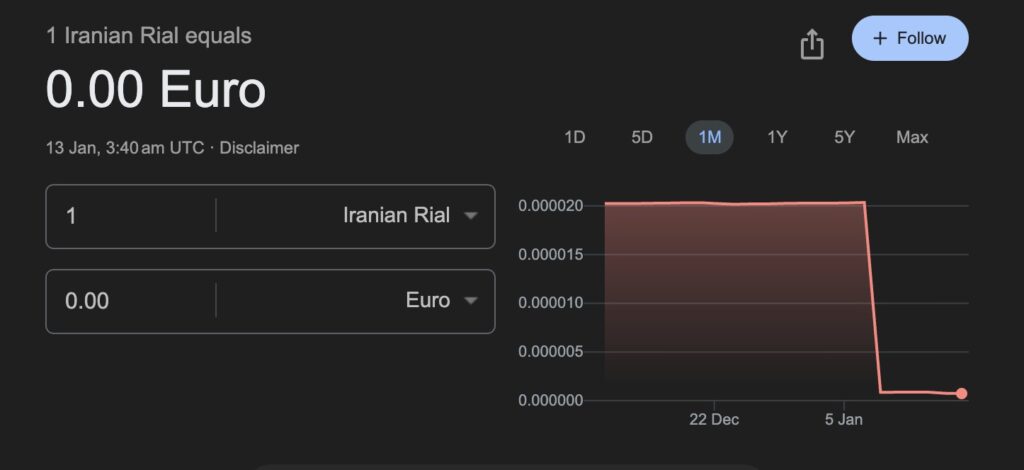
Google’s currency converter showing the Iranian rial as “0.00 per euro” reflects the currency’s extreme devaluation amid a worsening economic crisis and nationwide protests that have morphed into broad political unrest. The display is a rounding effect caused by the rial’s collapse and is intertwined with deepening public anger over inflation and governance in Iran.
Why Google Shows the Rial at Zero
When users search for exchange rates on Google, the platform rounds figures that are too small to fit its standard format. Due to the Iranian rial’s dramatic drop, trading at about 1.4 million rials to the US dollar and similarly weak against the euro, Google has displayed the euro-to-rial rate as 0.00 because the value of one rial is an extremely small fraction of a euro.
This does not mean the rial is literally worthless, but highlights just how low its international value has sunk amid the ongoing crisis.
Record Currency Collapse in Iran
Iran has been experiencing a sharp economic decline for years, but in late 2025 and early 2026, the situation worsened significantly:
- The rial has lost a huge portion of its value over the past year and decades, with the dollar rising from around 817,500 rials in early 2025 to over 1.4 million.
- Inflation in Iran has surged, with food and basic goods prices increasing rapidly, squeezing household budgets.
This crash in currency value erodes purchasing power, contributes to soaring prices and savings loss, and has been a direct trigger for social unrest.
Economic Crisis Fuels Widespread Protests
What began as economic protests in late December 2025 quickly spread nationwide. The collapse in the rial and escalating inflation drove shopkeepers, traders, students, and ordinary citizens into the streets to demand relief and policy change.
Initial demonstrations over currency woes and cost of living rapidly escalated into broader political unrest as chants shifted from economic demands to calls for fundamental change.
Protests Escalate Into Broader Political Uprising
Over recent weeks, the protests have intensified and spread across Iran:
- Major urban centres, including Tehran, Mashhad, Shiraz, and Isfahan, have seen large demonstrations.
- Security forces have clashed with protesters, leading to dozens or even hundreds of reported deaths and thousands of arrests.
- The unrest is now seen as one of the largest challenges to the Islamic Republic since the 2022–2023 “Woman, Life, Freedom” movement.
Public frustration stems not just from economic hardship but also from political dissatisfaction and a desire for systemic reform.
Economic Drivers Behind the Unrest
Experts and analysts point to multiple deep-rooted causes of the crisis:
- Long-standing sanctions: Western sanctions tied to Iran’s nuclear program and geopolitical tensions have restricted oil revenues, trade, and international finance.
- Domestic mismanagement: Tight capital controls, economic centralization, and the dominance of the Islamic Revolutionary Guard Corps (IRGC) in key industries have limited broader economic growth.
- Inflation and living costs: With inflation rates well into double digits and essential goods becoming unaffordable for many, economic desperation has grown.
These factors together have eroded public confidence and deepened frustration across demographic groups.
Government Response and Escalation
Iranian authorities have responded with a mix of concessions and crackdowns:
- The government introduced limited cash handouts aimed at offsetting the worst effects of inflation, but they were widely seen as insufficient.
- Security forces, including the Basij militia, have been deployed in many cities, resulting in violent clashes.
- To control the flow of information, Iran imposed nationwide internet blackouts, hindering communications and reporting.
Despite state efforts to suppress dissent, protests continue to gain momentum.
From Economic Grievances to Regime Challenges
While the initial catalysts were economic, falling currency, high inflation, and loss of purchasing power, many protesters now voice broader political demands, including calls for:
- Accountability from the theocratic leadership
- Greater political freedoms
- Overthrow of the current system
Observers say Iran’s conditions now resemble a national crisis that combines both economic collapse and political instability.
International reactions have varied, with some foreign governments condemning the crackdown and others expressing concern about potential instability.
What the Currency Collapse Symbolizes
The display of the rial at 0.00 per euro on Google is not just a technical quirk; it symbolizes a deeper crisis:
- Economic decay undermining everyday life
- Social frustration transforming into collective action
- Political pressure building against a decades-old regime
As Iran navigates this turbulent period, the interplay between economic hardship and political aspirations will likely shape both domestic stability and regional geopolitics in 2026.
FAQs
Q: Does Google’s 0.00 rate mean the rial is worthless?
No. It reflects an extremely low value due to currency collapse and is a rounding artifact, not a declaration of zero worth.
Q: Why are people protesting in Iran?
Protests began over the plummeting rial and economic hardship but expanded into widespread political demands against the leadership.
Q: Has the government responded to protests?
Authorities have used both limited economic measures and security crackdowns, including internet blackouts, to manage unrest.