
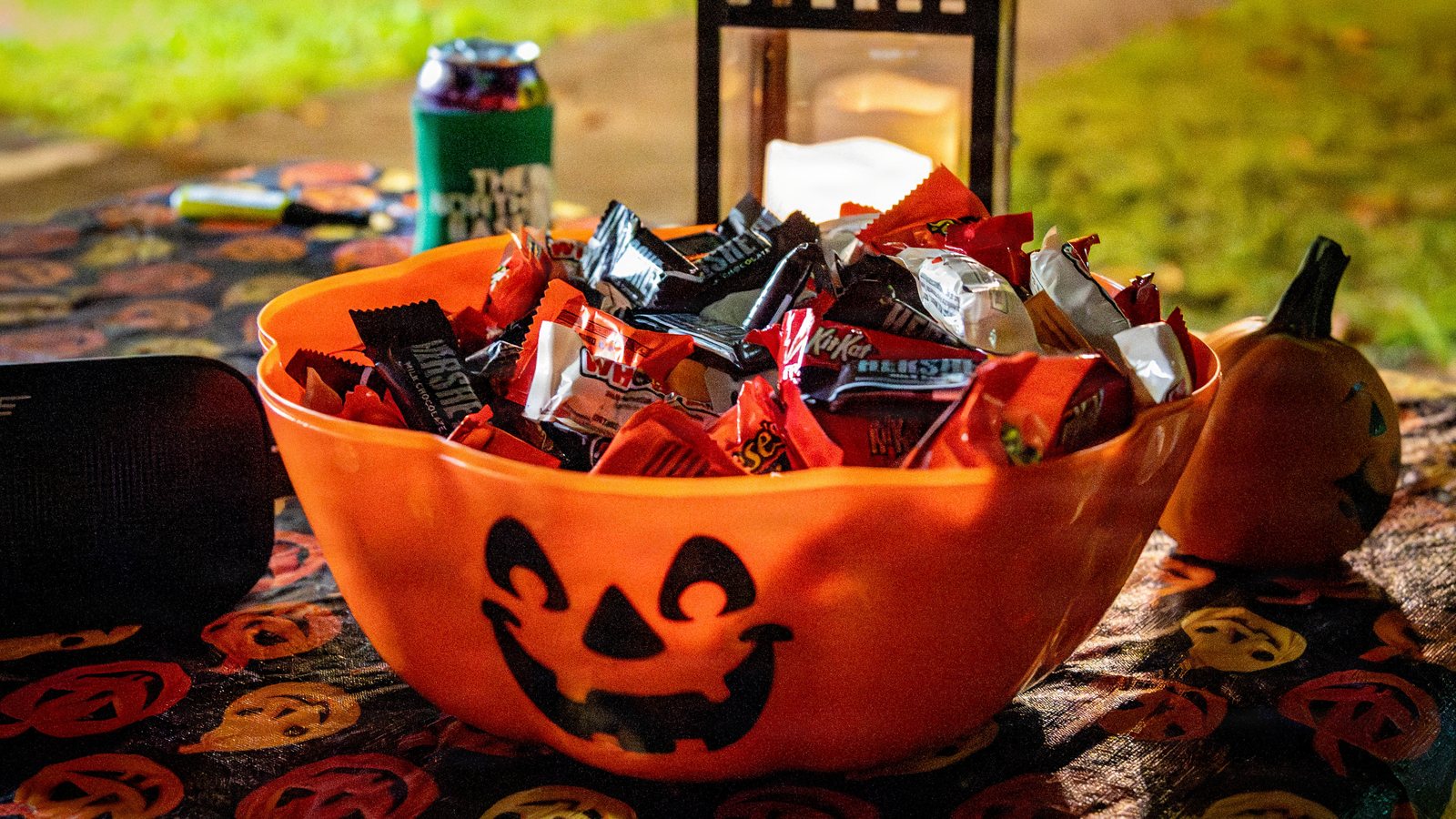

Halloween candy prices have climbed so far that shoppers are pulling back. Sales fell 6.7% in the four weeks to October 17 from a year earlier, according to NielsenIQ figures reported by the Associated Press. Government data shows candy and gum costing 44% more than five years ago, almost double the rise for groceries overall.
That matters a week out from Halloween, which falls on Saturday, October 31. Retailers and candy makers are hoping the slump means people are shopping late rather than skipping candy altogether. Our own math shows why families hesitate. A bag of Mars chocolate now works out to roughly 15 cents a piece.
What a bag of fun-size chocolate costs per piece now
This week Aldi advertised a 135-piece variety pack of Mars chocolate bars for $19.87, the AP reported. That’s 14.7 cents a piece.
Five years ago the same money bought far more. In October 2021, the fan site Aldi Reviewer listed a 250-piece Mars mix at $19.54. That’s 7.8 cents a piece. A 135-piece Mars fun-size mix cost $14.74, which is 10.9 cents a piece.
So on a like-for-like count, the 135-piece bag costs 35% more than it did in 2021. Compared with the old 250-piece bag, each piece costs nearly twice as much. Handing out 200 pieces costs about $29 this year, against about $16 at the 2021 bulk price.
Two caveats on our math. Bag contents and piece sizes change from year to year, and we couldn’t confirm the weight of this year’s 135-piece pack. Shelf prices also vary by store and region.
Candy prices rose twice as fast as groceries
Candy and gum prices were 44.3% higher in September than five years earlier, according to the Bureau of Labor Statistics consumer price index. Food eaten at home rose 22.5% over the same period. We checked both figures against the monthly series, republished in the Federal Reserve’s FRED database for candy and gum and food at home.
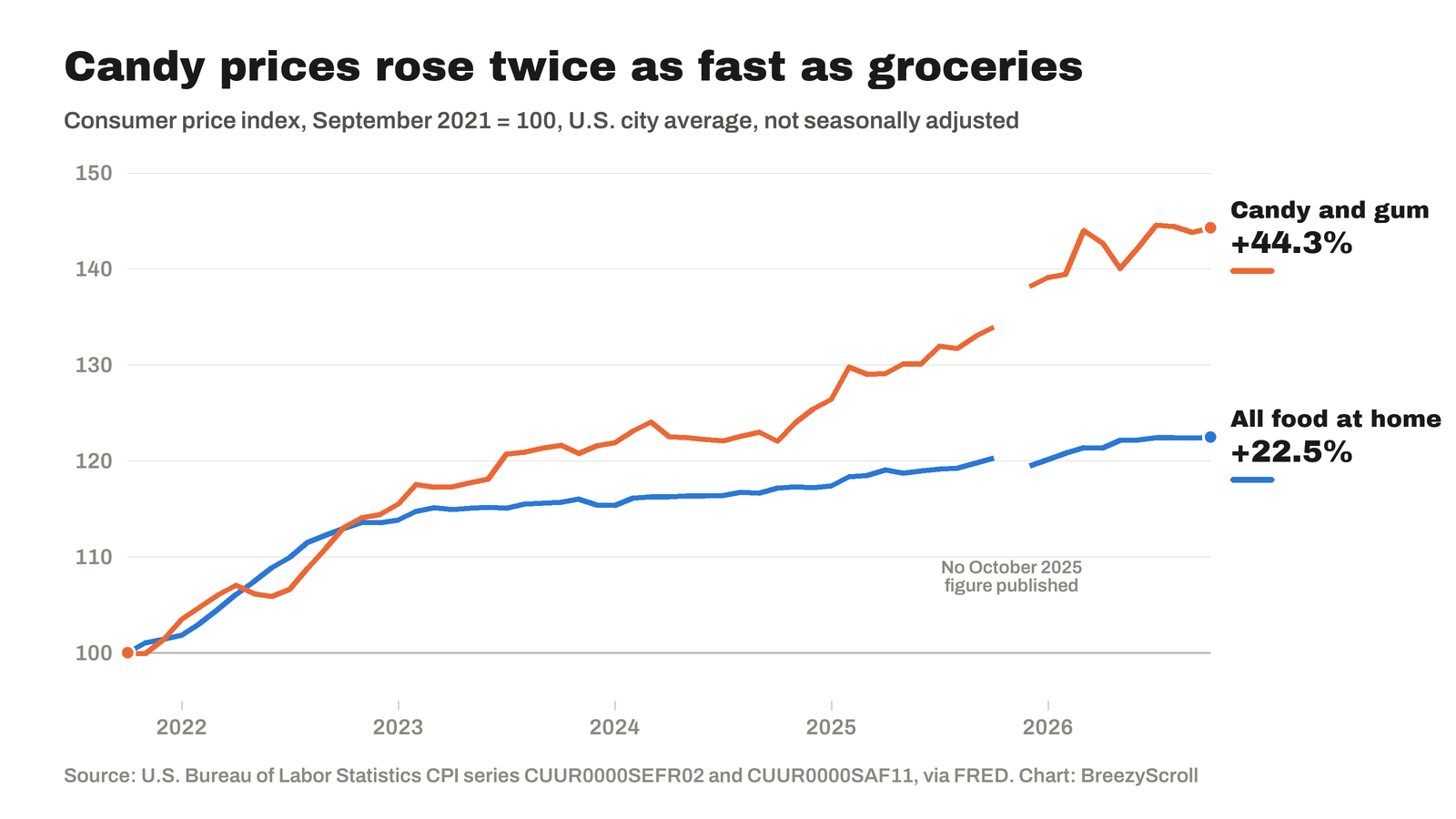
The two lines tracked each other until late 2022. Then grocery inflation cooled, while candy kept rising. Over the past year alone, candy and gum prices are up 7.7%, compared with 1.8% for food at home.
The candy index has barely moved since February, though. It stood at 229.1 that month and 229.5 in September. Prices have stopped rising, but they haven’t come down.
Cocoa crashed, then started climbing again
Chocolate makers spent most of 2024 and 2025 paying record prices for cocoa. The International Monetary Fund’s monthly global cocoa price averaged $10,710 a metric ton in January 2025, the record the AP cited.
Then it fell for more than a year, to $3,241 a ton in March 2026. That was the lowest monthly average since June 2023.
It hasn’t stayed there. Cocoa averaged $5,919 a ton in September. That’s up 83% from March, and more than double its level five years ago. The AP tied the spring rebound to the Iran war disrupting fertilizer supplies to African farms. Market reports at the time agreed. In April, Barchart’s cocoa coverage said the closed Strait of Hormuz had “reduced fertilizer supplies.” It also pointed to drought across much of Ivory Coast and Ghana.
Fertilizer remains scarce on the ground. In August, the analysis group CropGPT said many cocoa farmers in both countries couldn’t get enough fertilizer. Farms that go without face yield losses of up to 50%, it warned, Confectionery Production reported. We covered the shipping standoff behind that shortage in our explainer on Iran’s latest Hormuz escalation.
Weather is the next risk. NOAA’s Climate Prediction Center says a “strong-to-very strong El Niño” is likely through January to March 2027, in its October 8 update. The AP reported that El Niño could hurt cocoa output, with hot, dry weather forecast through February.
Why cheaper cocoa hasn’t reached the candy aisle
Candy makers lock in ingredient costs well ahead of time. Hershey says in its latest quarterly filing that it generally hedges commodity prices for 3 to 24 months. So much of this October’s chocolate was costed when cocoa was far pricier. The crash shows up in company margins before it reaches the register.
Hershey’s second-quarter results, released July 30, show that pattern. In its North American candy business, prices added about 14 percentage points to sales in the second quarter, while volume fell about 10 points. Segment margins rose, which the company attributed to higher prices and “lower net commodity costs.”
In plain terms, Hershey sold fewer bars at higher prices as its costs eased, and its candy profits rose.
Gummies and lollipops show that price alone doesn’t explain the slump. Non-chocolate candy averaged $6.08 a pound in the nine weeks to October 17, about 3% cheaper than a year ago, according to Nielsen. Sales still didn’t rise, the AP reported.
Shoppers are squeezed by gas and buying smaller bags
NielsenIQ’s Chris Costagli told the AP the bigger problem is everything else families are paying for. “I think what you’re seeing now is a consumer that’s spending so much additional money on fuel and housing and clothing and food,” he said.
Gas is the clearest example. The national average for regular gasoline was $4.29 a gallon on Sunday, up from $3.06 a year ago, according to AAA. That’s a 40% jump, on top of power bills that are up 6.9% this year.
Shoppers are adjusting rather than quitting. Small bags were the only size selling more than last year through mid-October, Costagli said. Large and extra-large bags fell the most. Sales had dropped 11.7% in mid-September, wiping out the early-season gains of the previous two years.
Circana’s Sally Lyons Wyatt said people may simply be waiting until closer to the holiday. “I do believe we will still see softness overall with candy, but I don’t think Halloween is doomed,” she told the AP. The National Confectioners Association said “consumer enthusiasm remains incredibly strong” as the peak week begins.
If you’re still shopping, divide the bag price by the piece count before you buy. Anything well under 15 cents a piece beats this week’s Aldi deal. Non-chocolate mixes are also the one category that got cheaper this year.
The final week of sales will settle whether this is a slow start or a down year. The first company read on that comes Thursday, October 29, when Hershey reports its third-quarter results two days before Halloween.