TL;DR
A magnitude 7.3 earthquake off Alaska’s Aleutian Islands on July 16 drew scientific attention not for its damage, which was minimal, but because it was the fifth major quake in that region since 2020. Experts say it may be part of a broader seismic pattern. While no injuries were reported, the quake triggered tsunami warnings and highlighted the importance of preparedness in one of the world’s most earthquake-prone zones.
What happened in Alaska this week?
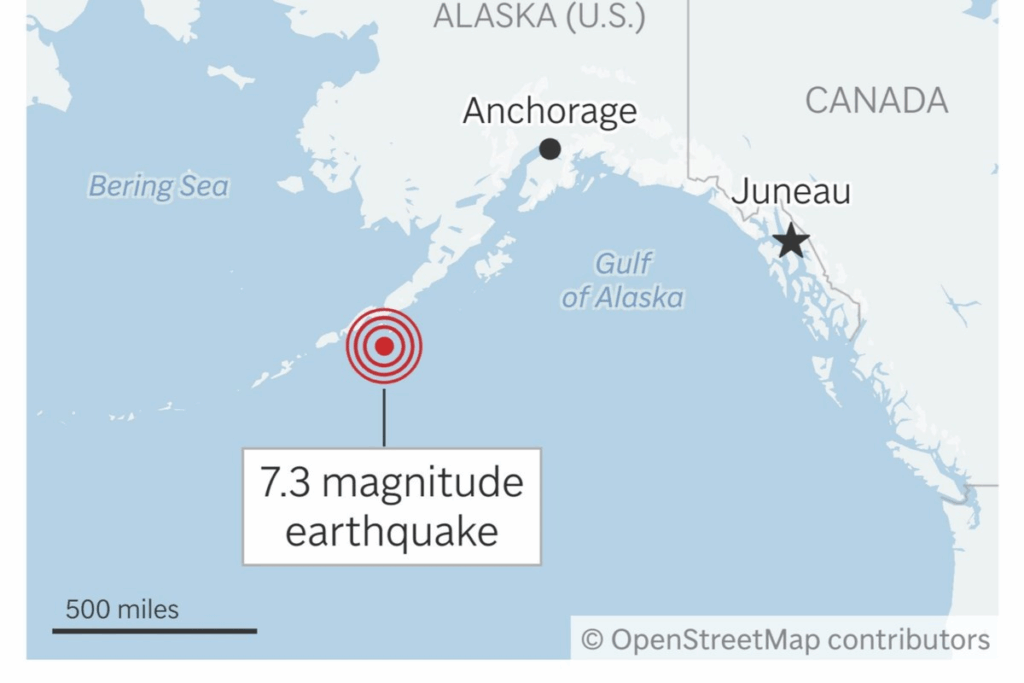
On Wednesday, July 16, 2025, a powerful 7.3 magnitude earthquake struck off the coast of Alaska’s Aleutian Islands, prompting a tsunami warning that was later downgraded. The quake hit at 12:37 p.m. local time, and while it didn’t cause significant damage or injuries, scientists and emergency officials are monitoring the event closely, not because of what it did, but because of where and how it happened.
This was no random tremor. It occurred in a region that’s been unusually active over the past five years, making it part of a potentially significant seismic sequence that could signal deeper tectonic changes.
Where exactly did the earthquake strike?
The earthquake’s epicenter was located off the Aleutian Islands, roughly 55 miles (88 kilometers) south of the community of Sand Point, which reported the highest tsunami wave, just under 4 inches (10 centimeters). Despite the relatively minor wave height, tsunami warnings were triggered along a 700-mile (1,127-km) stretch of Alaska’s southern coast.
Authorities swiftly alerted residents using sirens, radio broadcasts, cellphone push notifications, and even door-to-door warnings in some places. Communities such as King Cove and Unalaska urged residents to move to higher ground, though the warning was downgraded within about an hour and cancelled by 2:45 p.m.
Why are scientists especially concerned this time?
A pattern, not an outlier
Alaska is no stranger to seismic activity; in fact, it’s the most earthquake-prone state in the U.S. and one of the most seismically active zones on the planet. But what’s different here, scientists say, is that this quake is the fifth earthquake exceeding magnitude 7.0 in this immediate region since 2020.
According to Michael West, Alaska’s state seismologist, this event shouldn’t be viewed as an isolated incident.
“It appears to be part of a larger sequence spanning the last several years.”
The frequency and clustering of high-magnitude quakes in this zone, especially after decades of relative quiet, has prompted experts to reevaluate long-term patterns in the Aleutian arc.
Not quite “the big one,” but a reminder
The Aleutian arc forms part of the boundary where the Pacific Plate subducts beneath the North American Plate, a geologic setting prone to generating powerful quakes and tsunamis. The 1964 Great Alaska Earthquake — a magnitude 9.2 monster — remains the second-largest earthquake ever recorded globally and led to the deaths of about 130 people.
And then there’s the 1946 magnitude 8.6 quake, mentioned by West, which occurred further west but produced a deadly tsunami that killed more than 150 people, including many in Hawaii. That event was so catastrophic it spurred the creation of the U.S. tsunami warning system.
The 7.3 quake this week isn’t in the same league in terms of magnitude, but its location and context mean it can’t be ignored.
Could a bigger earthquake or tsunami be on the horizon?
There’s no definitive answer, but scientists are keeping a close watch.
West emphasized that this area is capable of generating trans-Pacific tsunamis, the kind that can impact places far beyond Alaska, including the U.S. West Coast, Hawaii, and parts of Asia. While there’s no immediate cause for alarm, West warns against complacency:
“I feel like maybe the best way to stay vigilant … is maybe to look into our deeper history beyond just the last five years.”
The concern isn’t just scientific, it’s practical. Emergency managers like Jeremy Zidek from Alaska’s Division of Homeland Security stress that “burnout” among residents could reduce preparedness. Many communities in the region have faced repeated tsunami evacuations since 2018, all of which ended without major disaster.
The risk now is psychological: people may start ignoring warnings. But as history has shown, it only takes one overlooked warning to turn a drill into a tragedy.
How are residents and authorities staying prepared?
Early warnings and evacuation protocols
Thanks to advances in earthquake detection and tsunami modeling, authorities were able to quickly issue and then cancel alerts during Wednesday’s event. But not everyone may receive the warning in time, which is why residents are reminded to trust their senses.
“If it shakes violently for 20 seconds or more, that is your warning sign,” Zidek explained. “You should head to higher ground if you’re in a coastal area.”
Geography offers some help
Much of coastal Alaska becomes steep very quickly, which means communities often don’t have to travel far to find safer elevation. Some towns have designated shelters like schools or community centers on higher ground. In others, residents simply head uphill until the danger passes.
Public outreach remains critical
Keeping residents informed and engaged through drills, signage, and school programs is key to long-term safety. Zidek and other officials say they’re working to reinforce the importance of taking each warning seriously, no matter how many past evacuations turned out to be false alarms.
Why this matters far beyond Alaska
The seismic events occurring off the Aleutian Islands have global implications. Here’s why:
- Tsunamis don’t respect borders: A significant quake here can generate waves that travel across the Pacific Ocean.
- A bellwether for tectonic stress: What happens in Alaska’s subduction zones could reflect stress accumulation in other parts of the Pacific Ring of Fire.
- Preparedness lessons for all: The importance of rapid evacuation, early warning systems, and community readiness applies not just in Alaska, but everywhere at risk of earthquakes or tsunamis.
As we’ve seen repeatedly in the past, from Japan’s 2011 disaster to Chile’s coastal quakes, the difference between survival and catastrophe often comes down to how seriously we take the signs before disaster strikes.