
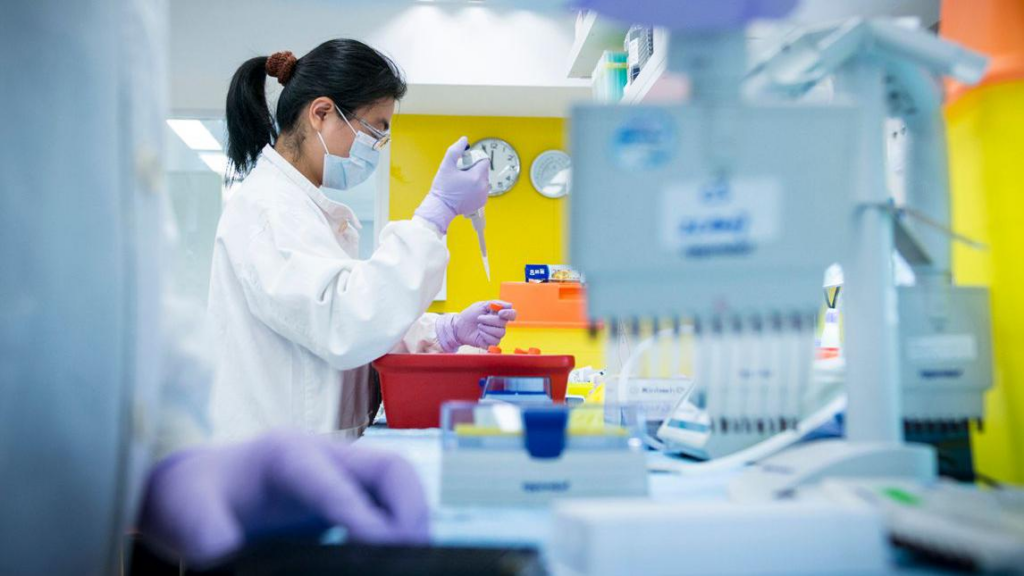
Artificial intelligence has helped researchers take a step toward one of medicine’s most ambitious goals: a vaccine that could protect against not just one coronavirus but an entire family of them.
Scientists at the University of Cambridge have developed what they describe as a fundamentally new type of vaccine using AI to design its core component. The early-stage research aims to create broader protection against current and future coronavirus threats, potentially reducing the need to constantly update vaccines as viruses evolve.
The breakthrough marks the first time a vaccine’s key antigen has been designed entirely by artificial intelligence and then tested in human volunteers.
What is the AI-designed coronavirus vaccine?
Traditional vaccines are usually developed to target a specific virus or strain. The challenge is that viruses mutate over time, sometimes making existing vaccines less effective.
The Cambridge team took a different approach.
Instead of targeting a single coronavirus variant, researchers used AI to analyze vast amounts of genetic data from multiple coronaviruses. The system then designed to create a synthetic “super-antigen” intended to train the immune system to recognize features shared across many members of the coronavirus family.
The goal is broader immunity that remains effective even as viruses change.
Professor Jonathan Heeney of the University of Cambridge described the strategy as an attempt to stay ahead of viral evolution rather than constantly reacting to it.
“We’re always behind,” Heeney said. “What we’re trying to do is get ahead of the curve.”
How did researchers use AI to create the vaccine?
The process began with artificial intelligence analyzing thousands of recorded coronavirus genetic sequences.
Step 1: Studying viral genetics
Researchers fed genetic information from multiple coronaviruses into AI systems capable of identifying common characteristics across different strains.
These included:
- Shared protein structures
- Conserved genetic regions
- Features less likely to mutate over time
Step 2: Designing a “super-antigen”
Using those insights, the AI created a synthetic antigen designed to represent multiple coronavirus variants simultaneously.
Rather than mimicking one virus, the antigen serves as a broader immune training target.
Step 3: Human testing
The AI-designed vaccine was then tested in a first-stage clinical trial involving 39 participants.
The initial trial focused primarily on safety rather than effectiveness.
According to findings published in the Journal of Infection, the vaccine was found to be safe, while the immune response generated was described as “modest.”
Researchers say larger studies are needed to determine how well the vaccine works in real-world conditions.
Why is this different from current vaccines?
Current vaccines generally target specific pathogens or variants.
For example:
- Seasonal flu vaccines are updated annually.
- COVID-19 boosters have been modified to address emerging strains.
- Many vaccines lose effectiveness as viruses evolve.
The Cambridge approach seeks to create a vaccine that remains relevant across multiple variants and potentially across related viruses.
Potential advantages
If successful, AI-designed universal vaccines could:
- Reduce the need for frequent vaccine updates
- Protect against future coronavirus variants
- Improve preparedness for emerging zoonotic diseases
- Accelerate vaccine development timelines
- Strengthen pandemic prevention efforts
However, scientists caution that these benefits remain theoretical until larger clinical trials are completed.
What happens next?
The project remains in its early stages.
Researchers are preparing a larger trial involving approximately 200 participants, which should provide more detailed information about the vaccine’s effectiveness and immune response.
Expanding beyond coronaviruses
The technology may eventually be applied to other high-risk viruses.
Scientists are already exploring similar approaches for:
- Influenza (flu)
- Ebola
- Other emerging infectious diseases
A universal flu vaccine is considered one of the most sought-after goals in public health because seasonal flu vaccines must currently be reformulated each year.
Why vaccine development is so challenging
Creating vaccines remains one of the most complex processes in medical science.
A typical vaccine development program involves:
- Identifying a suitable antigen.
- Testing immune responses.
- Evaluating safety in laboratory studies.
- Conducting phased clinical trials.
- Regulatory review and approval.
The process often takes between five and ten years.
AI could potentially accelerate the earliest stages by helping researchers identify promising vaccine targets more quickly than traditional methods.
Could AI transform vaccine research?
The Cambridge study is part of a broader trend of using artificial intelligence in drug discovery and biotechnology.
AI is increasingly being used to:
- Analyze genetic data
- Predict protein structures
- Identify drug candidates
- Design new molecules
- Improve clinical trial planning
The vaccine project offers one of the clearest examples yet of AI moving beyond data analysis and contributing directly to the design of a medical intervention tested in humans.
Professor Marian Knight, scientific director at the UK’s National Institute for Health and Care Research, called the trial a significant milestone in the search for broader viral protection.
What does this mean for future pandemics?
While it is far too early to describe the vaccine as a pandemic-proof solution, the research highlights a growing shift in infectious disease strategy.
Instead of responding after a virus emerges, scientists are increasingly attempting to build defenses against entire groups of viruses before outbreaks occur.
If successful, AI-designed vaccines could become a powerful tool for pandemic preparedness, helping health systems respond faster to future threats.
For now, researchers emphasize that larger trials will determine whether the promising concept can deliver meaningful protection in practice.
TL;DR
Scientists at the University of Cambridge have developed the first coronavirus vaccine whose key antigen was designed entirely by artificial intelligence. The vaccine aims to provide broad protection against multiple coronavirus variants rather than a single strain. An initial safety trial involving 39 people showed promising early results, with larger studies planned. Researchers hope the same AI-driven approach could eventually be used to create universal vaccines for flu, Ebola, and other emerging diseases.