
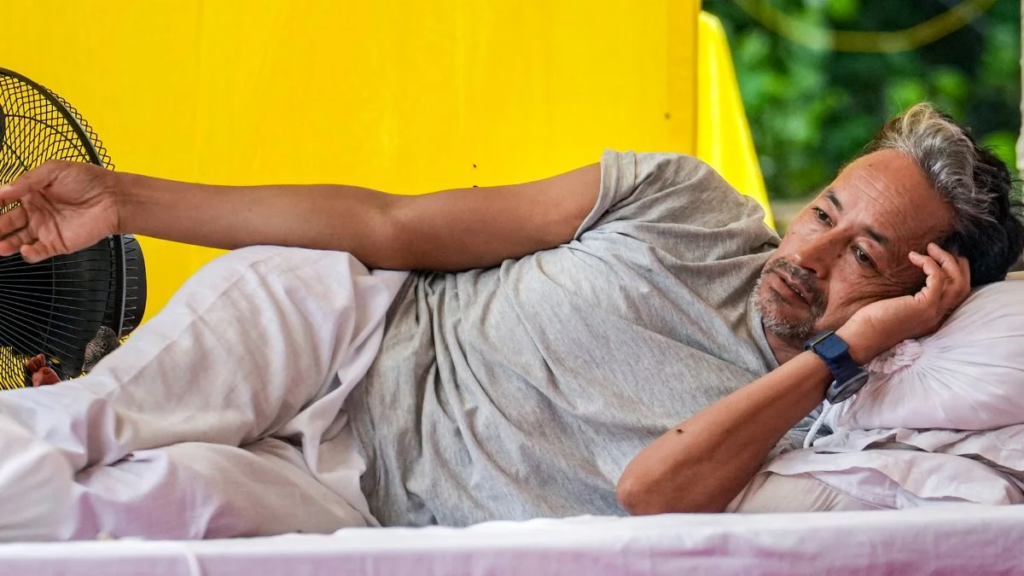
Environmentalist and education reformer Sonam Wangchuk is once again making national headlines after being hospitalized during an indefinite hunger strike in New Delhi. The 59-year-old innovator, best known for transforming education in Ladakh and pioneering the Ice Stupa project, was shifted to Delhi’s Safdarjung Hospital after his health deteriorated following weeks of fasting.
Wangchuk has long been one of India’s most influential voices on sustainable development, climate adaptation, and education. His latest protest, however, has drawn attention for a different reason: his allegations of irregularities in competitive examinations and his demand for greater accountability in India’s education system.
TL;DR
- Sonam Wangchuk is an engineer, inventor, education reformer, and environmental activist from Ladakh.
- He founded SECMOL and the Himalayan Institute of Alternatives, Ladakh (HIAL).
- He is internationally known for inventing the Ice Stupa, an artificial glacier that stores water for spring use.
- Wangchuk launched an indefinite hunger strike on June 28, 2026, alleging irregularities in competitive examinations and demanding accountability from the Union Education Ministry.
- On July 18, 2026, he was admitted to Safdarjung Hospital after his health worsened during the protest.
- He received the 2018 Ramon Magsaysay Award for his contributions to education and sustainable development.
Who Is Sonam Wangchuk?
Sonam Wangchuk is an Indian mechanical engineer, inventor, educationist, and environmental activist from the Ladakh region. Over the past three decades, he has become one of India’s most recognisable innovators by combining engineering with community-based solutions to address challenges in education, water conservation, and climate change.
He is the founder of the Students’ Educational and Cultural Movement of Ladakh (SECMOL), an organisation established in 1988 to improve educational outcomes in the Himalayan region. He later founded the Himalayan Institute of Alternatives, Ladakh (HIAL), which promotes experiential, sustainable, and locally relevant higher education.
Internationally, Wangchuk is best known for developing the Ice Stupa, an artificial glacier designed to store winter water for agricultural use during the dry spring months.
Sonam Wangchuk’s Early Life
Sonam Wangchuk was born on September 1, 1966, in Uleytokpo, a village near Alchi in the Leh district, then part of the erstwhile state of Jammu and Kashmir.
His childhood shaped many of the ideas that later defined his career. Because his village lacked a school, Wangchuk did not receive formal education until he was nine years old. Instead, he was taught at home by his mother in his native Ladakhi language.
When he later moved to Srinagar for schooling, he struggled because instruction was primarily in languages unfamiliar to him. That experience exposed the challenges faced by students educated in languages different from their mother tongue and inspired his lifelong efforts to reform education.
Education and Career
After completing his schooling, Wangchuk earned a Bachelor of Technology in Mechanical Engineering from the National Institute of Technology (formerly Regional Engineering College), Srinagar, graduating in 1987.
The following year, he co-founded SECMOL, an organization focused on improving educational quality in Ladakh by introducing practical learning methods and reducing school dropout rates.
His work later expanded through initiatives such as Operation New Hope, a collaborative effort aimed at improving government schools across Ladakh by strengthening teacher training, curriculum, and community participation.
Today, Wangchuk’s educational philosophy emphasizes hands-on learning, local knowledge, innovation, and sustainability.
The Ice Stupa Innovation Explained
Perhaps Wangchuk’s most globally recognized contribution is the Ice Stupa.
The Ice Stupa is an artificial glacier that stores water during winter by spraying it into freezing mountain air, where it forms cone-shaped towers of ice. As temperatures rise in spring, the ice melts gradually, providing water for irrigation during one of the driest periods of the year.
The technology addresses a growing challenge in Himalayan communities, where glaciers are shrinking due to climate change, reducing water availability for farming.
The innovation has attracted international attention as a low-cost, climate adaptation solution for high-altitude regions.
Awards and Recognition
Sonam Wangchuk’s work has earned recognition both in India and internationally.
Among his most notable honors is the 2018 Ramon Magsaysay Award, often regarded as Asia’s highest civilian honor, awarded for his leadership in education reform and community-based innovation.
Over the years, he has also received several national and international awards recognizing his contributions to environmental sustainability, engineering, and social development.
Sonam Wangchuk’s Family
Sonam Wangchuk is the son of Sonam Wangyal, a former minister in Jammu and Kashmir, and Tsering Wangmo.
He is married to Gitanjali J. Angmo, an educationist and social entrepreneur who has collaborated with him on several educational initiatives, including the Himalayan Institute of Alternatives, Ladakh.
The couple has maintained a relatively private personal life. There is no officially confirmed public information regarding their children.
Why Is Sonam Wangchuk on a Hunger Strike?
On June 28, 2026, Wangchuk began an indefinite hunger strike at Jantar Mantar in New Delhi.
According to organizers, the protest was aimed at raising concerns over alleged irregularities in competitive examinations, including the NEET-UG examination paper leak, and demanding greater accountability in the education system.
Among his key demands was the resignation of Union Education Minister Dharmendra Pradhan.
The hunger strike drew support from students, activists, and civil society groups, while also sparking political debate over examination integrity and educational governance.
Health Update: Why Was He Hospitalised?
After more than two weeks without food, Wangchuk’s health reportedly deteriorated due to prolonged fasting and dehydration.
Doctors monitoring his condition advised immediate medical treatment, prompting the Delhi High Court to direct authorities to ensure his health was continuously monitored.
On July 18, 2026, Delhi Police shifted Wangchuk to Safdarjung Hospital for treatment after medical experts recommended hospitalisation.
According to hospital officials, Wangchuk’s condition was reported to be stable, though he remained physically weak and required close medical supervision.
His supporters criticized the decision to move him, while authorities maintained that the hospitalisation followed medical advice and court directions.
Why Sonam Wangchuk Matters Beyond the Current Protest
Although the current hunger strike has placed Wangchuk back in the national spotlight, his broader legacy extends well beyond this episode.
His work has consistently focused on addressing systemic challenges through practical, community-driven solutions. Whether improving education in remote Himalayan villages or developing innovative methods to conserve water, Wangchuk has advocated for approaches that combine scientific thinking with local knowledge.
His initiatives have also highlighted the importance of climate resilience in fragile mountain ecosystems, making him a prominent voice in discussions on sustainable development and environmental policy.
As debates continue over education reforms and governance, Wangchuk’s influence remains rooted in decades of work aimed at improving opportunities for communities in Ladakh and beyond.