
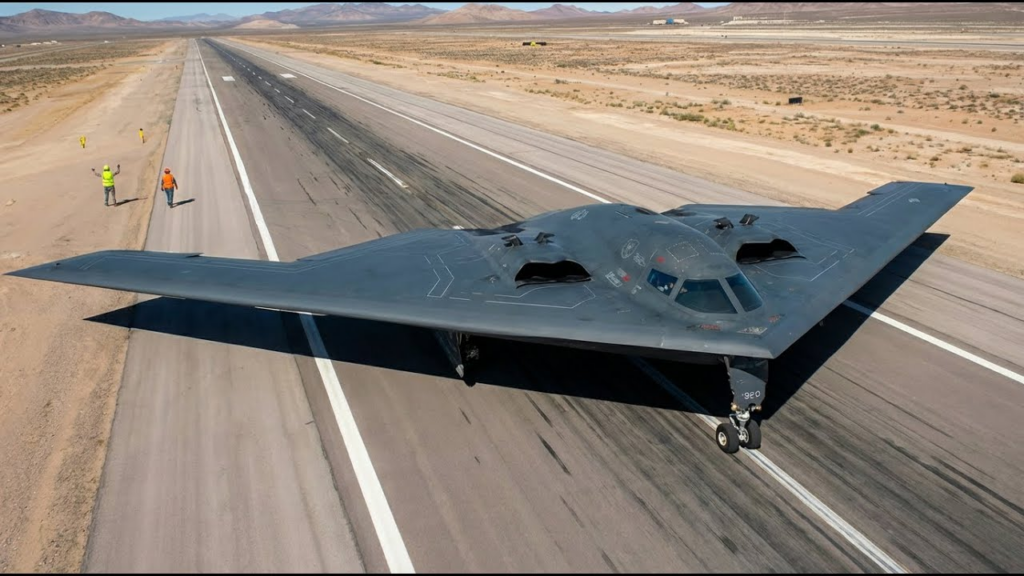
Delivering a nuclear gravity bomb presents an immediate challenge for the aircraft releasing it—the crew must escape the effects of the explosion before detonation. A nuclear blast generates a powerful shockwave, intense thermal radiation, and an electromagnetic pulse (EMP), all of which can threaten an aircraft if it remains too close.
Modern strategic bombers such as the B-2 Spirit are designed for this mission and use carefully planned delivery profiles, hardened systems, and extensive crew training to maximize their chances of survival.
Why is dropping a nuclear bomb dangerous?
Unlike a missile launched from hundreds of kilometers away, a gravity bomb is released directly from an aircraft. That means the bomber initially remains relatively close to the future blast site.
If it fails to create enough separation before detonation, it could be exposed to:
- A destructive blast wave
- Extreme thermal radiation
- Electromagnetic pulse (EMP)
- Flying debris and severe atmospheric turbulence
Mission planners therefore calculate release altitude, bomb settings, aircraft speed, and escape route well before the mission.
How does the B-2 escape?
After releasing the weapon, the bomber immediately performs a pre-planned escape maneuver designed to increase the distance between itself and the detonation point.
While the exact procedures remain classified, publicly available information indicates the maneuver involves:
- Turning away from the target area
- Accelerating to maximize separation
- Following a carefully calculated escape route
- Maintaining an orientation that reduces exposure to the blast and thermal pulse
The objective is straightforward: create as much distance as possible before detonation.
Why timing is critical
Modern nuclear gravity bombs can be configured with delayed fuzes or airburst settings, depending on mission requirements.
A delayed detonation gives the aircraft additional time to move away from the target.
The amount of time varies depending on the weapon’s settings and delivery profile. Publicly available sources do not support a fixed “90-second” survival window across all missions. The actual timing depends on factors such as release altitude, bomb configuration, and target requirements.
What threatens the aircraft?
Blast wave
The primary danger is the expanding shockwave generated by the explosion.
The farther the aircraft is from the detonation, the lower the overpressure it experiences. Military planners use detailed weapons-effects models to ensure the escape profile keeps the bomber outside destructive blast zones.
Thermal radiation
The intense flash from a nuclear explosion travels at the speed of light, making it impossible to outrun.
Instead, crews reduce exposure by ensuring the aircraft is oriented so the explosion occurs behind or below them whenever possible, minimizing heating of vulnerable surfaces.
Electromagnetic pulse (EMP)
A nuclear detonation can produce a powerful EMP capable of disrupting or damaging electronic systems.
The B-2 is specifically certified for nuclear missions and incorporates EMP hardening, including:
- Shielded electronics
- Protected wiring
- Surge-resistant systems
- Redundant flight-critical components
These features help the aircraft remain operational even after exposure to nuclear electromagnetic effects.
How do crews prepare?
B-2 crews undergo specialized nuclear mission training using high-fidelity simulators and inert training weapons that replicate the handling characteristics of operational bombs.
Training emphasizes:
- Precise weapon release procedures
- Immediate execution of escape maneuvers
- Aircraft systems management
- Crew coordination under extreme time pressure
Because the procedures are highly standardized, crews repeatedly practice them so they can respond quickly and accurately during a real mission.
Is the “90 seconds to live” claim accurate?
The phrase is an oversimplification.
There is no publicly confirmed rule stating that B-2 crews have exactly 90 seconds to survive after releasing a nuclear weapon. Survival depends on multiple variables, including:
- Weapon yield
- Release altitude
- Bomb fuze settings
- Aircraft speed
- Escape trajectory
- Burst altitude
Mission planners calculate these factors carefully to ensure the aircraft remains outside the predicted hazardous effects of the explosion.
Key takeaways
- A B-2 survives by creating maximum distance between itself and the detonation before the weapon explodes.
- The bomber performs a pre-planned escape maneuver immediately after release.
- EMP-hardened avionics allow it to continue operating even after nuclear electromagnetic effects.
- The aircraft cannot outrun the thermal flash but minimizes exposure through orientation and distance.
- The widely repeated “90-second” figure is not a universal or officially confirmed value; the available escape time varies by mission and weapon configuration.