Black holes are often described as cosmic objects that swallow everything that comes too close. But could these extreme environments also provide the ingredients needed to create planets? New research suggests that the answer may be yes.
A study published in The Astrophysical Journal on June 29, 2026, proposes that planets could form in the dusty regions surrounding supermassive black holes. The research, titled Active Galactic Nucleus Tori: Potential Birthplace to Millions of Planets, explores whether the same physical processes that build planets around stars can operate in these unusual environments.
The researchers suggest that a single active galactic nucleus, or AGN, could potentially produce millions of planet-forming objects. These objects could initially reach masses comparable to Jupiter and continue growing, with some potentially becoming much more massive than conventional planets.
The findings are based on theoretical modeling, however. Astronomers have not yet confirmed the existence of planets formed in these environments, and the study does not establish that every active black hole hosts them.
How Could Planets Form Around a Black Hole?
The role of active galactic nuclei
The study focuses on supermassive black holes that are actively consuming surrounding material. These objects are found at the centers of galaxies and can become extremely bright as gas and dust spiral inward.
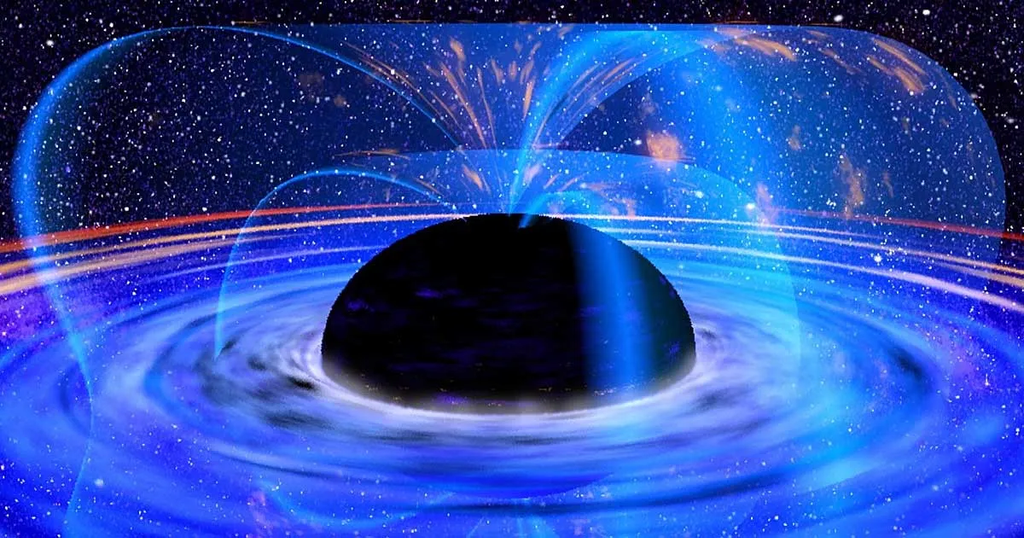
An actively feeding supermassive black hole and its surrounding luminous region are known as an active galactic nucleus. As material moves around the black hole, it forms an accretion disk, where friction and gravitational energy heat the gas to very high temperatures.
The researchers examined the dusty structures surrounding these active galactic nuclei, particularly their cooler outer regions. Unlike the extremely hot inner portions of an accretion disk, these outer areas can have conditions that allow dust to condense and solid particles to accumulate.
That distinction is crucial. The proposed planets would not form right next to the black hole’s event horizon. Instead, they could develop much farther out, where temperatures and the availability of solid material make planet formation more plausible.
Why the process resembles planet formation around stars
Most of the planets in our solar system formed from a disk of gas and dust surrounding the young Sun. Over time, tiny solid particles collided, stuck together and grew into larger bodies. Those bodies eventually developed into planetesimals and planetary embryos, some of which became full-sized planets.
The new research explores whether a similar sequence could occur in the dusty regions surrounding supermassive black holes.
The underlying physics of how particles interact does not automatically change simply because the central object is much more massive than a star. What changes are the scale, gravitational environment, radiation levels and conditions within the surrounding material.
If dust particles can concentrate sufficiently in the outer regions of an active galactic nucleus, they may begin forming larger bodies. Those objects could then grow by gathering additional solid material.
The researchers use models of a process known as streaming instability, in which interactions between gas and solid particles can help concentrate dust into dense clumps. Such concentrations are considered important in explaining how the early stages of planet formation can proceed efficiently.
The paper examines whether these processes could produce planet-mass objects in the dusty environments around active galactic nuclei. The result is a theoretical pathway for planet formation in a setting that differs dramatically from a young star system.
Could One Black Hole Produce Millions of Planets?
The researchers’ models suggest that active galactic nuclei could potentially create enormous numbers of planet-forming objects.
The key factor is the amount of material available. Supermassive black holes can be surrounded by extensive structures containing gas and dust. If enough of this material becomes concentrated into solid bodies, the resulting population could be far larger than the number of planets typically associated with an individual star.
The study explores the possibility that a single active galactic nucleus could produce millions of such objects. This is a theoretical estimate, not an observed count of planets around a particular black hole.
Some objects could grow beyond Jupiter’s mass
The models suggest that the objects produced through this process could begin with masses comparable to Jupiter and then continue accumulating material.
Depending on their growth, some could become much more massive than Jupiter. At the upper end, the objects might reach masses associated with brown dwarfs or even stars.
Brown dwarfs occupy the mass range between giant planets and stars. They are too low in mass to sustain ordinary hydrogen fusion in their cores, although some can fuse deuterium for a limited period.
The possibility of forming objects across such a wide range of masses makes these environments particularly interesting. Rather than producing only conventional planets, an active galactic nucleus could potentially support a spectrum of objects whose final nature depends on how much material they accumulate.
However, the formation of a massive object does not guarantee that it will survive indefinitely. Its future would depend on its growth, orbit and interactions with the surrounding gas, dust and other bodies.
Why Don’t the Black Hole’s Gravitational Forces Destroy Everything?
Black holes have such intense gravitational fields that nothing can escape from within their event horizons, including light. But their presence does not mean that every object orbiting at a sufficient distance must fall inward.
Objects can orbit a black hole just as planets orbit stars, provided they remain outside the region where their orbits become unstable and are not otherwise disrupted.
The proposed planet-forming regions are located far from the event horizon. Their main challenge is not simply avoiding immediate capture but surviving the complicated conditions of an active galactic nucleus.
These environments can contain intense radiation, rapidly moving gas and strong gravitational interactions. Objects may collide, migrate through the surrounding disk or lose material as conditions change.
Some newly formed bodies could be pulled toward the central black hole or disrupted by their surroundings. If that happened, they could contribute material back to the surrounding environment rather than survive as planets.
This makes the predicted number of planet-forming objects different from the number that might ultimately remain intact. Theoretical models must account for both the creation of bodies and the processes that can destroy or alter them.
The researchers’ work therefore raises two separate questions: how efficiently planets can form in these environments, and how many could survive over longer periods.
How Long Could Planet Formation Continue Around a Black Hole?
An active galactic nucleus does not necessarily remain in the same state forever. Its brightness and activity depend on how much gas and dust are available to feed the central black hole.
The study’s scenario allows for planet formation during periods when an active galactic nucleus contains the conditions needed to support the process. Over time, the supply of material and the structure of the surrounding disk can change.
If the environment repeatedly becomes active over the life of a galaxy, different episodes could provide additional opportunities for solid material to accumulate and grow. The total population of objects would depend on the duration of those episodes, the quantity of available dust and the efficiency of planet formation.
This is one reason the proposed number of millions of objects should be treated as a model-dependent possibility rather than a universal prediction for every supermassive black hole.
Not all active galactic nuclei have identical environments, and the amount of material available for planet formation can vary substantially. The research identifies a potential mechanism, but further work is needed to establish how often it operates in nature.
Could These Planets Support Life?
The possibility of planets forming around black holes naturally raises questions about whether they could be habitable. But planet formation and habitability are very different challenges.
A planet’s ability to support life depends on factors such as its composition, temperature, atmosphere, access to suitable energy sources and long-term environmental stability.
The regions around active galactic nuclei can experience intense radiation and energetic outflows. These conditions could make the environment hostile to life, particularly for objects located close to the most active parts of the system.
Even if a planet formed and survived, the study does not establish that it would have liquid water, a stable atmosphere or the conditions needed for biology.
It is also possible for a planet to form in a hostile environment without remaining there forever. However, the research does not establish the likelihood of such planets migrating to safer locations or becoming habitable.
For now, the main scientific significance is that planet formation may be possible in a wider range of environments than astronomers traditionally considered. Whether any of these objects could support life remains an entirely separate question.
How Could Scientists Confirm Planets Around Black Holes?
Detecting planets around an active galactic nucleus would be difficult. The central region can emit enormous amounts of radiation, making it challenging to identify the much fainter signatures of individual objects.
Astronomers would need observational evidence that distinguishes the effects of planets from other activity in the gas and dust surrounding the black hole.
Potential avenues for future research include:
- Studying the structure of dusty regions: Observations could help determine whether the outer material has conditions that support the concentration of dust into larger bodies.
- Looking for indirect signatures: Researchers could investigate whether orbiting objects leave measurable changes in the surrounding gas or radiation.
- Improving theoretical models: Simulations could test how quickly solid bodies grow, how massive they become and how many survive.
- Comparing different active galactic nuclei: Studying a range of environments could help identify which conditions are most favorable for planet formation.
These approaches would help researchers move from a plausible theoretical mechanism toward evidence that the process actually occurs.
The discovery of a planet formed in such an environment would also raise questions about how planets are distributed throughout galaxies and whether the familiar model of planets forming around stars describes only one part of a much broader process.
What Does the Study Mean for Our Understanding of the Universe?
The research expands the range of environments in which astronomers can investigate planet formation. Until now, the best-understood examples have involved disks surrounding young stars, where the evolution of dust and gas can eventually produce planets.
The new work suggests that similar physical mechanisms might operate in the outer dusty regions of active galactic nuclei, even though these systems are vastly larger and more energetic than ordinary planetary systems.
The findings do not overturn the established understanding of how our solar system formed. Nor do they show that black holes routinely produce planets. Instead, they identify a potential route through which massive objects could emerge in environments that were not traditionally considered planet-forming regions.
The next challenge is to determine how common the process might be and whether the predicted objects can be detected. Researchers will also need to establish how the intense radiation, gas dynamics and gravitational interactions of an active galactic nucleus affect the survival of newly formed bodies.
For now, the study offers a striking possibility: the universe’s most extreme gravitational environments may not only consume matter but could also provide the conditions for creating new planetary objects.
That possibility remains theoretical, but it opens a new direction for understanding where planets can form and how diverse planetary systems might be across the cosmos.