

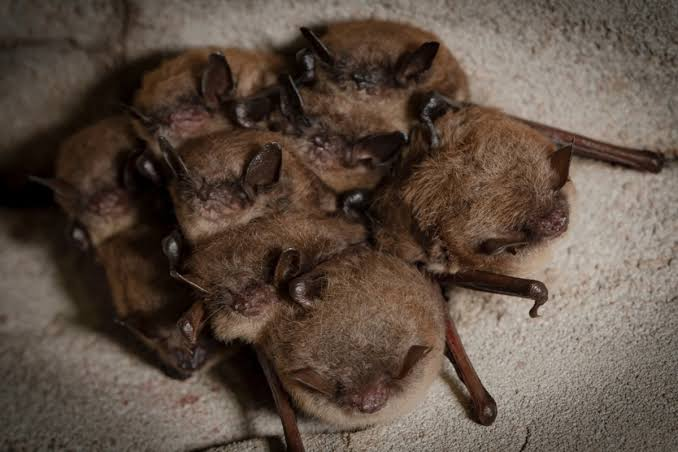
Scientists studying endangered little brown bats have discovered a remarkable biological response that may help explain why some bats can live unusually long lives while avoiding cancer.
Research published this week suggests that when bat cells suffer severe damage, they can rapidly switch from trying to repair the damaged DNA to destroying the affected cells altogether. Researchers say this “kill the cell” strategy could be one reason bats are exceptionally resistant to cancer and may offer new clues for future human research.
“We found the literal opposite of what we expected if you treat the bats with a lethal dose of this chemical,” biologist Juan Manuel “Manny” Vazquez, an assistant professor at Penn State University and co-lead author of the related study, confirmed in a news release from the University of California, Berkeley.
The discovery does not mean scientists have found a cure for cancer. Any potential treatment based on the mechanism remains years away. But researchers say the finding provides a new way of thinking about how the immune system, cellular repair and aging are connected.
Why are scientists studying little brown bats?
Bats are unusual among mammals.
Despite their relatively small bodies, several bat species can live for decades. The little brown bat, in particular, can survive for many years compared with other mammals of a similar size.
That longevity is especially interesting because bats are also highly active animals.
They fly for long periods, have exceptionally high metabolic demands and are exposed to a wide range of pathogens.
Yet they appear to have evolved biological mechanisms that allow them to tolerate the cellular damage associated with both intense activity and infection.
Scientists believe studying those mechanisms could reveal new approaches to human disease.
What did researchers discover about bat cells?
The researchers found that little brown bat cells can respond to severe cellular damage in an unexpected way.
Scientists exposed tissue samples to a chemical capable of causing lethal cellular damage.
They initially expected the cells to activate DNA repair mechanisms, attempting to fix the damage and survive.
Instead, the researchers observed a very different response.
The damaged cells rapidly shifted toward programmed cell death.
In other words, when the damage was too severe to repair, the cells appeared to decide that the better option was to eliminate themselves.
Biologist Juan Manuel “Manny” Vazquez, a co-lead author of the study, described the response as the opposite of what researchers expected.
He compared the process to abandoning a damaged ship rather than attempting to save it at any cost.
Why would killing damaged cells help prevent cancer?
Cancer develops when damaged cells survive, continue dividing and accumulate additional genetic abnormalities.
The immune system and cellular quality-control mechanisms therefore have an important task: eliminate cells that have become too dangerous to keep.
A damaged cell that successfully repairs itself can survive normally.
But a cell with irreparable damage may become a potential cancer cell.
By rapidly triggering cell death when repair is unlikely to succeed, an organism can potentially remove dangerous cells before they have an opportunity to become tumors.
That does not mean every damaged cell in a bat is automatically destroyed.
Rather, the findings suggest bats may have evolved a particularly effective threshold for deciding when repair is no longer worth pursuing.
What role does the immune gene PRK play?
Researchers also found that little brown bats carry multiple copies of an immune-related gene known as protein kinase R, or PKR.
In many mammals, there is typically one copy of the gene.
The researchers believe having additional copies could contribute to the bats’ unusually robust immune responses.
PKR is involved in cellular defenses against viral infections and can influence how cells respond to stress.
The researchers are now interested in understanding whether this genetic duplication contributes to the bats’ ability to maintain immune function as they age.
The discovery could eventually help scientists investigate whether similar pathways can be strengthened in humans.
Could PRK help humans fight cancer?
That is one of the long-term questions raised by the research.
Researchers are not suggesting that simply adding extra copies of the gene to humans would prevent cancer.
The human immune system is considerably more complicated, and changing the activity of a gene can have unintended consequences.
Instead, scientists want to understand how the bat version of these biological pathways works.
If researchers can identify the specific mechanisms responsible for the bats’ enhanced cellular defenses, they could potentially look for drugs or therapies that reproduce some of those effects in humans.
That process would require extensive laboratory, animal and clinical research.
What does the research reveal about aging?
The findings could be relevant to aging as well as cancer.
One challenge of getting older is that the body’s ability to repair cellular damage and maintain immune function gradually declines.
Researchers studying brown bats are interested in how these animals appear to avoid some of those age-related problems.
Elise Lauterbur, an evolutionary biology researcher and co-lead author, described pathogen adaptation, longevity and cancer resistance as fundamentally connected.
That connection could help explain why adaptations that evolved to protect bats from disease might also contribute to their long lifespans.
Why do Brown Bats have such unusual immune systems?
Bats live with an extraordinary combination of biological pressures.
They fly.
They have high metabolic rates.
They encounter viruses and other pathogens.
And some species live much longer than their body size would normally suggest.
Scientists believe these factors may have shaped unusual immune defenses over evolutionary time.
Instead of allowing inflammation and immune reactions to become excessive, bats appear to have developed ways of balancing strong antiviral defenses with control over the damaging effects of inflammation.
That balance may help protect their tissues while allowing them to respond effectively to infections.
How could this help cancer research?
Cancer is fundamentally a disease of uncontrolled cell growth.
The body has multiple layers of protection against it, including DNA repair, immune surveillance and programmed cell death.
The bat research focuses on how those defenses interact.
The particularly interesting finding is that bats may be unusually efficient at deciding when a damaged cell should stop trying to repair itself and instead be eliminated.
Scientists could potentially study the molecular signals behind that decision.
If those signals can be understood and safely reproduced, they might eventually contribute to new cancer therapies.
Does this mean Brown Bats do not get cancer?
No.
It would be incorrect to say that bats are completely immune to cancer.
The research suggests that bats have strong mechanisms that may reduce cancer risk or help suppress tumor formation.
That is very different from saying they never develop tumors.
Cancer remains a biological possibility in bats and other animals.
The scientific interest comes from the unusually low apparent rates of cancer and the mechanisms that may contribute to that resistance.
Why compare bats with elephants?
The researchers point to elephants as another example of a long-lived mammal with unusual cancer resistance.
Despite having vastly more cells than smaller mammals, elephants do not develop cancer at rates one might expect simply from their size and number of cell divisions.
This apparent paradox is sometimes described as Peto’s paradox.
Researchers studying elephants have found additional copies of certain genes involved in responding to cellular damage.
The bat study suggests that these very different animals may have evolved a similar broad strategy: when a cell is too badly damaged to save, eliminate it before it becomes dangerous.
What is Peto’s paradox?
Peto’s paradox describes the observation that larger, longer-lived animals do not necessarily develop cancer more frequently than smaller, shorter-lived animals.
That is surprising because more cells and longer lifespans should theoretically create more opportunities for cancer-causing mutations.
Species such as elephants and some long-lived bats appear to have evolved additional defenses that help solve this problem.
Understanding those defenses is one of the major areas of comparative cancer research.
How does this relate to human aging?
Humans also rely on cellular repair and programmed cell death.
As people age, however, some of these protective systems become less efficient.
Cells accumulate damage.
DNA repair can become less reliable.
The immune system also changes with age.
Researchers hope that studying animals capable of maintaining strong cellular defenses for decades could reveal ways to delay some of these changes in humans.
Vazquez suggested that understanding bats could potentially help scientists investigate how to maintain immune function later in life.
Could the discovery lead to a cancer treatment?
Possibly, but that is a long-term possibility rather than an immediate medical breakthrough.
Scientists first need to identify exactly which molecular pathways are responsible for the bat response.
They would then need to determine whether those pathways can be manipulated safely in human cells.
A potential therapy would also have to distinguish between dangerous damaged cells and healthy cells.
That is a major challenge.
Forcing too many cells to die could itself cause serious tissue damage.
The goal would therefore be precise control rather than simply increasing cell death.
Why is controlled cell death important?
Programmed cell death is already a normal part of human biology.
Cells routinely destroy themselves when they become damaged, infected or no longer needed.
This process is known as apoptosis.
It is an important defense against cancer because it removes cells that could otherwise become abnormal.
Cancer cells often develop ways to avoid this built-in destruction mechanism.
Understanding how bat cells trigger death in response to severe damage could therefore provide useful clues about how to restore or strengthen similar defenses.
What role does viral resistance play?
The researchers believe the connection between immunity and cancer may have evolved partly because bats face constant exposure to pathogens.
An immune system that can respond quickly to infection while limiting unnecessary inflammation provides an advantage.
Over evolutionary time, those adaptations may have also produced stronger mechanisms for dealing with damaged cells.
That could help explain why pathogen resistance, longevity and cancer resistance appear to overlap in some bat species.
Why is the little brown bat endangered?
The little brown bat has been severely affected by white-nose syndrome, a fungal disease that has killed large numbers of bats in North America.
That makes studying the species especially valuable.
Researchers are interested not only in what the bats can teach us about cancer and aging, but also in understanding the biological mechanisms that help them survive disease.
The species’ vulnerability to white-nose syndrome also highlights the importance of conserving animals that may hold information relevant to human medicine.
Could this research also help with infectious diseases?
Yes.
PKR is an immune-related gene involved in antiviral defenses.
Understanding why bats carry multiple copies of the gene could provide clues about how they respond to viral infections.
Researchers could investigate whether the bat’s genetic architecture allows stronger or more sustained immune responses.
Any discoveries in that area could have implications for future antiviral therapies as well as cancer research.
Why is the discovery described as a “shocking truth”?
The surprising part is not that bats have good immune systems.
Scientists have known for years that bats possess unusual biological defenses.
The striking result is what the cells do when those defenses encounter catastrophic damage.
Rather than repeatedly attempting to repair the damage, the cells appear to switch quickly to a “destroy the damaged cell” strategy.
That is the opposite of what researchers initially expected from the experiment.
The finding suggests that one of the secrets behind bat longevity may be their ability to make aggressive decisions at the cellular level.
What happens next?
Researchers will need to determine exactly how the bat cells make this decision.
They will also need to establish which genes and molecular pathways are responsible.
The additional copies of PKR are one possible clue, but they may be only part of a much larger system.
Scientists will also need to determine whether similar mechanisms exist in other long-lived bat species and whether comparable pathways can be identified in humans.
Only after that work can researchers begin investigating possible medical applications.
The bigger picture
The little brown bat may look insignificant compared with humans, but its biology could contain clues to some of medicine’s biggest questions.
How can cells prevent cancer?
How can the immune system remain effective as the body ages?
And how can an animal endure intense physical stress without accumulating catastrophic cellular damage?
The latest research suggests bats may have evolved an intriguing answer.
When a cell suffers damage that cannot realistically be repaired, the bat may be unusually good at eliminating that cell before it becomes a larger problem.
Researchers have also identified multiple copies of the immune-related PKR gene, offering another potential explanation for the species’ strong defenses.
None of this means a bat-derived cancer treatment is around the corner.
But by studying animals that appear to have solved biological problems that humans struggle with, scientists can uncover mechanisms that might otherwise remain hidden.
The next breakthrough may not come from inventing something entirely new.
It may come from understanding how nature has already been doing it.




