
TL;DR
Archaeologists in Mexico have uncovered a 1,400-year-old skull shaped like a cube—an unprecedented find in the region of Tamaulipas. The skull belonged to a man from the Classic period, and its shape was intentionally created through cranial deformation. While this practice was common across ancient Mesoamerica, no other cube-shaped skull has ever been found in this area, raising a compelling mystery: Why was he the only one?
What Did Scientists Find in Tamaulipas?
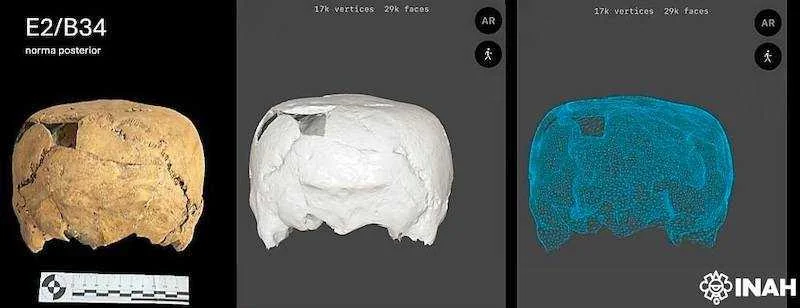
Archaeologists from Mexico’s National Institute of Anthropology and History (INAH) made a highly unusual discovery at the Balcón de Montezuma archaeological site: a cube-shaped human skull dating back roughly 1,400 years.
The skull belonged to a man around 40 years old who lived between 400 and 900 AD—an era known as the Classic period in Mesoamerica. The discovery immediately stood out for one reason: nothing like it has ever been found in Tamaulipas.
How Did the Skull Become Cube-Shaped?
Intentional Cranial Deformation
The skull did not evolve naturally, nor does it represent a new or unknown human lineage. Instead, the man’s head was deliberately reshaped during infancy through a practice known as intentional cranial deformation.
This process typically involved:
- Placing flat boards around a baby’s head
- Wrapping the skull tightly with bandages
- Applying steady pressure over months or years
Infant skulls are soft and malleable, and the bones gradually grow into the desired shape. Researchers stress that, when done correctly, this method does not cause pain or long-term harm.
A Tradition Across Ancient Mexico
Many groups—including the Olmec, Maya, and various cultures in Central Mexico—practiced cranial modification. Cone-shaped skulls are the most famous examples, often associated with beauty, status, or cultural identity.
But a cube? That’s new—and this is where the mystery begins.
Why Is This Skull So Rare?
A One-of-a-Kind Find in the Region
While cube-shaped skulls have been found in parts of Veracruz and Maya-influenced settlements in southeastern Mexico, none have ever been uncovered near Huasteca or the mountainous region of Tamaulipas.
The key questions puzzling researchers:
- Why did only one person in the region undergo this extreme form of modification?
- Was he part of a unique social group or ritual?
- Was he singled out for religious, political, or symbolic reasons?
He Never Left Tamaulipas
To rule out the possibility that he migrated from another region, scientists measured “stable oxygen isotopes” in his bones. These isotopes act like geographic water fingerprints—different regions leave distinct chemical marks over a person’s lifetime.
The results confirmed:
- He was born in Tamaulipas
- He lived his entire life there
- His skull shape was created within the local community
This makes the lone discovery even more perplexing.
What Makes Intentional Skull Shaping Significant?
Identity and Status
Throughout ancient Mesoamerica, shaped skulls were closely tied to:
- Social prestige
- Group identity
- Beauty ideals
- Ritual significance
Cone-shaped skulls among the Maya, for example, were associated with nobility and aesthetic preference.
So Why Only One Cube?
Researchers are exploring several theories:
- A unique family tradition: Perhaps only his lineage practiced it.
- A form of elite or priestly identity: He may have held a role that required distinct physical marking.
- An experimental or transitional style: Cultures often adopt and abandon practices over generations.
- A personal or parental choice: His caregivers may have been inspired by styles from neighboring regions.
Until more skulls—or something contextual like carvings or burial inscriptions—are found, these remain hypotheses.
What Comes Next for Researchers?
Scientists at INAH are continuing to examine:
- Burial context
- The man’s diet and health
- Cultural influences in the region around 600–900 AD
They’re also investigating whether the cube shape carried a symbolic meaning tied to local beliefs or regional trade connections.
Because intentional deformation typically reflects identity, understanding why this man’s skull shape stands alone could reshape what we know about ancient Tamaulipas societies.
Why This Discovery Matters
A single skull may not seem groundbreaking, but in archaeology, anomalies often rewrite chapters of human history. This cube-shaped skull challenges assumptions about cultural uniformity, social practices, and identity in ancient northern Mexico.
It also underscores how much of the ancient world remains unexplored—and how one unusual find can widen the story of human diversity.