
TL;DR
Scientists have long referred to the period between 1.8 billion and 800 million years ago as Earth’s “Boring Billion,” assuming little changed geologically or biologically during that time. But new research suggests the opposite: the breakup of the supercontinent Nuna triggered geological and environmental shifts that set the stage for complex life. The resulting shallow, oxygen-rich seas became incubators for early eukaryotes, the ancestors of animals, plants, and fungi.
What Was the “Boring Billion”?
For decades, scientists called the period between 1.8 billion and 800 million years ago Earth’s “Boring Billion.” The nickname came from the belief that nothing significant happened — no dramatic climate changes, no major extinction or diversification events, and no new geological activity.
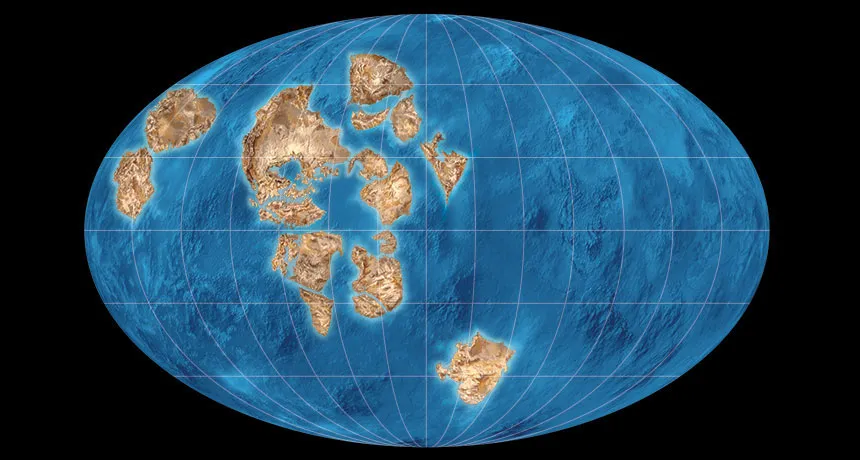
During this time, Earth hosted its first major supercontinent, called Nuna (sometimes also referred to as Columbia). When Nuna began breaking apart, it eventually reassembled as another supercontinent known as Rodinia. For years, researchers thought that was the only major development of the era.
But a new study published on October 27 in Earth and Planetary Science Letters challenges that perception. Using sophisticated tectonic simulations, scientists found that Nuna’s breakup quietly reshaped the planet’s surface, oceans, and atmosphere, and, ultimately, the trajectory of life on Earth.
What Triggered the Change?
The research team simulated 1.8 billion years of tectonic plate movement, tracking how continental shifts influenced the carbon cycle and atmospheric composition.
Their findings revealed that as Nuna split apart:
- Shallow seas spread across the planet, covering more than 130,000 kilometers, roughly three times Earth’s circumference at the equator.
- These seas formed in the gaps between drifting continental fragments, creating oxygen-rich, nutrient-dense environments ideal for life.
- Subduction zones, where one tectonic plate slides beneath another, became shorter.
That last point may sound technical, but it’s key.
Shorter subduction zones meant less volcanic activity, which in turn meant lower carbon dioxide (CO₂) emissions from Earth’s mantle. With less CO₂ in the atmosphere, the planet gradually cooled, making it more stable and habitable.
How Did This Lead to Complex Life?
Reduced volcanic activity and cooler global temperatures likely increased the amount of oxygen dissolved in shallow seas. These newly formed continental shelves provided ideal conditions for eukaryotes, organisms with complex cells containing nuclei, to evolve and diversify.
“We think these vast continental shelves and shallow seas were crucial ecological incubators,” said Juraj Farkaš, a co-author of the study. “They provided tectonically and geochemically stable marine environments with presumably elevated levels of nutrients and oxygen, which in turn were critical for more complex lifeforms to evolve and diversify on our planet.”
In simple terms: Nuna’s breakup didn’t just rearrange continents; it rewired Earth’s life-support system.
These changes likely accelerated the diversification of eukaryotes, paving the way for the multicellular organisms we see today. Every plant, animal, and fungus on Earth owes its existence to these early evolutionary leaps.
Why Scientists Got It Wrong Before
The “Boring Billion” was long viewed as geologically dull because Earth lacked the dramatic markers of later eras, no snowball Earth events, no Cambrian explosion, no major asteroid impacts.
But the new simulations reveal that much of the action was slow and subtle, happening over hundreds of millions of years.
Instead of catastrophic change, it was gradual tectonic reorganization that quietly set the stage for the planet’s next evolutionary chapter.
This rethinking also underscores how much of Earth’s deep history remains hidden beneath the surface, both literally and figuratively.
Why It Matters Today
Understanding what happened during the “Boring Billion” helps scientists answer a fundamental question: How did Earth become a planet that supports complex life?
By linking tectonic movements to shifts in atmospheric composition and ocean chemistry, this study bridges geology and biology in a powerful way.
It also serves as a reminder that not all progress is dramatic. Sometimes, the most profound transformations happen slowly, shaping life quietly over eons.
For modern researchers, these findings could also refine models of exoplanet habitability, helping identify worlds that might host life elsewhere in the universe.
The Takeaway
What scientists once dismissed as a geological lull may, in fact, have been one of the most important transitions in Earth’s history.
The breakup of Nuna cooled the planet, enriched its oceans, and created stable habitats, giving rise to complex, oxygen-breathing life for the first time.
So maybe the “Boring Billion” wasn’t boring after all. It was the quiet revolution that made everything else possible.