
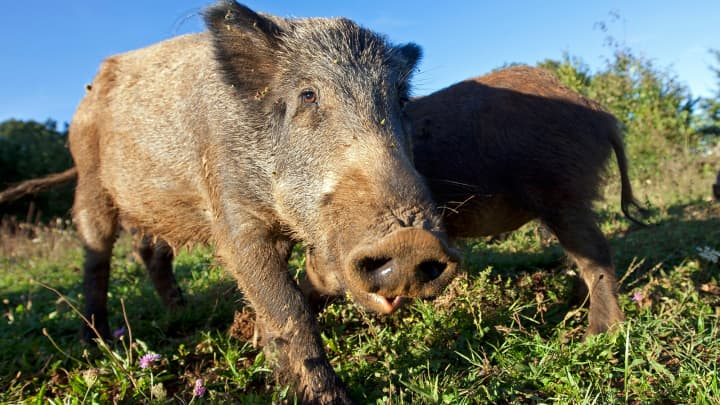
More than a decade after the Fukushima nuclear disaster emptied towns and farms across northeastern Japan, an unexpected biological experiment is unfolding in the forests: domestic pigs and wild boar have interbred to create hybrid animals that scientists say are accelerating evolution in real time.
These animals, often dubbed “Fukushima nuclear hogs” or “ghost hogs,” aren’t radioactive monsters or glowing curiosities. They are something far more interesting: living proof of how quickly nature adapts when humans disappear, even in landscapes marked by radiation.
Their story offers a rare, data-backed glimpse into what happens when domesticated life is abruptly abandoned—and how evolution doesn’t slow down in crisis. It speeds up.
What are the Fukushima “nuclear hogs”?
The term refers to hybrid offspring born from domestic pigs left behind after the 2011 Fukushima evacuation and native Japanese wild boar (Sus scrofa leucomystax).
After the tsunami-triggered nuclear accident forced nearly 164,000 residents to flee, farms were deserted almost overnight. Domesticated pigs escaped or were released into the wild. With humans gone, fences decaying, and predators scarce, these pigs encountered wild boar populations at an unprecedented scale.
They mated and kept mating.
The result is a growing population of hybrids now roaming the exclusion zone and surrounding forests, carrying a mix of domestic and wild genetics.
Importantly, these animals are not “nuclear mutants.” Radiation exposure is part of their environment, but the evolutionary story unfolding here is driven primarily by reproductive biology and human absence, not mutations caused by radiation.
How did the Fukushima disaster create this evolutionary shortcut?
The Fukushima Daiichi nuclear disaster began on March 11, 2011, when a magnitude 9.0 earthquake and massive tsunami crippled the power plant’s cooling systems. Reactors melted down, radioactive material was released, and large areas were declared uninhabitable.
Within hours:
- Entire towns were evacuated
- Farms were abandoned
- Livestock, including pigs, were left behind
From an ecological perspective, this created something extremely rare: a sudden, large-scale removal of humans from a modern, managed landscape.
What followed resembles a real-world simulation of a post-human world.
Why are these hybrids evolving faster than normal wild boars?
This is where the science gets fascinating.
A research team led by Shingo Kaneko of Fukushima University, working with Donovan Anderson, a geneticist at Hirosaki University, analyzed multiple generations of these hybrid animals. Their findings were published in the Journal of Forest Research.
The key insight: reproductive tempo.
Domestic pigs vs. wild boar reproduction
- Wild boar
- Breed once per year
- Seasonal reproduction
- Slower population turnover
- Domestic pigs
- Polyestrous (can breed year-round)
- Multiple litters annually
- Rapid generational cycling
When domestic pigs bred with wild boars, the hybrids inherited the domestic pig’s reproductive clock through the maternal line.
That single biological trait changed everything.
What scientists mean by “fast-forward” evolution
Kaneko’s team found that these hybrid hogs are effectively running evolution on fast-forward.
In practical terms:
- A normal wild boar population might go through three generations in a given time span
- The Fukushima hybrids have gone through nearly ten generations in the same period
This matters because evolution works through generations. The more generations that pass, the faster natural selection can act.
In other words, the Fukushima hybrids aren’t just changing, they’re changing faster than expected by orders of magnitude.
One researcher described this as a “temporal shortcut”: evolution without waiting.
Why domestic pig DNA is disappearing, not dominating
At first glance, you might expect domestic pig traits to overtake wild ones. But the opposite appears to be happening.
The genetic paradox
- Domestic pigs contributed to rapid reproduction
- But wild boar genetics are better suited to survival in forests
Because hybrids breed quickly and repeatedly back-cross with wild boar populations, wild traits are gradually winning out.
Kaneko explained that while domestic genes jump-start population growth, they are also being “purged” over time as natural selection favors:
- Leaner bodies
- Stronger foraging instincts
- Greater wariness of humans
The result is a population that reproduces like domestic pigs but increasingly looks and behaves like wild boar.
This challenges a common assumption that domestication permanently weakens animals. Given the chance, evolution can undo human influence surprisingly fast.
Is radiation driving these changes?
Radiation is part of the environment, but it is not the main engine of this evolutionary shift.
Studies of wildlife in Fukushima—including boar, birds, and insects—have shown mixed results regarding radiation’s biological impact. While radioactive exposure can cause harm at high doses, the hog phenomenon is better explained by:
- Sudden human absence
- Ecological release (fewer constraints)
- Reproductive biology
That distinction matters. It prevents the story from drifting into sci-fi territory and keeps it grounded in real ecology.
Why scientists are paying close attention
Researchers say the Fukushima hogs are more than a local curiosity. They represent a living laboratory for understanding how species respond to abrupt human withdrawal.
Key lessons emerging from the study
- Evolution can accelerate rapidly without humans
- Domestication is not a one-way genetic street
- Reproductive traits can outweigh survival traits—at first
- Nature does not “wait” for conditions to stabilize
Scientists believe similar mechanisms may apply elsewhere, including in regions dealing with invasive or feral pig populations.
For example:
- Texas, where feral hogs cause billions in agricultural damage
- Alberta, where wild pig populations are expanding
Understanding how reproduction and hybridisation drive population booms could help design better management strategies.
What Fukushima’s “ghost hogs” say about a post-human world
Perhaps the most unsettling takeaway is philosophical rather than biological.
The Fukushima exclusion zone shows that nature does not pause for recovery timelines, cleanup schedules, or political debates. Once humans step back—even under catastrophic circumstances—ecosystems reorganise immediately.
Not slowly. Not cautiously. But aggressively.
The hybrid hogs roaming Fukushima’s forests are a reminder that:
- Human control is thinner than we think
- Landscapes remember how to function without us
- Evolution doesn’t need permission
They are not monsters born of radiation. They are messengers from a world where human systems collapsed—and life simply rerouted.
TL;DR
- After the 2011 Fukushima disaster, abandoned domestic pigs interbred with wild boar
- The hybrids inherited year-round breeding from domestic pigs
- This led to evolution occurring up to five times faster than normal
- Domestic pig DNA is now being phased out through natural selection
- The phenomenon shows how quickly nature adapts when humans disappear