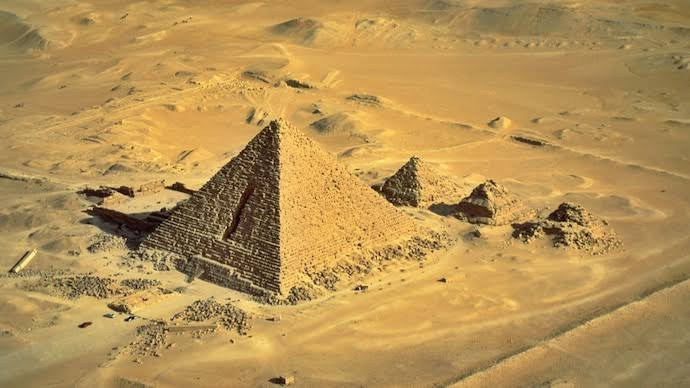
investigating Egypt’s famed Giza Plateau have uncovered evidence of a large, unexplained underground structure hidden beneath one of the ancient site’s elite burial grounds, raising new questions about what may still lie undiscovered beneath the sands surrounding the pyramids.
Using advanced subsurface imaging technology, researchers identified two unusual structures beneath the Western Cemetery at Giza, a burial complex reserved for royal family members and high-ranking officials more than 4,500 years ago. While scientists have stopped short of declaring the discovery a lost tomb, they say the findings point to a significant man-made feature that warrants excavation.
The discovery adds a new chapter to ongoing efforts to map hidden archaeological features at Giza without disturbing the site.
What Did Scientists Find Beneath the Giza Cemetery?
The findings come from a study led by Motoyuki Sato of Tohoku University and published in the journal Archaeological Prospection.
Researchers employed two non-invasive survey methods:
- Ground-penetrating radar (GPR)
- Electrical resistivity tomography (ERT)
Together, these technologies allow scientists to detect buried structures by measuring differences in underground density and electrical properties.
The team focused on the Western Cemetery, one of the most important burial areas at Giza. The cemetery contains numerous mastabas—rectangular, flat-roofed tombs used by Egypt’s elite during the Old Kingdom period.
During the survey, researchers identified an L-shaped anomaly approximately 6.5 feet (2 meters) below the surface. The structure measures roughly 33 feet (10 meters) in length and appears to have been intentionally filled with sand after construction.
Because of its geometric shape and clear boundaries, researchers concluded it is unlikely to be a natural geological formation.
“The Western Cemetery at Giza is known as an important burial place of members of the royal family and high-class officers,” the researchers noted in their study.
Why Is the Deeper Structure Generating More Interest?
The most intriguing discovery lies beneath the L-shaped feature.
Researchers detected a much larger anomaly located approximately 16 to 33 feet (5 to 10 meters) underground. Unlike the upper structure, however, the deeper feature remains difficult to interpret.
Electrical data showed the area is highly resistive, suggesting one of two possibilities:
- A dense mixture of sand and gravel
- A structure containing significant air-filled spaces or voids
Either explanation could indicate human activity rather than natural geology.
The deeper anomaly occupies a space surrounded by known mastabas but lacks any visible surface architecture. That absence may explain why archaeologists overlooked the area for decades.
Scientists speculate that the shallower L-shaped feature may have served as an entrance or access point to whatever lies below.
A Potential Entrance to a Larger Complex?
One of the study’s more compelling suggestions is that the upper structure and the deeper anomaly may be connected.
Researchers wrote that the L-shaped feature “may have been an entrance to the deeper structure.”
If true, the discovery could represent:
- An undiscovered tomb complex
- A ceremonial chamber
- A storage area connected to elite burials
- Another type of archaeological structure not yet identified
At this stage, however, scientists emphasize that the available data cannot determine the exact nature of the anomaly.
What Makes This Discovery Different From Recent Pyramid Claims?
The latest findings should not be confused with recent controversial claims involving alleged giant underground structures beneath the Pyramid of Khafre.
Earlier reports from a separate group of Italian researchers suggested the existence of massive hidden formations extending beneath one of Giza’s major pyramids. Those claims attracted widespread attention but also significant skepticism from archaeologists and geophysicists.
The newly published study is far more cautious in its conclusions.
Rather than claiming the existence of vast underground chambers, Sato’s team reports only what their instruments detected and acknowledges the limitations of remote sensing technology.
The researchers repeatedly stress that geophysical surveys can identify anomalies but cannot definitively reveal what those anomalies are made of.
That distinction is important because underground scans often produce signals that require physical excavation to verify.
Why the Western Cemetery Matters
The Western Cemetery is one of the most historically significant sections of the Giza pyramid complex.
Located west of the Great Pyramid, the burial ground served as a resting place for:
- Royal relatives
- Government officials
- Priests
- Members of Egypt’s administrative elite
Many of the mastabas in the area have yielded valuable information about life during Egypt’s Fourth Dynasty, the era responsible for building the pyramids.
A previously unknown structure beneath this cemetery could offer new insights into burial practices, social hierarchy, and the development of ancient Egyptian funerary architecture.
Hidden Archaeology Beneath Familiar Ground
One of the most surprising aspects of the discovery is its location.
Giza is among the world’s most studied archaeological sites, yet the findings demonstrate that important features may remain hidden beneath areas long considered fully explored.
Modern imaging technologies have transformed archaeological research by allowing scientists to identify potential structures without excavation. Similar methods have revealed hidden settlements, temples, and burial complexes in countries ranging from Egypt to Mexico.
The latest Giza discovery highlights how even iconic sites can still hold secrets.
Can Scientists Confirm It Is a Tomb?
Not yet.
Despite widespread interest in the possibility of a lost tomb, researchers have deliberately avoided making that claim.
The survey data indicate that something substantial exists underground, but the instruments cannot determine whether it is:
- A tomb
- A chamber
- A corridor
- A natural deposit
- Another type of archaeological feature
The study’s authors acknowledge that excavation remains the only reliable way to identify the anomaly.
Until archaeologists physically investigate the site, the underground structure will remain one of Giza’s newest mysteries.
What Happens Next?
Researchers believe the discovery provides a strong case for future excavation.
Additional surveys could help refine the anomaly’s dimensions and improve understanding of its shape, but only direct archaeological investigation can reveal its true purpose.
For now, scientists have established one key fact: beneath a cemetery used by Egypt’s ancient elite lies a significant buried feature that has escaped detection for thousands of years.
Whether it proves to be a forgotten tomb, an underground chamber, or something entirely unexpected, the finding underscores a reality that continues to fascinate archaeologists and the public alike—Giza still has stories left to tell.
TL;DR
- Researchers used ground-penetrating radar and electrical resistivity tomography to survey Giza’s Western Cemetery.
- They discovered an L-shaped structure roughly 6.5 feet below the surface.
- A larger anomaly was detected 16 to 33 feet underground.
- Scientists believe the upper feature may have served as an entrance to the deeper structure.
- Researchers are not claiming the anomaly is a tomb.
- Excavation will be required to determine what lies beneath the cemetery.
- The discovery is separate from controversial claims about giant hidden structures beneath the Pyramid of Khafre.