
Quick Summary
- Scientists found gold and ruthenium in Hawaiian lava, signaling leaks from Earth’s core.
- The core may contain up to 30 billion tons of gold—worth trillions—but only microscopic traces reach the surface.
- Mining is impossible with current technology; the real value is scientific, offering insight into Earth’s formation and structure.
- Hawaiian volcanoes are natural windows into Earth’s deepest layers.
For centuries, humans have dreamed of the riches buried deep beneath our feet. Now, scientists say a piece of that treasure is actually leaking out of Earth’s core, through volcanoes.
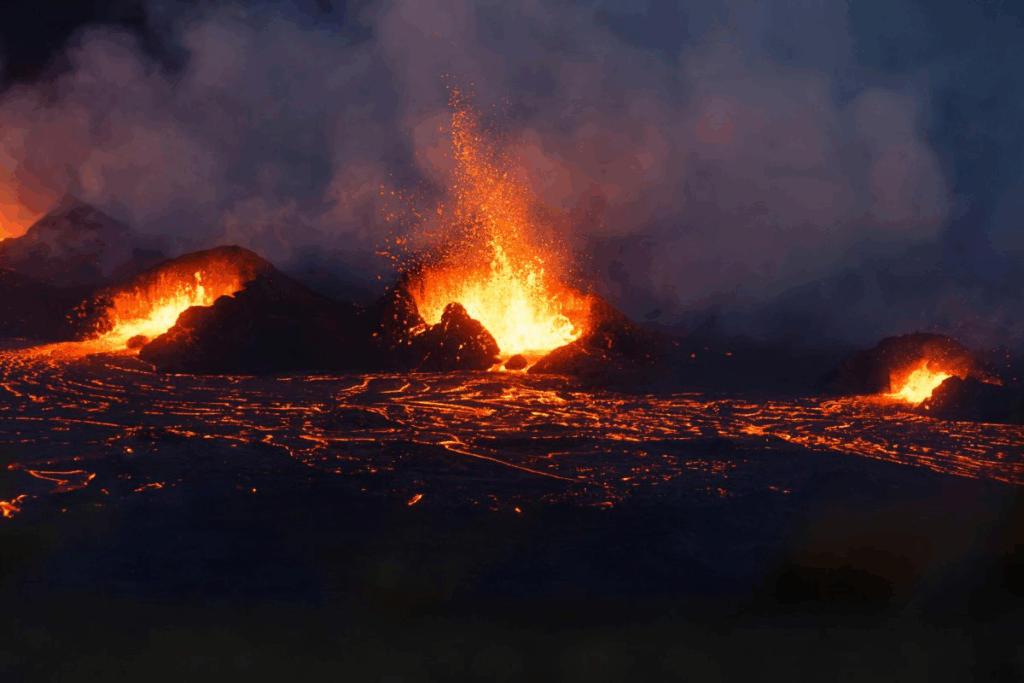
A new study led by researchers at the University of Göttingen in Germany has found chemical fingerprints of precious metals like gold and ruthenium in lava from Hawaiian volcanoes, including Kīlauea and Lo‘ihi. While only microscopic traces reach the surface, the finding provides rare evidence of what lies in Earth’s inaccessible core.
What exactly did scientists find?
By analyzing volcanic rocks called ocean island basalts, the research team detected unusual chemical signatures. These rocks are formed when plumes of molten rock rise from deep inside the Earth and erupt on the surface.
One of the key markers was ruthenium, a metal abundant in the core but rare elsewhere. Its presence in Hawaiian lava signals that material from near Earth’s center is making its way up. Alongside ruthenium, scientists also identified trace amounts of gold.
“We’re talking about traces, not nuggets,” said Matthias Willbold, co-author of the study, underscoring that the findings are about scientific insight—not prospecting.
How much gold is inside the Earth?
The study estimates that the Earth’s core could contain as much as 30 billion tons of gold—valued at roughly €2.77 trillion (about $3 trillion). For comparison, the total amount of gold ever mined by humans is just over 200,000 tons.
In other words, the core might hold 150,000 times more gold than all the vaults, jewelry, and bullion on the planet combined.
But before anyone starts imagining gold rushes under volcanoes, scientists are quick to clarify: the amounts that leak to the surface are vanishingly small. Current technology cannot access, let alone extract, these metals from the core.
Why does this matter if we can’t mine it?
The real value of this discovery isn’t economic—it’s scientific.
By tracking these “leaks” from the core, researchers can:
- Understand Earth’s composition: The core is the most inaccessible part of the planet, yet it plays a vital role in everything from generating Earth’s magnetic field to influencing volcanic activity.
- Reconstruct Earth’s history: Studying how these metals travel offers clues to how the planet formed and evolved over billions of years.
- Advance geoscience: Findings like this help scientists refine models of Earth’s interior—something satellites and seismic instruments alone can’t fully explain.
This is less about treasure hunting and more about peering into the blueprint of the planet we live on.
How do scientists detect core material in lava?
The method hinges on chemical “fingerprints.”
- Ruthenium as a tracer: Because ruthenium is densely concentrated in the core but scarce elsewhere, its presence in lava acts like a signature pointing back to Earth’s deepest layers.
- Ocean island basalts: Volcanic rocks from hot mantle plumes, like those in Hawaii, are particularly valuable to study because they originate closer to the core-mantle boundary.
- Isotope analysis: Researchers compare the isotopes of metals in lava with known values, allowing them to detect anomalies linked to core material.
Could this ever lead to deep-Earth mining?
In short: not anytime soon.
Scientists stress that mining the Earth’s core is technologically impossible with today’s tools. Even drilling just a few miles into the crust is a challenge, while the core lies thousands of miles deeper. Temperatures there exceed 9,000°F—hotter than the surface of the Sun.
Still, the idea sparks curiosity. If future technologies allowed, extracting even a fraction of the core’s gold could reshape the global economy. But for now, the discovery remains a window into natural processes—not an economic plan.
Why Hawaii?
Hawaiian volcanoes are prime research sites because they sit above one of Earth’s most powerful mantle plumes. Unlike volcanoes formed by tectonic plate boundaries, these plumes pull material from much deeper within the Earth. That makes them natural laboratories for studying what lies beneath.
Other volcanic islands, such as those in Iceland and the Galápagos, are also candidates for similar research. But Hawaii’s ongoing activity and accessibility make it a hotspot for such studies.
The bigger picture
This study highlights how even trace elements can rewrite what we know about Earth. By proving that tiny amounts of core material escape through volcanic eruptions, scientists now have a tool to probe questions about planetary formation, mantle dynamics, and geochemistry.
As one researcher put it, these traces are like messages in a bottle from the Earth’s core, rare, fragile, but incredibly revealing.