
For centuries, the Great Pyramid of Giza has mystified archaeologists, engineers, and historians alike. How could an ancient civilization, with no cranes or advanced machinery, construct a structure of such precision and scale, 480 feet tall and made of over two million limestone and granite blocks?
Now, a groundbreaking theory from New York-based scientist Simon Andreas Scheuring challenges everything we thought we knew. His study, published in npj Heritage Science, proposes a bold idea: the Great Pyramid may have been a giant machine designed to build itself.
What does the “self-building pyramid” theory claim?
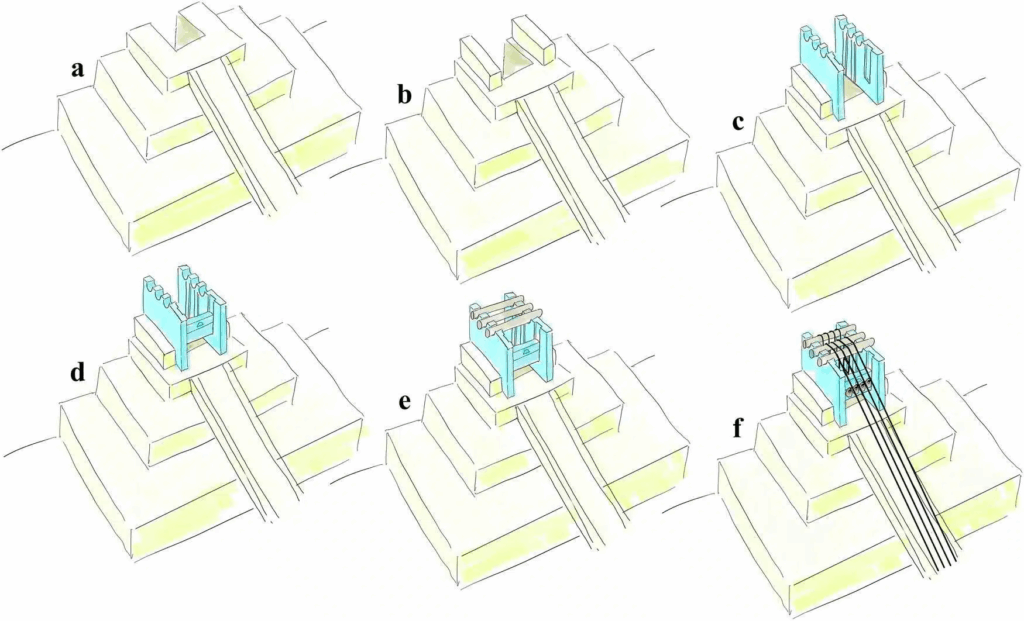
Scheuring’s hypothesis reimagines the construction process from the ground up, quite literally. Rather than massive external ramps or sheer manpower, he argues the pyramid’s internal architecture functioned as a mechanical system.
According to the theory:
- The Grand Gallery and Ascending Passage acted as internal ramps or chutes.
- Pulley-like mechanisms and sliding counterweights were built into these passages.
- The pyramid’s design allowed it to lift and position its own stone blocks, essentially turning the structure into a self-assembling system.
If true, this would explain why archaeologists have never found evidence of the enormous ramps traditionally believed to have transported 60-ton blocks to the top. Scheuring contends that external ramps, if they existed, would have been even larger than the pyramid itself, an implausible scenario with no archaeological trace.
How could an ancient “machine” lift millions of tons of stone?
Scheuring’s model suggests that ropes threaded over wooden beams inside the pyramid’s internal chambers acted like pulleys, using gravity and counterweights to move heavy blocks upward.
In his reconstruction:
- Workers would slide counterweights down the Grand Gallery to lift stones up through shafts.
- The Antechamber, long thought to be a security feature, instead housed the mechanical system that redistributed weight and controlled lift.
- The process repeated in phases, allowing the structure to expand from the inside outward rather than layer by layer.
This method, he argues, made it possible to place one block every one to three minutes, matching historical estimates that the pyramid was completed in roughly 20 years.
Why this theory challenges traditional pyramid construction models
Mainstream Egyptology maintains that the Great Pyramid, built around 2560 BCE for Pharaoh Khufu, was constructed using straight or spiral ramps and tens of thousands of laborers. Yet these models have never been fully proven.
Archaeologists have long debated:
- Where are the ramps? No physical remains of the vast earthworks required have been found.
- How were heavy blocks maneuvered at steep angles?
- Why are some passages unusually precise or oddly placed?
Scheuring’s hypothesis potentially resolves these inconsistencies by showing that the pyramid’s inner design may have been functional, not decorative — a network of ramps, shafts, and chambers that served as the pyramid’s own construction engine.
Could the Great Pyramid really be a machine?
The concept of a “self-building” structure sounds like science fiction, but Scheuring insists it’s grounded in physics and architectural logic. He frames the pyramid as an ancient mechanical computer, a device designed to solve the problem of its own creation.
He writes that the pyramid’s geometry, weight distribution, and symmetry would have made it self-reinforcing as each layer was completed. Each block placed strengthened the internal mechanism that lifted the next.
This inside-out construction could also explain:
- The pyramid’s perfect alignment with true north.
- The consistency in block placement across millions of stones.
- The absence of major structural flaws over 4,000 years.
What does this mean for our understanding of ancient engineering
If validated, Scheuring’s model could rewrite our understanding of human innovation in the ancient world. Rather than brute force, it would suggest that Egyptian architects used deep mechanical insight, possibly predating key engineering principles by millennia.
The Great Pyramid would no longer be seen merely as a tomb but as an early example of adaptive architecture, a design that transformed itself as it grew.
Experts remain cautious, noting that while the theory elegantly addresses several mysteries, direct archaeological evidence of the proposed pulleys or ramps is still lacking. Future scanning projects using muon tomography and ground-penetrating radar could test these internal passage predictions.
Why it matters today
The fascination with how the Great Pyramid was built is more than historical curiosity; it touches on how civilizations harness creativity under constraints. Whether or not Scheuring’s theory holds up under scrutiny, it invites a new conversation about the fusion of architecture and mechanics in early human history.
As technology advances, we may finally uncover whether the Great Pyramid of Giza was not just a monument to power but a machine that defied time, logic, and gravity itself.
TL;DR
A new study by Simon Andreas Scheuring suggests the Great Pyramid of Giza was designed as a self-building machine. Using internal ramps, pulleys, and counterweights, it may have assembled itself from the inside out, eliminating the need for massive external ramps or extraordinary manpower. If proven, this could redefine ancient Egyptian engineering as one of the earliest examples of mechanical automation in architecture.