
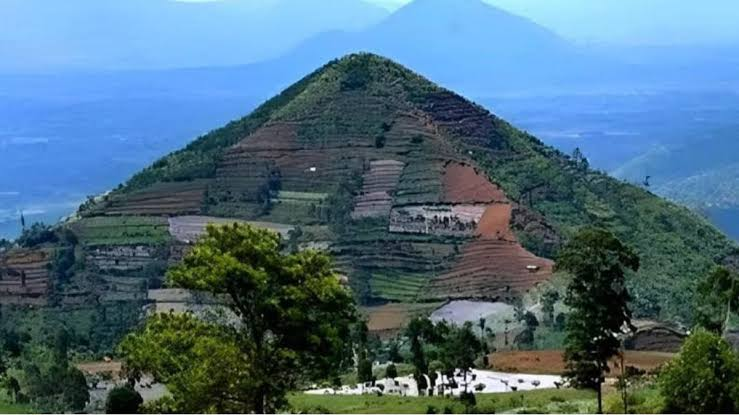
A controversial archaeological study claiming that Indonesia’s Gunung Padang structure may date back as far as 25,000 BC has triggered a fierce debate among scientists — and raised new questions about the origins of human civilisation.
If true, the claim would dramatically rewrite accepted history.
The paper, published in the journal Archaeological Prospection, argues that parts of the Gunung Padang site in West Java, Indonesia, may have been deliberately constructed during the last Ice Age — thousands of years before the rise of agriculture or the Egyptian pyramids.
But many archaeologists strongly disagree, saying there is little evidence the buried structures were actually built by humans.
The dispute has become one of the most closely watched controversies in modern archaeology.
What is Gunung Padang?
Gunung Padang is a hilltop archaeological site in Indonesia known for its stone terraces, volcanic rock formations, and ancient cultural significance.
For years, researchers have debated whether the site is:
- A naturally formed volcanic hill
- A partially modified natural structure
- Or an enormous ancient pyramid built by humans
The site has often been compared to other ancient monumental locations such as Göbekli Tepe in Turkey and Egypt’s pyramids because of its unusual layered structure.
Why the site matters
If researchers could prove Gunung Padang was intentionally constructed 25,000 years ago, it would challenge long-standing beliefs about early human societies.
The accepted archaeological timeline generally holds that:
- Large-scale architecture emerged after agriculture
- Permanent settlements developed roughly 10,000–12,000 years ago
- Complex civilisations formed much later
The Gunung Padang theory challenges that framework entirely.
What did the controversial study claim?
The research was led by Indonesian geologist Danny Hilman Natawidjaja of the Indonesian Institute of Sciences.
According to the paper, the site’s deepest layers may have originated during the last glacial period — potentially around 25,000 BC.
Researchers argue the structure’s core consists of:
- “Meticulously sculpted” andesite lava
- Architecturally layered stone formations
- Modified volcanic structures shaped by humans
The paper states that what began as a natural lava hill was later “sculpted and architecturally enveloped” by ancient builders.
The bigger claim: advanced civilisation before agriculture
Perhaps the study’s most controversial argument is that advanced construction techniques may have existed long before farming societies emerged.
The researchers wrote:
“This study sheds light on advanced masonry skills dating back to the last glacial period.”
The paper also suggests that sites like Gunung Padang and Göbekli Tepe indicate that sophisticated building practices may have existed before the invention of agriculture.
That idea directly challenges mainstream archaeological understanding.
Why do many archaeologists reject the findings?
The study quickly faced criticism from archaeologists and geologists worldwide.
Critics argue that the paper confuses natural geological formations with evidence of human construction.
“No clear evidence” of human building
Flint Dibble, an archaeologist at Cardiff University, criticised the paper in comments to Nature.
“There’s no evidence of working or anything to indicate that it’s man-made,” Dibble said.
He argued that the orientation of buried materials can occur naturally as rocks move downhill over time.
Other researchers say the study lacks definitive signs of human activity, such as:
- Tool marks
- Artifacts
- Human remains
- Charcoal deposits
- Bone fragments
- Evidence of organised habitation
Questions about the dating evidence
Another major criticism centers on how the site was dated.
Bill Farley, an archaeologist at Southern Connecticut State University, reportedly said the soil samples may be old — but that does not prove humans built anything there.
“The 27,000-year-old soil samples from Gunung Padang, although accurately dated, do not carry hallmarks of human activity,” Farley said.
Critics note that dating soil or volcanic layers is not the same as dating construction by humans.
That distinction is central to the controversy.
Why the Gunung Padang debate matters
The intense reaction surrounding the study reflects a broader fascination with “lost civilisation” theories and the possibility that human history may be more complex than previously believed.
Stories involving mysterious ancient structures often gain massive public attention because they touch on enduring questions:
- When did civilisation truly begin?
- How advanced were prehistoric humans?
- Could major societies have existed before recorded history?
At the same time, archaeologists warn that extraordinary claims require extraordinary evidence.
The danger of rewriting history too quickly
Experts say archaeology depends on cumulative evidence gathered through excavation, dating, and peer review over many years.
One disputed study is rarely enough to overturn decades of scientific consensus.
That’s especially true for claims that would fundamentally alter humanity’s historical timeline.
Some researchers worry sensational interpretations can spread online faster than careful scientific analysis.
Journal launches an investigation into the paper
The controversy has now escalated beyond academic debate.
According to reports, the co-editor of Archaeological Prospection confirmed that an investigation has been launched into the paper and its review process.
That does not automatically mean the study will be retracted, but it signals that the journal is taking the criticism seriously.
Meanwhile, Natawidjaja has defended the research and invited international scientists to conduct further studies at the site.
“We are really open to researchers around the world who would like to come to Indonesia and do a research programme on Gunung Padang,” he said.
Is Gunung Padang older than the Egyptian pyramids?
Officially, no.
The oldest widely accepted pyramid remains the Step Pyramid of Djoser in Egypt, built around 2,630 BC.
While Gunung Padang itself may contain ancient geological formations and cultural layers, mainstream archaeology has not accepted claims that humans built a pyramid there 25,000 years ago.
For now, the site remains one of archaeology’s most disputed mysteries — sitting somewhere between scientific curiosity, geological puzzle, and internet fascination.
Why does the story keep going viral?
Part of the reason the Gunung Padang debate attracts so much attention is that it challenges deeply familiar narratives about human history.
The idea that Ice Age civilisations may have possessed advanced engineering skills is both scientifically provocative and culturally irresistible.
That combination has helped the story spread far beyond archaeology circles into documentaries, podcasts, YouTube theories, and social media debates.
But until stronger evidence emerges, most experts remain sceptical.
TL;DR
- A controversial study claims Indonesia’s Gunung Padang structure may date back to 25,000 BC.
- Researchers argue that ancient humans modified a natural lava hill into a pyramid-like structure.
- Critics say there is no clear evidence that the buried layers were man-made.
- Archaeologists dispute the dating methods and the lack of artifacts.
- The journal that published the study has launched an investigation into the paper.