Quick Summary
To fight a deadly bird-killing disease, Hawaii is releasing 500,000 lab-bred, non-biting male mosquitoes weekly using drones. These mosquitoes carry Wolbachia, a bacterium that causes mosquito eggs to fail when they mate with wild females. The goal is to reduce mosquito populations, stop the spread of avian malaria, and save endangered birds like the honeycreepers before it’s too late.
Why Hawaii is using lab-bred mosquitoes to fight extinction
In a bold and unconventional move, Hawaii is turning to drones—and mosquitoes—to combat an escalating ecological crisis. But these aren’t your typical buzzing bloodsuckers. They’re lab-engineered, non-biting males carrying a bacterium that could help save Hawaii’s native birds from the brink of extinction.
The initiative, which deploys these mosquitoes by air across forests in Maui and Kauai, represents a groundbreaking fusion of technology and conservation science. The goal? Stop avian malaria, a mosquito-borne disease that has already wiped out dozens of bird species and now threatens the few that remain.
What’s killing Hawaii’s birds?
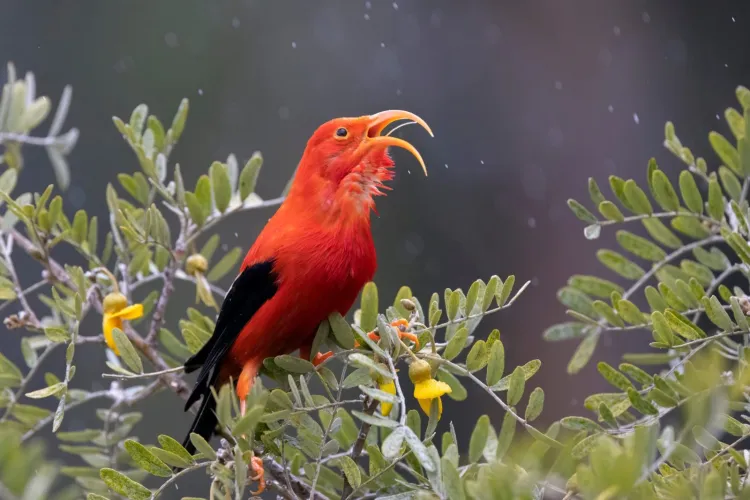
Hawaii was once home to more than 50 unique species of honeycreepers—small, colorful birds that evolved in isolation over millennia. Today, only 17 species remain, and most are endangered. Some, like the ‘akikiki, are already considered functionally extinct in the wild.
Honeycreepers are not just beautiful—they’re vital pollinators and seed dispersers, playing an essential role in Hawaii’s native ecosystems.
While deforestation and habitat loss have taken a toll, the main culprit is avian malaria, a disease transmitted by mosquitoes. Birds in Hawaii have no natural immunity to it because mosquitoes were never native to the islands—they were introduced accidentally in the 1800s, likely by whaling ships.
How climate change made things worse
Historically, cooler temperatures in Hawaii’s mountain regions acted as a natural barrier, keeping mosquitoes and avian malaria at bay. Honeycreepers retreated to these higher elevations to survive.
But climate change is changing that. As temperatures rise, mosquitoes are climbing higher into these mountain sanctuaries, leaving the birds with nowhere left to escape.
Dr. Chris Farmer of the American Bird Conservancy warns, “It’s a steady progression… until there’s no longer habitat left that [the birds] can survive in. If we do not interrupt that cycle, we will lose our honeycreepers.”
The science behind the solution: Wolbachia and IIT
The strategy hinges on an innovative approach known as the Incompatible Insect Technique (IIT). The concept is simple, but the science is clever:
- Scientists breed male mosquitoes that carry a bacterium called Wolbachia.
- These lab-raised males do not bite and do not transmit disease.
- When they mate with wild females that don’t carry Wolbachia, the eggs never hatch.
- Over time, this suppresses the local mosquito population.
Because only male mosquitoes are released, and they don’t bite, there’s no risk to humans or animals. And since no genetic modification is involved, it avoids many of the controversies tied to GMO-based techniques.
Why drones are crucial
To distribute the mosquitoes across vast, rugged terrain, conservationists are using drones and helicopters to drop biodegradable pods filled with about 1,000 mosquitoes each.
Each week, 500,000 male mosquitoes are released on both Maui and Kauai, part of a large-scale effort to outnumber the wild males and find as many wild females as possible.
This drone-based delivery system makes it possible to target remote and otherwise inaccessible areas with surgical precision—far more effective than ground-based approaches.
Why not just use pesticides?
Traditional methods like spraying insecticides are not only ineffective on such a large scale but also pose serious risks to non-target species, many of which are also native to Hawaii.
“We don’t want to harm damselflies, fruit flies, or other native insects that are critical to our ecosystem,” Farmer explains.
The IIT strategy, by contrast, is species-specific, chemical-free, and environmentally sustainable.
What’s next?
The drone mosquito drop is part of a broader plan to stabilize and eventually restore Hawaii’s delicate native ecosystems. Though the project is still in its early stages, conservationists are hopeful.
Success could mean:
- Halting the spread of avian malaria.
- Giving endangered birds a fighting chance.
- Offering a model for other regions grappling with invasive species or vector-borne diseases.
But scientists caution that results will take time. The scale of Hawaii’s mosquito problem means it could take years before population suppression is measurable.