
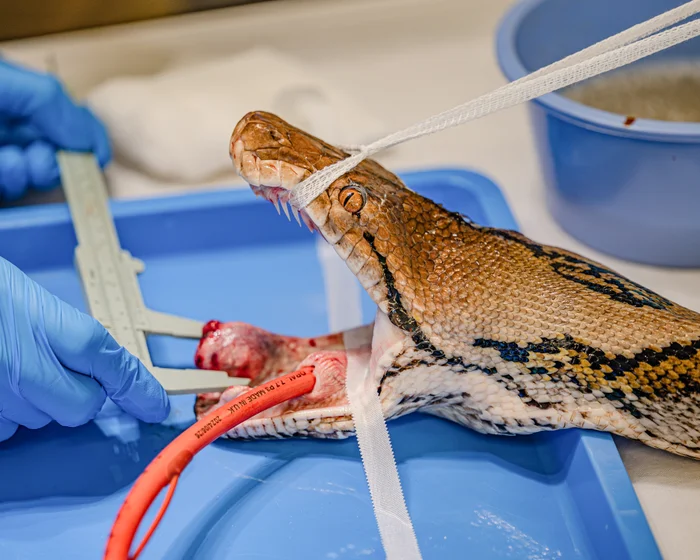
A 23-year-old reticulated python named Jodie Foster has made a remarkable recovery after veterinarians at Chester Zoo adapted a cancer treatment normally used in humans to treat her recurring tumour.
The 15-foot snake had developed a tumour on her jaw that had returned after being surgically removed in 2024. When the cancer began affecting the surrounding bone, veterinarians realised that another conventional operation alone was unlikely to be enough.
They turned to electrochemotherapy, a treatment involving chemotherapy and controlled electrical pulses. According to Chester Zoo, Jodie has since shown no detectable signs of cancer and has returned to eating normally.
Who is Jodie Foster the python?
Jodie Foster is a 23-year-old reticulated python living at Chester Zoo in England.
She is approximately 15 feet long and has been at the zoo for many years.
Her unusual name has an equally unusual origin.
When actress Jodie Foster visited the zoo nearly two decades ago, keepers noticed that the snake’s paperwork identified her as “JF,” meaning juvenile female. The initials inspired the name Jodie Foster.
The python has now become notable for another reason: she is believed to be the first snake to receive electrochemotherapy, a cancer treatment routinely used in human medicine.
What type of cancer did Jodie Foster have?
Jodie developed a tumor involving her jawbone.
Veterinarians initially removed the tumor surgically in 2024.
However, the cancer returned in 2025 and began affecting the surrounding bone.
That created a serious problem.
Because the tumor was located around the jaw, simply removing the visible growth again might not have eliminated all of the cancerous tissue.
The condition was also interfering with Jodie’s ability to eat.
For a python, that can become particularly dangerous because feeding is essential to maintaining its health and body condition.
Why couldn’t veterinarians simply operate again?
The zoo’s veterinary team determined that surgery alone was unlikely to provide a satisfactory solution once the cancer had returned and begun involving the bone.
Removing more tissue from the jaw could also have created significant functional problems.
Instead, veterinarians began looking for another way to destroy cancer cells that might remain after surgery.
That led them to electrochemotherapy.
The treatment offered a way to combine surgical removal of the visible tumor with a targeted approach against remaining cancerous cells.
What is electrochemotherapy?
Electrochemotherapy combines a chemotherapy drug with controlled electrical pulses.
In Jodie’s treatment, veterinarians used the chemotherapy drug bleomycin.
The basic principle is relatively straightforward.
Electrical pulses are delivered to the tumor or surrounding tissue. These pulses temporarily increase the permeability of cell membranes, allowing more of the chemotherapy drug to enter the cancer cells.
Once inside, the drug can exert a stronger effect on the targeted cells.
The technique has been used in human cancer treatment and has also been investigated in veterinary medicine, particularly for certain tumors in animals.
The unusual aspect of Jodie’s case was adapting the procedure for a giant reptile.
How was the treatment performed?
The procedure lasted approximately 90 minutes.
Jodie’s size created an immediate logistical challenge.
At around 15 feet long, she was far too large to fit conveniently on a conventional operating table.
The veterinary team therefore used two operating tables during the procedure.
The vets removed the tumor and part of the affected jawbone before applying electrochemotherapy to target cancer cells that might have remained.
According to Chester Zoo veterinarian Ian Ashpole, the team consulted cancer specialists while determining whether the treatment could be adapted safely for a snake.
Why is treating cancer in reptiles difficult?
Cancer treatment in reptiles presents challenges that veterinarians do not face in quite the same way with humans or conventional domestic animals.
Reptiles have different physiology, metabolism and responses to medication.
Their body temperature is also influenced heavily by their environment, which can affect metabolic processes and potentially influence how drugs work.
That means a treatment protocol designed for humans cannot simply be transferred to a snake without modification.
The veterinary team therefore had to consider both the cancer treatment itself and the biological differences between humans and reptiles.
What happened after the treatment?
The results have been encouraging.
Chester Zoo says Jodie was examined again this week and showed no signs of cancer.
More importantly, she has returned to eating normally.
The zoo says she can once again swallow whole chickens and has resumed exploring her enclosure.
That is particularly significant because her tumor had previously interfered with her ability to eat.
Despite losing part of her jawbone, Jodie has apparently adapted remarkably well.
She can grip and swallow food without difficulty.
How can a python eat after losing part of its jaw?
Snakes have an extraordinary feeding system that differs dramatically from that of mammals.
Their jaws are not rigidly fused together in the way human jaws are.
Instead, different parts of the snake’s skull and jaw are connected by highly flexible joints and ligaments.
The two sides of the lower jaw can move independently to help the snake “walk” its mouth over prey.
Their flexible jaw structure allows them to consume animals much larger than the diameter of their heads might suggest.
This flexibility appears to have helped Jodie adapt after part of her jawbone was removed.
The zoo says she is still able to grip and swallow food normally.
Why is this treatment important?
Jodie’s recovery is significant because it demonstrates how veterinary medicine can adapt techniques developed for humans to unusual animal patients.
The case also illustrates why zoo medicine sometimes requires highly specialized approaches.
Veterinarians treating wild and exotic species cannot always rely on standard protocols developed for dogs, cats or humans.
They may have to work with specialists in human medicine, veterinary oncology, surgery and animal physiology to develop an appropriate treatment plan.
In Jodie’s case, that collaboration appears to have produced a successful outcome.
Does this mean electrochemotherapy can now be used on all snakes?
No.
That would be an important overstatement.
Jodie’s treatment was an individual case involving a specific tumor, a particular species and a carefully adapted medical procedure.
A successful outcome does not establish that electrochemotherapy is safe or effective for every snake or every type of reptile cancer.
More cases and research would be required before veterinarians could determine how broadly the technique can be applied.
The significance of Jodie’s treatment is that it demonstrates the possibility of adapting the approach.
Why was the snake’s cancer especially concerning?
Jodie’s tumor was located on her jaw, an area critical to feeding.
A snake’s ability to capture, grip and swallow food depends heavily on the structure and movement of its mouth.
As the tumor returned and began affecting the surrounding bone, the problem was therefore not merely cosmetic.
It directly threatened an essential biological function.
If Jodie could no longer eat properly, her condition could have deteriorated rapidly.
That made finding an alternative to repeated surgery particularly important.
What does Jodie’s recovery tell us about zoo medicine?
Modern zoos increasingly operate sophisticated veterinary facilities that can perform procedures once associated almost exclusively with human hospitals.
Zoo veterinarians may deal with everything from advanced imaging and orthopedic surgery to cancer treatment.
Cases involving large reptiles are particularly demanding because the patients can be difficult to anesthetize, move and position safely.
Jodie’s procedure required specialized planning simply because of her size.
Her recovery shows the value of combining veterinary expertise with knowledge from human medicine.
The bigger picture
Jodie Foster’s story is unusual even by the standards of modern veterinary medicine.
A 15-foot reticulated python developed a recurring jaw tumor, underwent surgery, saw the cancer return and was then treated using an approach normally associated with human oncology.
The treatment combined removal of the tumor and part of the affected jawbone with electrochemotherapy using bleomycin and controlled electrical pulses.
The result has so far been encouraging.
Chester Zoo says Jodie currently shows no signs of cancer, is eating normally and has returned to exploring her habitat.
For the veterinary team, the case is more than a successful operation.
It demonstrates how treatments developed for human patients can sometimes be carefully adapted for animals whose anatomy and physiology are completely different.
And for Jodie herself, the most important outcome is considerably simpler: she is eating again.