Why do humans across cultures keep coming back to alcohol, despite knowing its risks? From wine at weddings to beer after work, drinking is woven into social life in ways few other substances are. According to a growing body of research, the answer may not lie in modern marketing or cultural habit alone, but in a far older story that begins millions of years ago in the forest canopy. Scientists studying primate behavior and human evolution suggest that our love of booze has deep evolutionary roots. Long before bars, breweries, or vineyards existed, our primate ancestors were already seeking out naturally fermented fruit. In doing so, they may have rewired our biology to tolerate, even favor, alcohol. This idea, sometimes called the “drunken monkey hypothesis,” reframes alcohol not as a modern temptation but as an ancient dietary signal that once helped our ancestors survive.
Why do humans like alcohol so much?
Alcohol tastes bitter, impairs judgment, and can be dangerous in excess. From a purely rational standpoint, it seems odd that humans would consistently choose it. Yet across history and geography, societies that independently developed agriculture almost always discovered fermentation.
The evolutionary explanation starts with fruit.
For millions of years, early primates relied heavily on fruit as a primary food source. Ripe fruit is calorie-dense, rich in sugars, and easier to digest than leaves. But ripe fruit does not last long. As it falls to the ground and begins to ferment, yeasts convert sugars into ethanol.
That fermentation process creates two important signals:
- A distinct smell that travels farther than the scent of unripe fruit.
- A chemical marker of ripeness and caloric payoff.
To a hungry primate, the faint scent of ethanol could function like a dinner bell.
Fermentation as a survival cue
In dense forests, visual cues are limited. Smell becomes crucial. Ethanol is volatile, meaning it evaporates easily and spreads through the air. Fruit that has begun fermenting advertises itself.
Research suggests that primates able to detect and tolerate small amounts of ethanol would have had an advantage. They could locate fallen fruit more efficiently and extract calories that others missed.
Over time, natural selection would favor individuals with:
- A strong attraction to the smell of ethanol.
- Enzymes capable of metabolizing alcohol safely.
- Neural reward systems that reinforced ethanol consumption.
Those traits did not disappear when humans left the forest.
What does primate behavior tell us about alcohol?
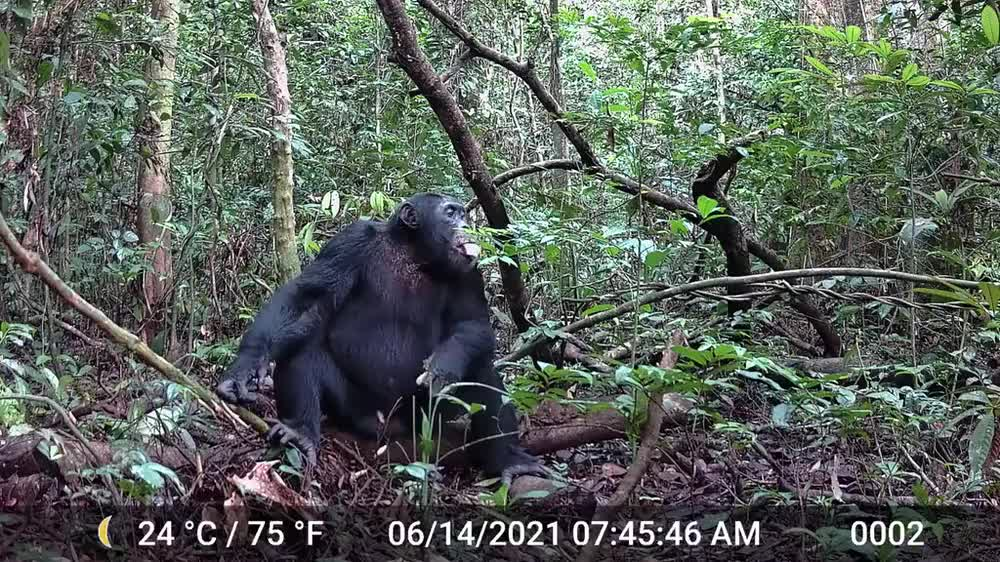
Modern primates offer a living window into this evolutionary past. Chimpanzees, gorillas, and other fruit-eating species regularly consume naturally fermented foods.
In Uganda, researchers have observed chimpanzees eating figs from the forest floor that contain measurable levels of ethanol. These animals are not getting drunk in a human sense, but they are ingesting alcohol routinely.
Nathaniel Dominy, an anthropology professor at Dartmouth College, has argued that this behavior is not accidental. Instead, it reflects a long-standing evolutionary relationship between primates and fermented foods.
The genetic clue hidden in our livers
One of the strongest pieces of evidence comes from genetics.
Humans and African apes share a mutation in the ADH4 gene, which plays a role in breaking down ethanol in the liver. This mutation, estimated to have emerged around 10 million years ago, dramatically increased the efficiency of alcohol metabolism.
That timing matters. It coincides with a period when ancestral apes began spending more time on the ground, where fallen, fermenting fruit was more abundant.
In evolutionary terms, this suggests:
- Alcohol consumption was common enough to shape genetics.
- Improved ethanol metabolism provided a survival advantage.
- Our bodies adapted long before brewing existed.
This is a key reason researchers argue that alcohol preference is not purely cultural.
How did this ancient trait shape modern drinking?
Fast-forward to human civilization, and the same biological wiring remains in place. What changed was the concentration.
Naturally fermented fruit contains low levels of ethanol, usually well under 2 percent. Modern beer, wine, and spirits can be many times stronger. The reward systems built for scarcity are now confronted with abundance.
This mismatch helps explain several modern patterns:
- Why alcohol reliably triggers pleasure and relaxation.
- Why moderation can be difficult for some people.
- Why alcohol use disorders exist across cultures.
Our brains evolved to treat ethanol as a useful signal, not a threat. In a world of distilled spirits, that ancient signal can overwhelm the system.
Social bonding and intoxication
Alcohol’s role is not limited to calories. Ethanol also affects the brain in ways that promote social bonding.
At low doses, alcohol reduces anxiety and increases sociability. For early humans living in tight-knit groups, these effects could strengthen cooperation and trust. Shared consumption of fermented beverages may have reinforced group identity long before written language or formal rituals.
This could help explain why alcohol appears so often in:
- Religious ceremonies.
- Feasts and celebrations.
- Diplomatic and social gatherings.
The biology of bonding met the culture of community.
Is the “drunken monkey hypothesis” universally accepted?
Not entirely. While the hypothesis is influential, it is still debated.
Some scientists argue that
- Alcohol tolerance does not necessarily mean preference.
- Cultural factors play a larger role in drinking behavior.
- Other evolutionary pressures may better explain alcohol metabolism.
However, even critics acknowledge that the genetic and behavioral evidence is difficult to ignore. At minimum, alcohol has been part of the primate diet far longer than previously assumed.
A useful way to think about this is not as destiny, but as predisposition. Evolution may load the dice, but it does not force the roll.
Why does this research matter today?
Understanding the evolutionary roots of alcohol use changes how we think about drinking, addiction, and public health.
Rather than framing alcohol consumption purely as a moral failing or modern vice, this perspective highlights a biological vulnerability shaped by deep time.
That has implications for:
- Public health messaging that acknowledges innate attraction.
- Addiction treatment models that reduce stigma.
- Policy debates around availability and advertising.
It also helps explain why simple warnings often fail. You are not just fighting habit or culture. You are negotiating with an ancient survival system.
Where visuals could add value
To strengthen this story for readers, consider adding:
- An infographic showing ethanol levels in fermented fruit versus modern drinks.
- A timeline tracing primate evolution alongside genetic changes in alcohol metabolism.
- A simple diagram explaining how ADH enzymes process ethanol.
These elements can make abstract evolutionary ideas concrete.
Does this mean alcohol is “natural” and therefore safe?
No. Natural does not mean harmless.
Evolution prepared humans to handle small amounts of ethanol, not daily exposure to high-proof spirits. The same biology that once helped our ancestors find food can, in a different environment, increase risk.
The takeaway is nuance, not permission.
Alcohol’s grip on human culture is not an accident, but neither is its potential for harm.
TL;DR: what this research really says
- Humans’ love of booze may trace back millions of years to fruit-eating primates.
- Fermented fruit provided calories and survival signals, favoring alcohol tolerance.
- Genetic adaptations support the idea that ethanol consumption shaped evolution.
- Modern alcohol is far stronger than anything our ancestors encountered.
- Understanding this mismatch can improve public health and reduce stigma.