
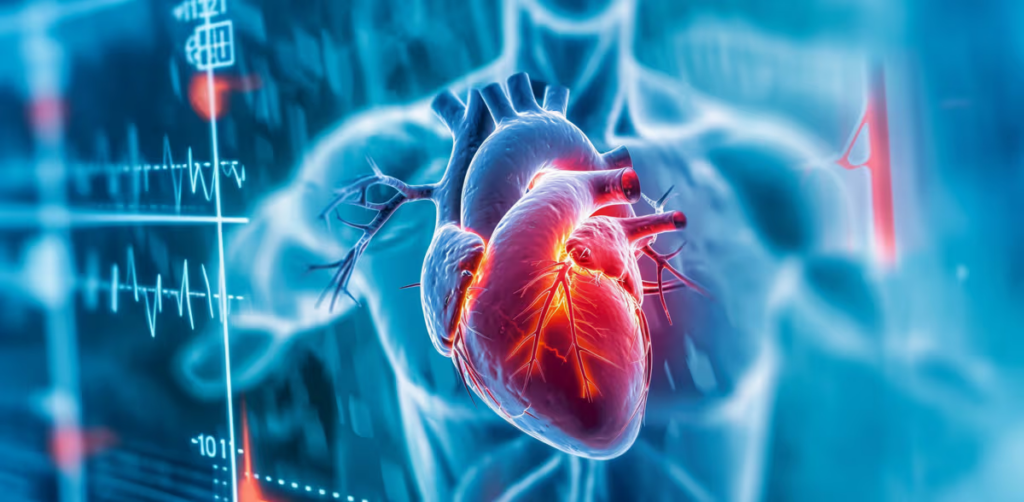
A new RNA-based therapy for heart repair could fundamentally change how doctors treat heart attack damage, turning a routine injection into a kind of biological “repair signal” for the heart.
Developed by researchers at Columbia University School of Engineering and Applied Science, the experimental treatment doesn’t just prevent further injury. It aims to help the heart rebuild itself, a feat long considered out of reach in modern cardiology.
Why is heart damage after a heart attack so hard to fix
When a heart attack strikes, the immediate priority is restoring blood flow. Procedures like stents or clot-busting drugs can reopen blocked arteries, but they don’t solve a deeper problem: dead heart muscle doesn’t grow back.
This limitation sets off a chain reaction.
- Lost muscle is replaced by scar tissue
- The heart becomes weaker and less efficient
- Over time, many patients develop heart failure
The heart, unlike the liver or skin, has almost no regenerative capacity in adulthood. That biological ceiling has shaped decades of treatment strategies that have focused more on damage control than on repair.
What is the new RNA-based therapy for heart repair after a heart attack?
The new approach flips the traditional model. Instead of delivering drugs directly to the heart, it turns the patient’s own body into a drug factory.
Here’s the idea in plain terms:
- Inject RNA into muscle (arm or thigh)
- Muscle cells produce a healing molecule
- That molecule travels through the bloodstream
- It activates only when it reaches the heart
This method avoids invasive procedures like catheter-based delivery or open-heart interventions.
How does the injection actually work?
Step 1: Programming the body
The therapy uses RNA-lipid nanoparticles, similar to those used in some modern vaccines. These particles carry instructions for producing a molecule called pro-ANP.
Once injected into skeletal muscle:
- Cells begin manufacturing pro-ANP
- The molecule enters circulation
Step 2: Activation in the heart
The real elegance lies in what happens next.
- An enzyme called Corin, highly concentrated in the heart, converts pro-ANP into its active form, ANP (atrial natriuretic peptide)
- Because Corin is about 60 times more abundant in the heart than elsewhere, activation happens primarily where it’s needed
This creates a built-in targeting system without physically targeting the heart.
Step 3: Long-lasting effect
The therapy uses self-amplifying RNA (saRNA), which can replicate inside cells. That means:
- One injection can remain active for weeks
- Early studies show effects lasting at least a month
For patients, that could translate into fewer hospital visits and simpler care.
Why scientists looked to newborn hearts for answers
The inspiration came from an unlikely source: newborn mammals.
In the first days of life, hearts can briefly regenerate. Scientists traced part of this ability to ANP, a hormone that:
- Promotes blood vessel growth
- Reduces inflammation
- Limits scar formation
In newborn mice, the gene responsible for ANP production surges dramatically after injury. In adults, that response is much weaker.
When researchers blocked this gene in newborns, their regenerative ability dropped sharply. That finding suggested a clear path forward: restore what adulthood takes away.
What do the early results show?
In preclinical studies, the results were striking.
Across multiple test conditions, a single injection:
- Reduced scar tissue
- Improved heart function
- Worked in both small and large animals
Researchers also stress-tested the therapy in more realistic scenarios:
- Older animals
- Models with atherosclerosis
- Subjects with type 2 diabetes
- Delayed treatment (administered a week after the heart attack)
The therapy remained effective across all of them.
That last point is critical. Many patients don’t receive immediate care after a heart attack, so treatments must work even after damage has already set in.
How is this different from existing treatments?
Current approaches to repairing heart damage face major trade-offs.
Traditional methods
- Direct injections into the heart: effective but invasive
- Cell therapies: complex, expensive, inconsistent results
- Drug infusions: limited targeting precision
The RNA injection approach
- Minimally invasive (simple intramuscular shot)
- Self-targeting via natural enzymes
- Longer-lasting due to RNA amplification
- Potentially scalable and accessible
In short, it shifts treatment from precision delivery to precision activation.
Why this matters beyond heart attacks
While the focus is on heart disease, the implications could ripple far beyond cardiology.
Many chronic conditions share a common thread: cell damage that the body struggles to repair.
If this platform works in humans, it could be adapted for:
- Kidney disease
- High blood pressure
- Pregnancy-related conditions like preeclampsia
- Other organ injuries where regeneration is limited
The broader concept is powerful: use RNA to activate healing only where it’s needed, reducing side effects elsewhere.
What happens next?
The therapy is still in the experimental stage. Before it reaches patients, several steps remain:
- Manufacturing at clinical scale
- Phase 1 safety trials in humans
- Larger trials to confirm effectiveness
Researchers plan to begin early-stage trials at Columbia University Irving Medical Center.
That process will determine whether the promising animal results translate to people.
What are the risks and unknowns?
As with any emerging therapy, caution is essential.
Key questions include:
- How the immune system responds to repeated RNA injections
- Whether long-term activation of ANP has unintended effects
- How consistent results will be across diverse human populations
It’s also important not to overstate the findings. This is not yet a cure, and human trials will be the true test.
TL;DR
- A new RNA-based therapy for heart repair could help the heart heal itself after a heart attack
- It works by turning muscle into a temporary drug factory
- The therapy activates only in the heart, reducing the need for invasive procedures
- Early studies show reduced scarring and improved function
- Human trials are the next critical step