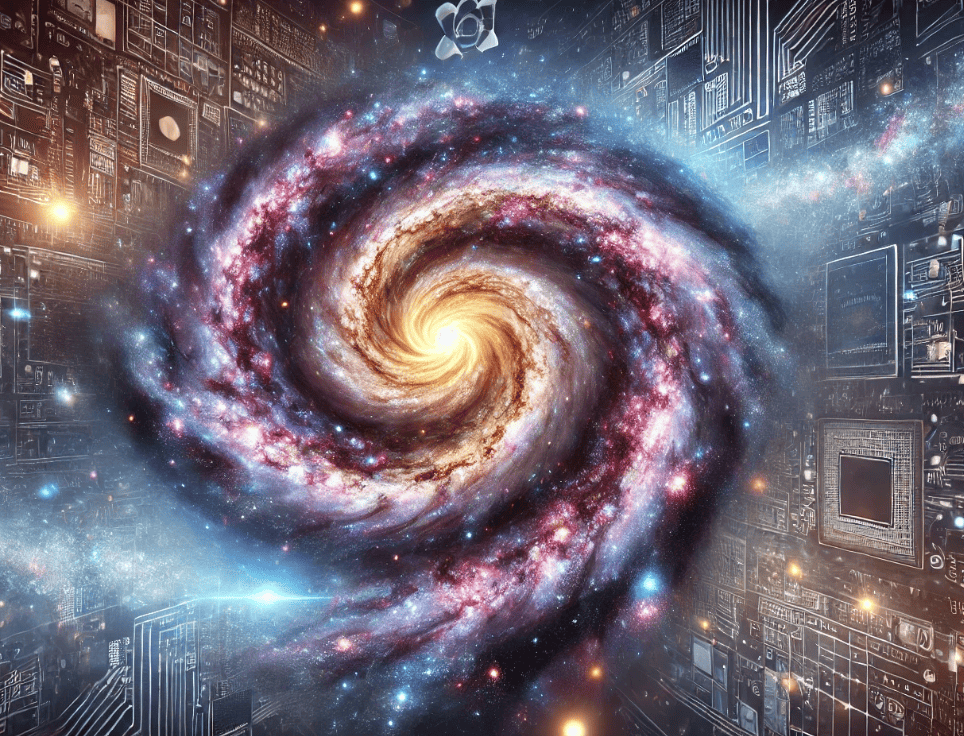
A groundbreaking new study proposes a radical reconceptualization of gravity, suggesting it may be an emergent property of computation processes occurring throughout the cosmos. The research, which positions the universe as functioning like an immense quantum computer, could fundamentally transform our understanding of reality and the forces that shape it.
The information theory of gravity
Dr. Melvin Vopson, a physicist at the University of Portsmouth, has developed a novel theory suggesting that gravity might not be a fundamental force as traditionally understood but rather a by-product of the universe’s information organization systems.
“My findings in this study fit with the thought that the universe might work like a giant computer, or our reality is a simulated construct,” explains Dr. Vopson. “Just like computers try to save space and run more efficiently, the universe might be doing the same. It’s a new way to think about gravity – not just as a pull, but as something that happens when the universe is trying to stay organized.”
The theory builds upon Dr. Vopson’s previous research, which proposed that information possesses mass and that elementary particles—the fundamental building blocks of the universe—store information about themselves, comparable to how biological cells contain DNA.
Space as a data storage medium
In his latest work, Dr. Vopson demonstrates how space pixelation in elementary cells might function as a data storage medium. These cells potentially register information in binary form—with empty cells registering a digital “0” and cells containing matter registering a “1.”
“The process is identical to how a digital computer game, virtual reality application, or other advanced simulation would be designed,” notes Dr. Vopson.
His theory suggests that when multiple particles can be accommodated in a single cell, the system evolves by consolidating them into a larger particle within that cell—an optimization that triggers what we perceive as gravitational attraction.
Computation efficiency and gravitational attraction
Dr. Vopson’s framework proposes that gravity might be an optimization mechanism within a computational process designed to compress information.
“It is far more computationally effective to track and compute the location and momentum of a single object in space, than numerous objects,” he explains. “Therefore, it appears that the gravitational attraction is just another optimising mechanism in a computation process that has the role to compress information.”
This perspective aligns with the second law of information dynamics, suggesting that matter and objects in space are drawn together because the universe is attempting to maintain information in a tidy, compressed state.
The implications of this research extend beyond physics, raising profound philosophical questions about the nature of reality and whether our universe might indeed be operating as a form of simulation—a perspective that continues to gain traction among some theoretical physicists and cosmologists.
If confirmed through further research, Dr. Vopson’s theory could represent one of the most significant paradigm shifts in our understanding of the universe since Einstein’s theory of relativity.