

President Donald Trump is pursuing one of the most ambitious redesigns of Washington, D.C., in modern history, with projects ranging from a massive new White House ballroom to a towering Independence Arch and sweeping changes to historic landmarks.
Supporters argue the initiatives will modernise federal spaces and create lasting national monuments. Critics, however, say the projects are costly, legally contentious, and risk altering some of America’s most historic sites. Several of the proposals are also facing lawsuits or public opposition.
Here’s a closer look at the projects reshaping the nation’s capital.
TL;DR
- Trump has launched or proposed several high-profile construction projects across Washington, D.C.
- The projects include a new White House ballroom, a redesigned Rose Garden, an Independence Arch, and the Garden of American Heroes.
- Critics have questioned costs, procurement practices, historic preservation, and presidential authority.
- Several projects are facing legal challenges, while others remain under review.
Why is Donald Trump reshaping Washington?
Every president leaves a mark on Washington, but Trump’s vision extends beyond policy into architecture, landscaping, and public monuments.
His administration argues the projects will celebrate American history, improve government facilities, and leave a lasting legacy ahead of the nation’s 250th anniversary in 2026.
Opponents counter that many of the projects prioritise symbolism over pressing national concerns, including inflation, housing affordability, and federal spending.
White House ballroom: Trump’s biggest construction project
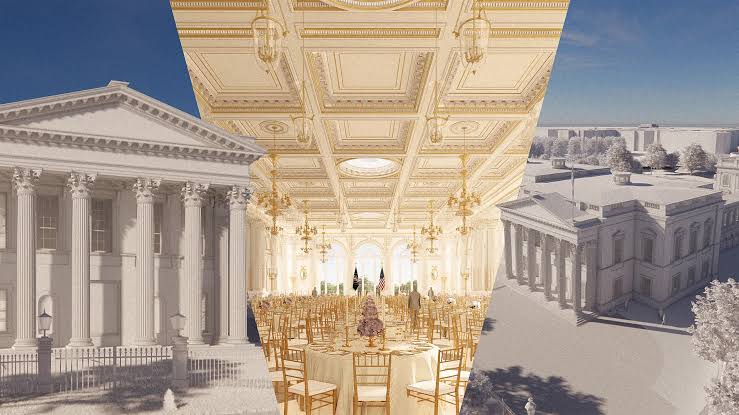
The centrepiece of Trump’s plans is a 90,000-square-foot ballroom adjacent to the White House.
According to the administration, the venue will accommodate up to 1,000 guests, eliminating the need for presidents to host large state events in temporary tents on the South Lawn.
Key details
- Approximately 90,000 square feet
- The estimated construction cost was initially placed at $400 million
- Later, accompanied by a request for $1 billion from Congress for additional security features
- Expected completion before the end of Trump’s current term
Trump has described the ballroom as “the greatest of its kind ever built”.
Why is it controversial?
The project has become one of the administration’s most debated initiatives because preservation groups argue it requires demolishing the historic East Wing, which housed the First Lady’s offices and the White House movie theatre.
Critics also question whether the president exceeded executive authority in approving such extensive changes to one of the country’s most historic buildings.
A federal lawsuit challenging the project remains ongoing.
Lincoln Memorial Reflecting Pool renovation
In April, Trump announced the renovation of the iconic Lincoln Memorial Reflecting Pool, one of Washington’s most recognisable landmarks.
The project reportedly cost more than $16 million.
What happened after the renovation?
Although Trump declared the project complete on June 6, reports soon emerged that:
- The paint was peeling
- Algae had spread through the water
- The pool turned green instead of maintaining its traditional reflective appearance
Administration officials blamed alleged vandalism, although no public evidence was presented to support that claim.
The reflecting pool is historically significant because it sits near the location where Martin Luther King Jr delivered his landmark “I Have a Dream” speech during the 1963 March on Washington.
Oval Office receives a gold makeover
Soon after returning to the office in January 2025, Trump began redesigning the Oval Office.
The changes include:
- Extensive gold accents
- Historic portraits placed throughout the room
- A framed copy of the Declaration of Independence
- Busts of Abraham Lincoln and Benjamin Franklin are positioned near the Resolute Desk
The redesign reflects Trump’s long-standing preference for ornate interiors, similar to those found at his Mar-a-Lago property in Florida.
Visitors to the White House have reportedly been given personal tours highlighting the renovations.
Rose Garden was transformed into a stone patio
Perhaps no outdoor project has generated more discussion than the redesign of the White House Rose Garden.
Trump replaced much of the traditional grass with a white stone patio featuring umbrella-covered seating areas.
According to the president, the redesign prevents visitors wearing high heels from sinking into soft ground during official events.
Additional changes include:
- Statues of Alexander Hamilton and Benjamin Franklin
- A Revolutionary War sculpture titled Freedom’s Charge
- Replacement of the historic Tennessee flagstone walkway with black granite
Portraits of every president line the White House
Another unusual addition is a gallery featuring portraits of all 47 U.S. presidents along the West Wing colonnade.
Each portrait reportedly includes a plaque describing the president from Trump’s perspective.
One of the most discussed changes involves former President Joe Biden.
According to reports, Biden’s portrait was replaced with an image of an autopen—a machine commonly used for signing official documents—a move critics described as political commentary rather than a historical presentation.
Trump has also installed large flagpoles on both the North and South Lawns.
What is the proposed Independence Arch?
Among Trump’s most ambitious proposals is the Independence Arch, a monument planned near the Potomac River.
Inspired by Paris’ Arc de Triomphe, the structure would be considerably larger.
Proposed features
- Approximately 250 feet tall
- Eagle sculptures
- A statue resembling Lady Liberty
- Location near the Lincoln Memorial across the Potomac River
If constructed at its proposed height, the monument would approach the height of the U.S. Capitol and surpass the Lincoln Memorial.
What are the concerns?
A structure of that size could interfere with aircraft approaching Ronald Reagan Washington National Airport.
Whether the final design proceeds as proposed remains uncertain.
Garden of American Heroes
Trump first proposed the National Garden of American Heroes during his first term.
Congress later approved $40 million for the project.
The outdoor memorial is planned for West Potomac Park and is intended to commemorate America’s 250th anniversary of independence.
Planned statues include
- Founding Fathers
- Military leaders
- Civil rights icons
- Religious figures
- Athletes
- Artists
- Entertainers
The project has missed its original opening deadline and remains tied up in legal challenges brought by preservation organisations.
Kennedy Center renovation sparks legal battle
The John F. Kennedy Center for the Performing Arts has also become a flashpoint.
A Trump-appointed board voted to rename the venue the Trump Kennedy Center, triggering widespread criticism.
Since then:
- Performances have reportedly been cancelled.
- Ticket sales have declined.
- Trump announced plans for a two-year renovation.
- A judge later ordered Trump’s name removed from the building and halted renovation plans.
Trump has since said he intends to transfer control of the institution to Congress, although questions remain over how that process would work legally.
East Potomac Golf Links overhaul
Trump, an avid golfer and owner of several golf properties, has proposed renovating Washington’s historic East Potomac Golf Links.
The administration hopes the redesigned course could eventually host major professional tournaments.
Construction has been targeted to begin on September 1, although lawsuits challenging the proposal remain unresolved.
Opponents argue the renovation may violate federal preservation and environmental laws.
Why are Trump’s Washington projects so controversial?
The debate extends beyond architecture.
Critics have raised concerns about:
- Federal spending priorities
- Historic preservation
- Procurement and contracting practices
- Executive authority
- Environmental impacts
- Public access to federal spaces
Supporters, meanwhile, argue the projects will create iconic landmarks, improve government facilities, and commemorate American history ahead of the country’s semiquincentennial celebration.
The legal outcomes of several ongoing court cases will likely determine how much of Trump’s vision ultimately becomes part of Washington’s landscape.
What happens next?
Some projects—such as the Oval Office redesign and portions of the Rose Garden renovation—have already been completed.
Others, including the White House ballroom, Independence Arch, Garden of American Heroes, and East Potomac Golf Links redevelopment, continue to face legal scrutiny or planning hurdles.
As Washington prepares for the United States’ 250th anniversary, Trump’s architectural agenda is likely to remain one of the most closely watched—and fiercely debated—aspects of his presidency.
