• About BreezyScroll
  • Privacy & Policy
  • Contact Us
Thursday, July 23, 2026
BreezyScroll
  • Home
  • Breezy Stories
  • Technology
  • Gaming
  • Entertainment
  • Lifestyle
  • World
  • Money
  • Sports
  • Breezy Explainer
No Result
View All Result
  • Home
  • Breezy Stories
  • Technology
  • Gaming
  • Entertainment
  • Lifestyle
  • World
  • Money
  • Sports
  • Breezy Explainer
No Result
View All Result
BreezyScroll
No Result
View All Result

Home  /  Science  /  James Webb Telescope captures formation of a ‘third world’ and potential moons 400 light-years away

James Webb Telescope captures formation of a ‘third world’ and potential moons 400 light-years away

by Jake Hoffman
April 4, 2024
in Science, Space
Reading Time: 2 mins read

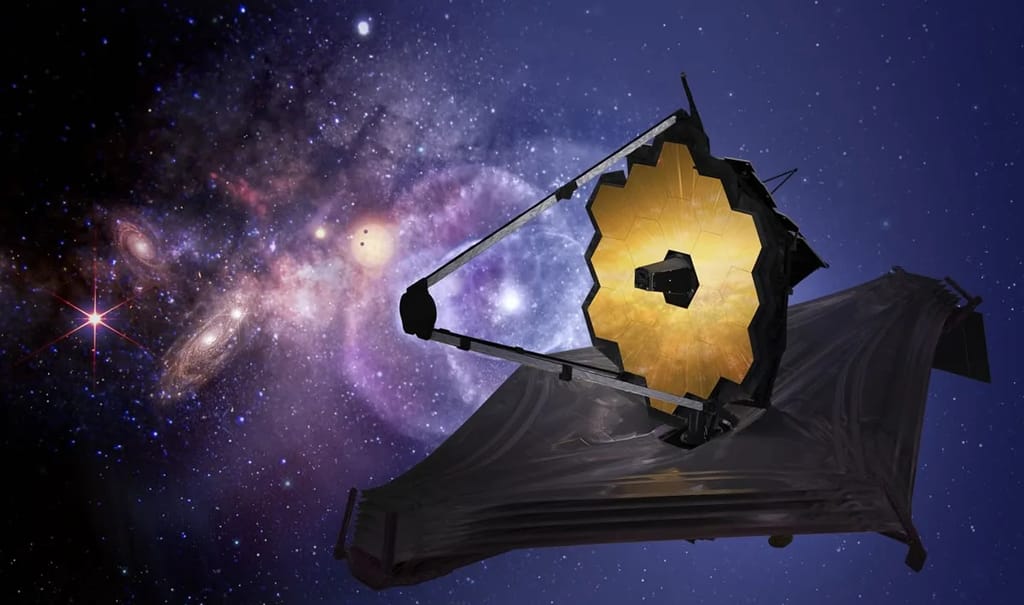
Astronomers using the James Webb Space Telescope (JWST) made a surprising discovery: They were able to see a third world being formed around the infant star PDS 70, some 400 light-years far away from Earth. The MIRI mid-infrared Disk Survey (MINDS) project recorded the formation of the “third world.”

Using JWST’s Near Infrared Camera (NIRCam), the scientists also observed a massive spiral stream of material that was accelerating the formation of an already discovered planet, PDS 70C.

“We found new evidence for the presence of a third planet in the system”

PDS 70C, a large planet, is surrounded by its disk of material, and the spiral stream is feeding it as well, resulting in the formation of its moons.

Valentin Christiaens, a MINDS team member and postdoctoral researcher at KU Leuven and the University of Liege, told Space.com “We found new evidence for the presence of a third planet in the system, which was proposed based on VLT observations.”

“Furthermore, the new infrared measurements we obtained for the two known protoplanets suggest the presence of heated material around them — which may be the building blocks for moons forming around them,” he said.

Astronomers studied the PDS 70 system using a variety of telescopes, including the ground-based Atacama Large Millimeter/submillimeter Array (ALMA) and the Very Large Telescope.

Astronomers have been attracted by the system since the protostar and its protoplanetary disk are likely less than 5.5 million years old.

“PDS 70 is special, as it is the only protoplanetary disk so far where all astronomers agree that we have found forming planets caught in the act,” said Christiaens.

“Detailed study of this system has thus allowed us to learn a lot about planet formation,” he added.

ADVERTISEMENT

The researchers need to gain more knowledge of the potential third planet’s attributes. If confirmed, the planet will be known as PDS 70D and will remain buried in a thick layer of dust.

“What is interesting is that this separation places it near 1:2:4 mean-motion resonance with planets PDS 70B and PDS 70C. This means its orbit would be almost exactly twice as short as B and four times shorter than planet C, respectively,” said Christiaens.

“This is a situation we know in the solar system with the three innermost Galilean moons of Jupiter: Io, Europa, and Ganymede,” the astronomer said. 

Tags: James Webb telescope
ShareTweetShareSend

Recent Articles

Hitler Birth House Reopens as Police Station in Austria to Deter Neo-Nazi Pilgrimages

Hitler Birth House Reopens as Police Station in Austria to Deter Neo-Nazi Pilgrimages

July 23, 2026
Why Odysseus Called Himself ‘Nobody’: The Ancient Greek Trick Behind Christopher Nolan’s The Odyssey

Why Odysseus Called Himself ‘Nobody’: The Ancient Greek Trick Behind Christopher Nolan’s The Odyssey

July 23, 2026
Why India’s 10% US Tariff Is Expiring And What Could Replace It

Why India’s 10% US Tariff Is Expiring And What Could Replace It

July 23, 2026
El Salvador

3,000-Year-Old Human Remains Found in El Salvador Could Rewrite Ancient Burial History

July 23, 2026
BreezyScroll Logo

BreezyScroll is a global content platform that provides a unique experience of enhancing the knowledge quotient for its audience by providing the latest news and updates from various categories such as politics, sports, entertainment, technology, and more.
The platform aims to provide a concise and easy-to-read format for its users. BreezyScroll covers news stories from around the world, majorly the United States. The platform was launched in 2021 and has become one of the fastest-growing content companies in the US.

Follow Us

Browse by Category

  • Africa
  • Alaska
  • Animals
  • Asia
  • Athletics
  • Australia
  • Auto
  • Basketball
  • Bollywood
  • Brand
  • Breezy Explainer
  • Breezy Feature
  • Breezy Soul
  • Business
  • Canada
  • Chess
  • China
  • Cricket
  • DIY
  • Education
  • Entertainment
  • Environment
  • EPL
  • Europe
  • Exclusive Interview
  • Exclusive Review
  • Football
  • Gaming
  • Health
  • Hollywood
  • India
  • International
  • K Pop
  • Law
  • Lifestyle
  • Middle East
  • Money
  • NFL
  • North America
  • OTT
  • Paris Olympics
  • Pets
  • Russia
  • Science
  • South America
  • Space
  • Sports
  • Startup
  • Technology
  • Tennis
  • Tennis
  • The Achievers
  • The US
  • Travel
  • UK
  • UK
  • Uncategorized
  • World
  • WWE

Trending Topics

Afghanistan AI Apple Australia Biden California Canada ChatGPT China Climate Change Donald Trump Elon Musk Featured Florida Google IPL Iran Japan Jeff Bezos Joe Biden Mars Meta Moon NASA NBA Netflix New York North Korea Ohio OpenAI Putin Russia Russia-Ukraine crisis South Korea SpaceX Taliban Tesla Texas TikTok Trump Twitter UFO UK Ukraine Virat Kohli

No Result
View All Result
  • About BreezyScroll
  • Privacy & Policy
  • Contact Us

© 2024 · BreezyScroll.com

No Result
View All Result
  • Home
  • Breezy Stories
  • Technology
  • Gaming
  • Entertainment
  • Lifestyle
  • World
  • Money
  • Sports
  • Breezy Explainer

© 2024 · BreezyScroll.com

Go to mobile version