
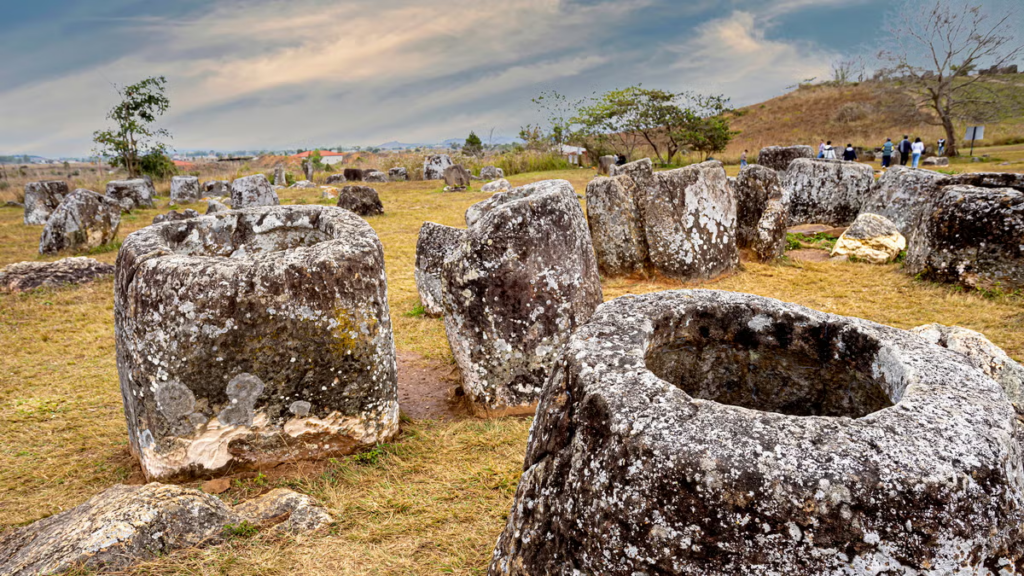
Archaeologists in northern Laos have uncovered one of the most intriguing discoveries yet at the enigmatic Plain of Jars—a massive stone container holding the remains of 37 ancient people. The unprecedented find is offering new clues about a civilization that lived nearly 1,000 years ago, while raising fresh questions about its mysterious burial rituals.
For decades, the Plain of Jars has fascinated archaeologists and historians alike. Scattered across the Xieng Khouang Plateau are thousands of giant stone jars, some weighing several tons, whose purpose has remained one of Southeast Asia’s greatest archaeological mysteries. Now, a newly excavated jar is shedding light on how these ancient monuments may have been used.
A Rare Discovery Inside a Giant Stone Jar
During excavations conducted between 2022 and 2024, researchers uncovered a massive megalithic stone vessel—known as Jar 1—measuring approximately 4 feet (1.2 meters) high and 7 feet (2.1 meters) wide.
Inside, archaeologists discovered the unburned skeletal remains of at least 37 individuals, making it the first known jar at the site to contain intact human bones instead of cremated remains.
Lead study author Nicholas Skopal described the discovery as a significant breakthrough, noting that previous investigations at similar jars had yielded only ashes and burned bones.
The finding provides researchers with an entirely new source of evidence for understanding the people who once inhabited the region.
Dating the Burial Site
Radiocarbon dating indicates that the jar was used repeatedly over several generations between AD 890 and AD 1160.
Researchers believe the vessel likely played an important role in ancient funerary practices. The arrangement of the remains suggests that larger bones and skulls were carefully placed along the outer edges of the jar rather than being randomly deposited.
The discovery points to a complex burial tradition rather than a single mass interment.
More Than Human Remains
The excavation also uncovered several artifacts buried alongside the bones, including:
- An iron knife
- A copper bell
- Stone slabs
- Earthenware fragments
- Glass beads
The glass beads may have served as ritual offerings placed with the deceased, although archaeologists caution that their exact purpose remains uncertain.
Was It Really a Burial Jar?
While many researchers believe the giant stone container functioned as part of a funerary ritual, not everyone agrees.
Archaeologist Kelly Brandão of the University of São Paulo and the Mamirauá Institute has urged caution, noting that there is currently no definitive evidence proving the jar was created specifically for burials.
The debate highlights how little is still known about the mysterious builders of the Plain of Jars.
A Two-Step Funeral Ritual?
Skopal has proposed a compelling theory to explain the unusual arrangement of the remains.
According to his hypothesis, the deceased may have first been placed in individual stone jars, where their bodies were left to decompose naturally. Once only the bones remained, family members may have gathered them and transferred them into a larger communal jar, creating a secondary burial.
One reason for this theory is the discovery of more teeth than matching skulls, suggesting bones may have been moved or reorganised after decomposition.
However, Skopal emphasises that this remains a working hypothesis rather than a confirmed explanation.
DNA Could Unlock the Mystery
The next phase of research focuses on extracting ancient DNA from the skeletal remains.
If successful, genetic analysis could reveal the following:
- Who these individuals were.
- Whether they were related.
- Where they originated.
- How they were connected to the broader communities that once lived across the region.
Scientists acknowledge that recovering usable DNA will be extremely challenging because the hot, humid tropical climate of Laos accelerates the breakdown of genetic material.
The Mystery of the Plain of Jars Continues
The Plain of Jars has puzzled researchers since it first attracted archaeological attention nearly a century ago. Despite decades of study, the purpose of its thousands of giant stone vessels remains unresolved.
This latest discovery represents one of the strongest pieces of evidence yet that at least some of the jars were involved in complex mortuary practices. At the same time, it underscores how much remains unknown about the ancient culture that created one of Southeast Asia’s most remarkable archaeological landscapes.
As researchers continue DNA testing and further excavations, the stone jar containing the remains of 37 individuals may provide crucial answers about a civilisation whose identity has remained hidden for centuries.