
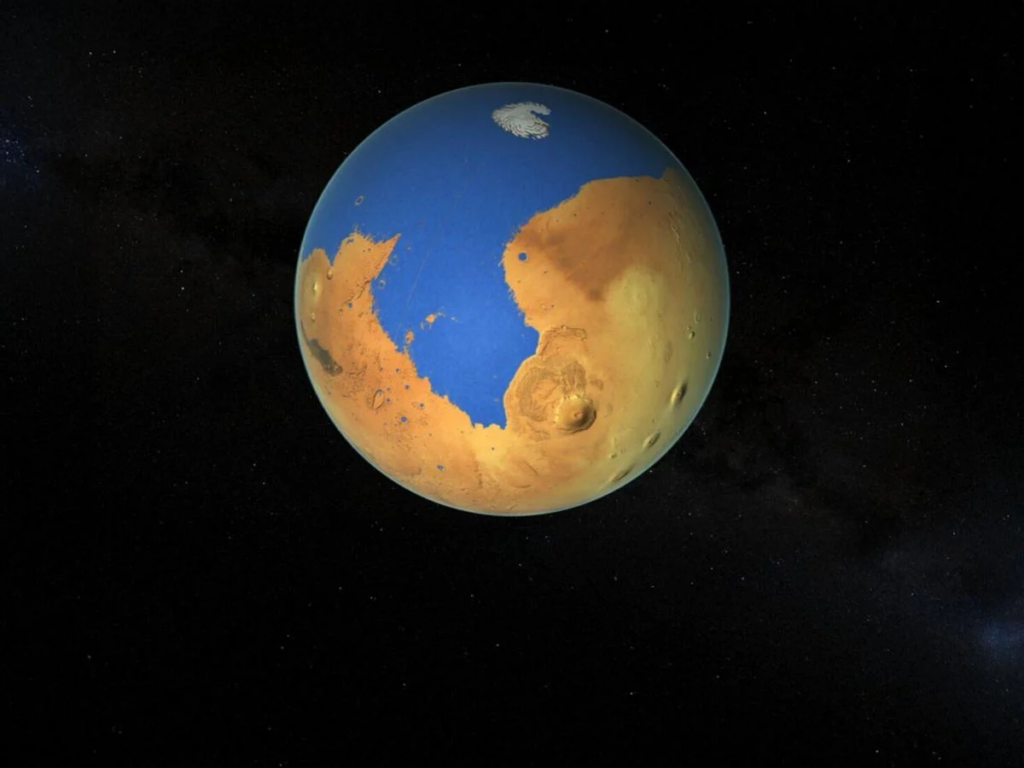
For decades, Mars has been defined by what it lacks: liquid water, a thick atmosphere, and the conditions needed to sustain life. But a new study by Swiss scientists is adding weight to a radical idea that keeps resurfacing in planetary science—that Mars was once a “blue planet,” much like Earth, complete with a massive ocean spanning much of its surface.
Researchers now say they have found direct geological evidence of a vast ancient ocean on Mars, comparable in size to Earth’s Arctic Ocean, along with what appears to be a preserved coastline and river deltas. If confirmed, the findings strengthen the case that Mars once had the conditions necessary to support life.
What does the new Mars study claim?
Scientists from the University of Bern and INAF, Osservatorio Astronomico di Padova, propose that Mars hosted its largest and deepest ocean yet identified, covering much of the planet’s northern hemisphere around three billion years ago.
Unlike earlier hypotheses that relied heavily on indirect clues, this study points to clear, high-resolution geological structures that resemble coastal landforms on Earth.
Key findings at a glance
- Evidence of a vast ocean similar in size to Earth’s Arctic Ocean
- Identification of a coastline and river delta-like formations
- Signs that water once flowed into the ocean from large rivers
- The ocean likely existed around 3 billion years ago
Where was this ancient Martian ocean located?
The proposed ocean stretched across Mars’ northern lowlands, a region long suspected to have held large bodies of water. What’s new is the level of detail researchers were able to achieve.
One of the most compelling areas lies near Valles Marineris, the largest canyon system in the solar system, located close to the Martian equator.
Why Valles Marineris matters
Previous observations had already suggested that:
- Major rivers once flowed through the region
- Water activity shaped the surrounding terrain
The new study goes further, identifying structures near the canyon system that closely resemble river deltas on Earth—including what appears to be the mouth of a river emptying into an ocean.
“These structures are clearly the mouth of a river into an ocean,” said Fritz Schlunegger, Professor of Exogenous Geology at the University of Bern.
How is this evidence different from earlier Mars ocean theories?
The idea of ancient Martian oceans is not new. What sets this research apart is the quality and precision of the data.
A shift from indirect to direct evidence
According to Schlunegger:
“We are not the first to postulate the existence and size of the ocean. However, earlier claims were based on less precise data and partly on indirect arguments.”
This study reconstructed ancient sea levels using high-resolution imaging, allowing scientists to identify what they describe as a distinct coastline—a key marker of long-standing oceans on Earth.
Why coastlines matter
On Earth, coastlines form through sustained interaction between land and water over long periods. Finding similar features on Mars suggests:
- Water was stable, not fleeting
- The ocean existed long enough to shape the planet’s surface
- Mars once had a more Earth-like climate system
Even today, Schlunegger notes, the region is blanketed by dust dunes—but the original coastal shapes are still visible beneath them.
What technology did scientists use to find the ocean?
The discovery was made possible by combining data from multiple high-precision space missions.
Key instruments and missions
- CaSSIS camera aboard ESA’s ExoMars Trace Gas Orbiter
- Data from ESA’s Mars Express
- Imaging from NASA’s Mars Reconnaissance Orbiter
The CaSSIS (Colour and Stereo Surface Imaging System) camera was especially critical, providing detailed stereo images that allowed researchers to analyze surface structures in three dimensions.
How large was the ancient Martian ocean?
The researchers estimate the ocean was comparable in size to Earth’s Arctic Ocean, making it the largest body of water ever proposed on Mars.
Why size matters
A larger ocean implies:
- A significant volume of water is stored on the planet
- A thicker atmosphere in Mars’ past to sustain liquid water
- A longer window during which life could potentially emerge
Schlunegger added that this was likely the deepest and most extensive ocean Mars ever had.
Could Mars have supported life?
This is where the discovery becomes especially compelling.
What scientists say
Ignatius Argadestya, a PhD student at the University of Bern involved in the study, said the findings reinforce the idea that Mars was once habitable:
“We know Mars as a dry, red planet. However, our results show that it was a blue planet in the past, similar to Earth.”
Liquid water is considered one of the most critical ingredients for life. An ocean of this scale, combined with rivers and deltas, would have created stable environments where microbial life could potentially develop.
A cautionary lesson from Mars
Argadestya also pointed to a broader implication:
“This finding also shows that water is precious on a planet and could possibly disappear at some point.”
In other words, Mars may serve as a long-term case study of planetary climate collapse.
Why this discovery matters for future Mars missions
Understanding where large bodies of water once existed can help guide future exploration.
Implications for space exploration
- Targeted landing sites for life-detection missions
- Better models of Mars’ climate evolution
- Insights into why Mars lost its water—and whether Earth could face similar risks
Regions with ancient coastlines and deltas are considered among the most promising places to search for biosignatures.
TL;DR: What this Mars discovery tells us
- Swiss scientists have found strong evidence that Mars once had a massive ocean
- The ocean was similar in size to Earth’s Arctic Ocean
- High-resolution images reveal coastlines and river deltas
- The ocean likely existed around 3 billion years ago
- The findings strengthen the case that Mars could once have supported life