
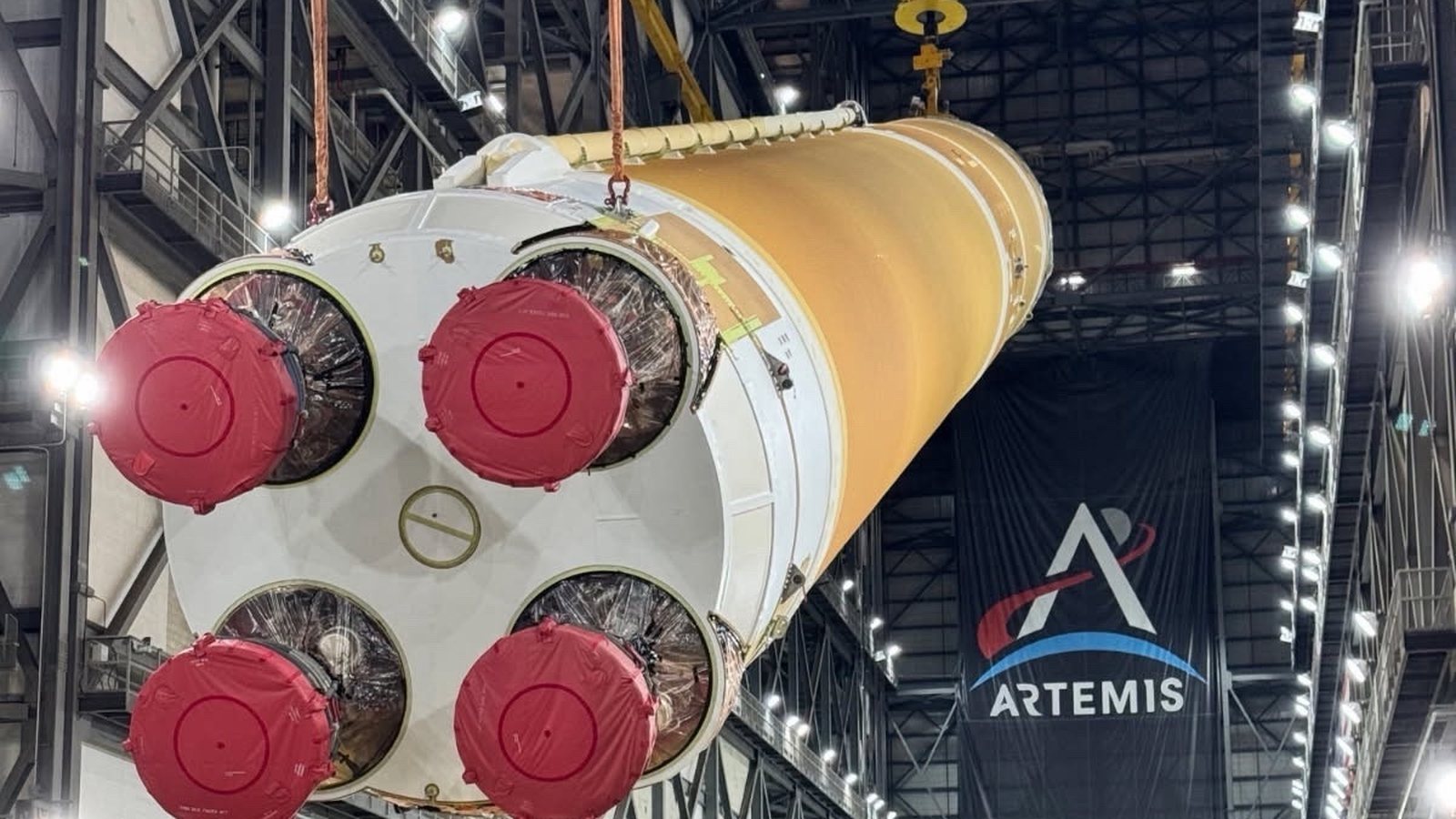
Artemis III will not land on the moon. NASA’s next crewed Artemis flight will instead spend 14 to 17 days in low Earth orbit in 2027. Its four astronauts will dock with test versions of two commercial moon landers, according to Payload. The first Artemis landing now belongs to Artemis IV, targeted for 2028.
NASA laid out the flight at an “Artemis Acceleration” news conference in Florida on October 23, the agency said. The change itself dates from February, but many people still picture Artemis III as the return to the lunar surface. That was true for most of the program’s life.
How the first landing slipped from 2024 to Artemis IV
The target has changed five times since 2019. We pulled each public announcement into one timeline:
2019: The Trump administration set 2024 as the target for putting Americans back on the moon, CBS News reported.
November 2021: Then-Administrator Bill Nelson said, “We are estimating no earlier than 2025 for Artemis 3.” He blamed thin funding and nearly seven months lost to Blue Origin’s lawsuit over SpaceX’s lander contract.
January 2024: NASA moved Artemis III to September 2026. It said partners needed more time on the lander and spacesuits.
December 2024: It slipped again, to mid-2027.
February 27, 2026: NASA turned Artemis III into an Earth-orbit test for mid-2027 and moved the landing to Artemis IV in early 2028. It also dropped a bigger upper stage and a second mobile launcher, citing delays.
April 27, 2026: Administrator Jared Isaacman told House appropriators he had responses from both lander companies “to meet our needs for a late 2027 rendezvous, docking and test,” Space.com reported.
Counted from the original goal, the first landing has slid at least four years. The 2028 target has held since mid-2025, NASA says, but the mission carrying it has changed.
Artemis II went first. In April its crew flew 10 days around the moon and traveled farther from Earth than any humans before. We covered that flight in our story on the Artemis II commander’s tense moment.
Three rockets, two landers, one crew
Artemis program manager Jeremy Parsons walked through the flight day by day. “We’re launching three of the most powerful rockets in the world, and undertaking what is likely the most complicated launch campaign ever undertaken,” he said, per Space.com.
Blue Origin’s New Glenn launches first, carrying an uncrewed Blue Moon test lander to orbit. NASA’s Space Launch System (SLS) then launches Orion with the crew. NASA named the crew in June, the AP reported. Randy Bresnik commands, Luca Parmitano of the European Space Agency is pilot, and Andre Douglas and Frank Rubio fly as mission specialists.
On flight day 3, Orion docks with Blue Moon about 273 miles up. Over the next two days the crew opens the hatch and goes inside. “They’re going to evaluate the environmental controls, the life support systems,” Parsons said. They will also test emergency scenarios and how the two docked vehicles are flown together.
Starship launches around day 6 with a docking adapter on its nose and meets Orion on day 8. That encounter lasts about two hours, and nobody goes aboard. The crew spends the rest of the flight testing Orion and new survival suits before splashing down.
What an Earth-orbit test can prove, and what it can’t
The test answers a narrow question. Can spacecraft built by three organizations find each other, latch on and work as one vehicle? A NASA explainer from July lists the specifics. Orion acts as the chaser, and teams will check docking hardware, software and how the joined stack handles in flight.
Orion’s software flies the combined vehicle during the Blue Origin phase. SpaceX’s vehicle takes control during its phase. Up to two astronauts will enter Blue Moon, whose test article carries a working life-support system and crew cabin.
It also rehearses the ground side. Three rockets must launch from Florida within a short window. Control teams at NASA and both companies then run one flight together.
Doing all of that near Earth buys a fast way home. Low Earth orbit is a place “where if something goes wrong, we can come home much more quickly,” Parsons said.
What the flight can’t prove is the hard part of a landing. Nobody lands, and nobody rides Starship.
The flight also won’t test refueling in orbit. Both landers need that to reach the moon, and no spacecraft has done it yet, Space.com noted. SpaceX plans a separate propellant-transfer demonstration in early 2027, Payload reported.
Artemis III is a docking and systems check. The riskiest steps of Artemis IV will be tested elsewhere.
Why NASA is racing China to 2028
Isaacman framed the schedule around China. He has predicted China will fly a crew around the moon in 2027, Payload reported. “This race will be much closer than it ever needed to be,” he said on Friday. “We will never launch until we are ready,” he added.
The schedule is already tight. Last month Isaacman told NASA staff that Artemis III is about 90 days behind, Space.com and Payload reported. Parsons pointed to supply-chain problems with the landers as some of the biggest hurdles.
Both landers carry their own risk. Blue Origin hasn’t flown New Glenn since a launch pad explosion in May, Payload reported. Starship only reached orbit in September. Parsons said each company will fly several more times before Artemis III.
The stakes reach beyond NASA’s calendar. The rivalry also covers what comes after landing. Our explainer on lunar nuclear power plants shows the US, China and Russia racing to build on the moon.
Artemis IV’s lander is still undecided
NASA has not chosen which lander will carry Artemis IV’s crew to the surface near the south pole. It showed two mission plans on Friday, one with SpaceX’s Starship and one with Blue Origin’s Blue Moon Mark 2.
On a Blue Origin flight, Orion would meet the lander in lunar orbit. On a SpaceX flight, Starship would likely dock with Orion near Earth and push it moonward, Parsons said. Isaacman said NASA won’t give up “a viable path to the surface before the data and schedule compels us to do so.”
NASA hasn’t set a launch date for Artemis III. Space.com reports a summer 2027 target. NASA’s lander office listed the third quarter of 2027 in an early October presentation. Before that, watch for New Glenn’s return to flight and SpaceX’s orbital refueling demonstration in early 2027.