
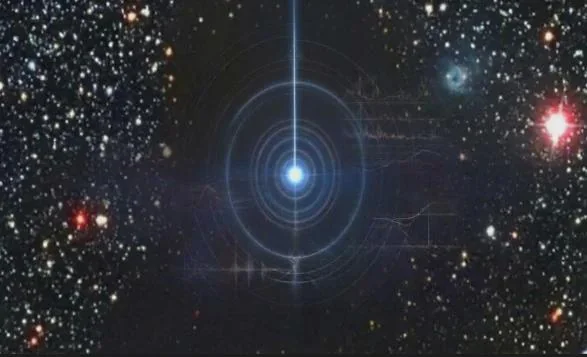
The universe is filled with galaxies, stars, and clouds of gas, but some regions appear almost completely empty even when viewed through the most powerful telescopes. Now, the James Webb Space Telescope (JWST) has detected an unusual signal in one such region — and the mystery deepened when the signal appeared again nearly three months later.
The discovery emerged from observations of the Hubble Ultra Deep Field, a small patch of sky that the Hubble Space Telescope studied for more than 270 hours. Those observations revealed nearly 10,000 galaxies, demonstrating how much of the distant universe can be hidden within what looks like an unremarkable, dark area of sky.
Researchers later turned JWST’s sensitive infrared instruments toward the same field, hoping to uncover faint objects that Hubble might have missed. Instead, they found a bright emission line at a wavelength of approximately 1.6 micrometers, with no clearly identified object to explain it.
The signal appeared in observations taken 88 days apart in 2023. Although the finding does not establish the presence of an unknown astronomical object, its repeated detection has made it difficult to dismiss as an ordinary instrumental glitch.
The research, published in The Astrophysical Journal, highlights a central challenge in astronomy: detecting a signal is one thing; determining what produced it can be much harder.
What Did the James Webb Space Telescope Detect?
The JWST observations revealed a single, unusually bright emission line in a tiny region of the Hubble Ultra Deep Field. The signal appeared in two observing sessions, separated by 88 days, without an obvious galaxy or other astronomical object at the same position.
An emission line occurs when atoms or ions release energy at specific wavelengths. Astronomers use these features to identify chemical elements, measure the motion of objects, and estimate how far away distant galaxies are.
Most astronomical sources produce more than one useful spectral feature. When researchers identify several lines, they can compare their wavelengths with known atomic transitions to determine what kind of object they are observing.
In this case, the researchers found a bright line at about 1.6 micrometers but no accompanying emission lines that could establish its identity.
That absence is the central puzzle. The signal was strong enough that astronomers would ordinarily expect it to be associated with a detectable source or other supporting evidence.
The team considered several possibilities, including a distant galaxy, a nearer galaxy, a supernova, or a black hole disrupting a star. None provided a satisfactory explanation for all the observed features.
For now, the signal remains an astronomical anomaly rather than evidence of a confirmed new class of object.
Why Is This Patch of Space So Mysterious?
The region lies within the Hubble Ultra Deep Field, one of the most extensively studied areas of the night sky.
The field was selected because it contains relatively few nearby, bright objects that would obscure faint galaxies in the distant universe. By collecting light over long periods, astronomers were able to reveal objects that would otherwise be too faint to see.
What is the Hubble Ultra Deep Field?
The Hubble Ultra Deep Field, often abbreviated as HUDF, is an image assembled from extensive observations by the Hubble Space Telescope. Its extraordinary depth revealed thousands of galaxies, including objects whose light has traveled for billions of years before reaching Earth.
Looking deeper into space also means looking further back in time. Because light takes time to travel, astronomers observe distant galaxies as they appeared in the past rather than as they exist today.
JWST was designed to extend this kind of investigation, particularly by detecting infrared light from faint and distant objects. Its instruments can observe wavelengths that are difficult or impossible for Hubble’s optical instruments to capture with the same sensitivity.
Astronomers therefore expected Webb to reveal sources that had remained hidden in Hubble’s images. The unexplained signal, however, presented a different problem: a spectral feature appeared where the available imaging showed no identifiable source.
Does an apparently empty region mean nothing is there?
No. A dark patch in a telescope image does not necessarily represent empty space.
An object might be too faint, too small, or too diffuse to distinguish from the background. Dust can obscure visible light, while extremely distant galaxies can appear faint because their light has been stretched to longer wavelengths by the expansion of the universe.
Different instruments also have different sensitivities and resolutions. An object that is invisible in one image might leave a measurable signature in a spectroscopic observation.
The researchers acknowledge that a faint source could exist at the signal’s location without being clearly visible in the available images. That possibility makes the discovery intriguing, but it also means the absence of a visible object cannot itself identify the source.
How Did JWST Find the Signal?
The discovery was made using JWST’s Near-Infrared Spectrograph, or NIRSpec, with an observing technique called Multiobject Coronagraphy for Slitless Spectroscopy (MOCSS).
Instead of focusing only on known galaxies, the researchers designed their observations to search a wider area for emission lines that might reveal previously unidentified sources. They also closed the instrument shutters covering known foreground objects, reducing contamination from their light.
The strategy produced six detections that could be matched to distant galaxies already identified in the Hubble Ultra Deep Field. A seventh signal, however, had no corresponding known source.
According to the research paper, the line appeared at approximately 1.60 micrometers, with a measured flux of \(2.5 \pm 0.3 \times 10^{-18}\) erg s\(^{-1}\) cm\(^{-2}\). It was recorded in four different dither positions and two instrument orientations, strengthening the case that the signal was real rather than an instrumental artifact.
The observations were collected in August and November 2023, 88 days apart. The repeat detection makes the signal especially interesting: researchers are not simply dealing with a one-off bright pixel in an image.
However, confirming that a signal is real does not automatically reveal its origin. The next challenge is determining which physical process could produce such a strong, isolated spectral feature without a clearly visible source.
What Could Be Producing the Mysterious Emission Line?
Astronomers use the wavelength of an emission line to identify the atomic transition responsible for it. If the source is moving away from Earth as the universe expands, the light can be stretched toward longer wavelengths, a phenomenon known as cosmological redshift.
A line observed at 1.60 micrometers could therefore originate from several different transitions at different distances. But each proposed explanation must also account for the lack of other expected lines and the absence of a detectable source in the images.
The research team examined several possibilities.
Could it be a distant galaxy?
A galaxy in the early universe could produce strong emission lines from ionized gas. Yet identifying its distance requires matching the observed feature to a known transition.
The researchers considered possibilities including the [O II], [O III], H-alpha, and Lyman-alpha lines. At the corresponding redshifts, however, the observed line’s extreme strength relative to the missing continuum emission, combined with the absence of other expected lines, makes these explanations difficult to reconcile with the data.
That does not prove that a galaxy is impossible. It means the simplest interpretations do not adequately explain the observations.
Could a black hole be responsible?
A supermassive black hole surrounded by hot, energetic gas can produce intense emission across a broad range of wavelengths. Such systems, known as active galactic nuclei, sometimes exhibit unusually strong spectral features.
A black hole could therefore be worth investigating, particularly if the signal originates from a source too faint to appear clearly in existing images.
However, the researchers have not established that a black hole produced the line. Additional spectral features or evidence of activity would be needed to support that interpretation.
Could it be a transient event?
Another possibility is a temporary astronomical event, such as a supernova or a star being torn apart by a black hole. These events can briefly produce bright emission from material heated to extreme temperatures.
A transient source could help explain why no obvious object appears in deep imaging. But the signal’s detection in observations separated by 88 days means researchers must determine whether its behavior fits the expected evolution of the proposed event.
A transient explanation remains a possibility, not a confirmed identification.
Why Can’t Scientists Identify the Source Yet?
The central difficulty is that astronomers have detected a spectral feature without identifying the object that produced it.
Ordinarily, researchers build a case by combining several kinds of evidence:
- Multiple spectral lines: Different atomic transitions can establish an object’s chemical composition and help determine its distance.
- Visible or infrared imaging: A source’s position and appearance can help distinguish a galaxy, star, or other astronomical object.
- Changes over time: Repeated observations can reveal whether a source is stable, variable, or associated with a short-lived event.
- Independent observations: Follow-up measurements can establish whether the signal persists and whether other instruments detect supporting evidence.
In this case, the absence of a visible counterpart and additional spectral lines makes identification unusually difficult. The researchers estimate a very high lower limit for the line’s equivalent width, a measure of line strength relative to the surrounding continuum. That result further restricts the range of plausible explanations.
The team describes the source as highly unusual because it appears to require extreme physical conditions. More observations will be necessary to establish whether the signal comes from an unusual galaxy, an energetic transient, an active black hole, or another process.
What Happens Next?
The most useful next step is to collect additional observations capable of distinguishing between competing explanations.
Astronomers could use JWST to obtain more detailed spectra, searching for additional emission lines that would help identify the source and measure its redshift. Repeated observations could also reveal whether the signal changes in brightness or disappears entirely.
Observations at other wavelengths may provide further clues. X-ray measurements, for example, could help test certain black-hole-related scenarios, while deeper infrared imaging might reveal a faint galaxy at the signal’s position.
The research paper establishes that the signal is difficult to explain using familiar astronomical sources. It does not establish that the signal comes from an entirely new type of object.
That distinction matters. In astronomy, an unexplained observation can be scientifically valuable without requiring a radical revision of existing theories. Sometimes the answer is an unusual combination of known processes; sometimes it exposes a genuine gap in current understanding.
The Bottom Line: A Real Signal, but an Unsolved Mystery
JWST’s repeated detection of an emission line in an apparently empty region of the Hubble Ultra Deep Field has given astronomers a compelling puzzle. The signal appeared at approximately 1.6 micrometers in observations separated by 88 days, yet neither Hubble nor JWST imaging has revealed an obvious source.
The research team has investigated several explanations, including distant galaxies, supernovae, and black-hole-related events, but none fully accounts for the available evidence.
The finding demonstrates the value of looking beyond known objects. By deliberately searching for spectral features rather than limiting observations to cataloged galaxies, astronomers can uncover phenomena that conventional surveys might overlook.
For now, the signal’s origin remains unknown. The next breakthrough will depend not simply on detecting it again, but on finding enough additional evidence to explain what produced it.