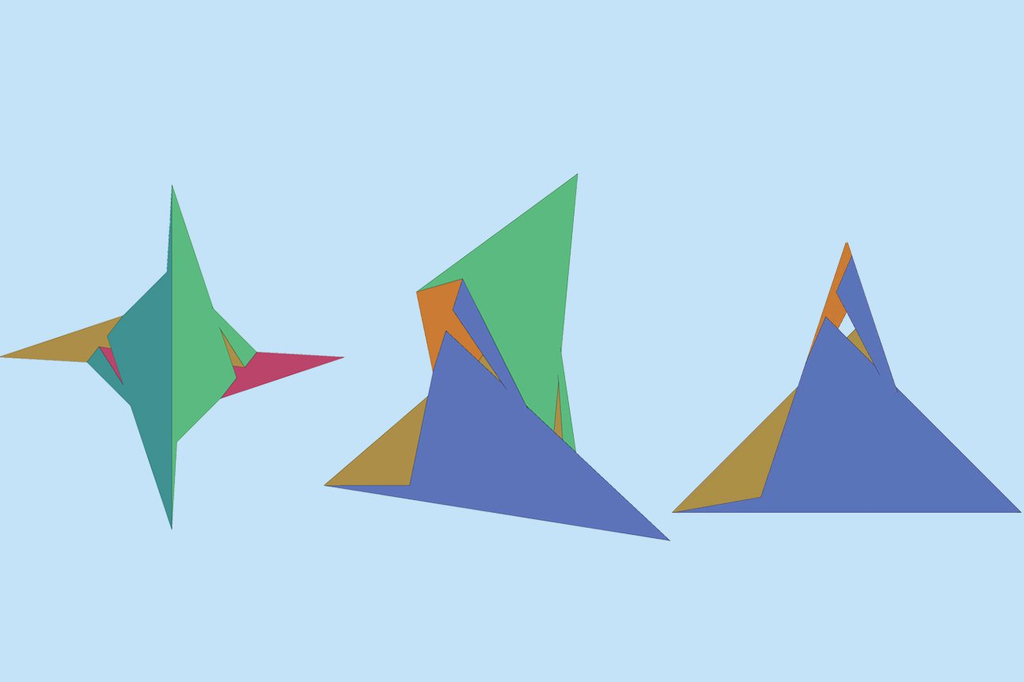
Mathematicians have produced a three-dimensional shape that looks less like a familiar solid and more like a geometric puzzle designed to break your brain. Called a genus-3 polyhedron, the structure has eight flat faces, 24 vertices and three topological holes.
The shape was constructed by independent researcher Ruslan Mizhaev, who published an exact integer-coordinate realization of it in a September 2026 preprint. The work provides the coordinates, face definitions and mathematical checks needed to reproduce the object in three-dimensional space.
There is, however, an important correction to some early reports about the shape. The verified construction has 36 edges, not 26. The 36-edge count follows directly from the eight nine-sided faces and is explicitly stated and verified in Mizhaev’s preprint.
The result is unusual not simply because it has three holes, but because of how tightly its eight faces are connected. Every face shares an edge with every other face. Twenty pairs of faces share one edge, while eight pairs share two edges.
What is the genus-3 polyhedron?
The genus-3 polyhedron is a type of non-convex polyhedral surface. Unlike a cube, which encloses a solid region without any holes, this structure has a topology with three handles.
In mathematical language, its genus is 3. Genus describes the number of independent holes or handles in a closed orientable surface. A sphere has genus 0, while the familiar doughnut-shaped torus has genus 1.
The new structure therefore sits several steps beyond the ordinary shapes encountered in elementary geometry.
Its eight faces are not triangles, squares or pentagons. Each face is a nine-sided polygon, known as a nonagon. The mathematical notation for the structure is {9,3}: every face has nine edges, and exactly three faces meet at each vertex.
The shape’s key numbers
- Faces: 8
- Shape of each face: nine-sided polygon, or nonagon
- Vertices: 24
- Edges: 36
- Genus: 3
- Faces meeting at each vertex: 3
- Face pairs sharing one edge: 20
- Face pairs sharing two edges: 8
These numbers are not arbitrary. They fit together through the mathematics of polyhedral surfaces.
Why does the shape have three holes?
One of the simplest ways to understand the topology is through Euler’s characteristic.
For a closed orientable surface, the relationship is:
χ = V − E + F
For a surface with genus g:
χ = 2 − 2g
Using the verified counts for Mizhaev’s construction gives:
χ = 24 − 36 + 8 = −4
Therefore:
−4 = 2 − 2g
which gives:
g = 3
That is where the term genus-3 comes from. The three holes are not simply three openings that happen to appear in a complicated object. They are a fundamental property of the surface’s topology.
The calculation also exposes why the reported figure of 26 edges cannot describe this particular construction. With eight nine-sided faces, there are 8 × 9 = 72 face-edge incidences. Because every edge belongs to two faces, those incidences correspond to 36 distinct edges. Mizhaev’s paper independently confirms the same count.
How can eight faces be connected to every other face?
This is arguably the strangest feature of the construction.
With eight faces, there are 28 possible pairs of faces. The polyhedron is arranged so that all 28 pairs share at least one edge.
Twenty of those pairs share exactly one edge. The remaining eight pairs share two edges each.
That produces 36 shared-edge relationships in total:
20 + (8 × 2) = 36
So the apparently bizarre edge count is actually a consequence of the way the faces interact.
In graph-theory terms, the underlying simple face-adjacency graph is the complete graph K8. Each of the eight faces is therefore adjacent to all seven of the others. When pairs that share two edges are counted with multiplicity, the structure has 36 edges in its dual multigraph.
This makes the object particularly interesting to mathematicians studying the relationship between geometry, topology and graph theory.
Is this really a “new” shape?
The answer needs some nuance.
Mizhaev’s September 2026 work does not appear to be the first description of the underlying genus-3 construction. His current paper says it is based on an earlier construction from 2020.
What is new in the 2026 preprint is an exact, self-contained integer-coordinate realization. In other words, Mizhaev provides numerical coordinates and plane equations that allow the geometric object to be checked and reproduced directly.
The distinction matters because mathematicians can describe an abstract arrangement of faces and edges before demonstrating that it can actually be embedded in ordinary three-dimensional space without unwanted intersections.
Mizhaev’s latest work performs exact checks of the coordinates, face planarity, topology and intersections. The paper says these calculations confirm that the eight faces form a closed, orientable surface with no unintended intersections.
The research remains a preprint rather than a peer-reviewed journal publication, so its claims should be treated accordingly.
What makes the construction mathematically difficult?
Creating an object with a specified number of faces is relatively straightforward. Creating one that simultaneously satisfies a long list of constraints is another matter.
Here, the researcher had to ensure that:
- All eight faces remain planar.
- Every face has nine sides.
- Exactly three faces meet at each vertex.
- The surface closes properly.
- Each edge belongs to exactly two faces.
- Every pair of faces shares an edge.
- The faces do not accidentally intersect elsewhere.
- The resulting surface has genus 3.
The preprint supplies 24 integer-coordinate vertices and equations defining the eight supporting planes. It then uses exact calculations to verify the construction.
The use of integer coordinates is particularly useful because the construction can be checked without relying on approximate floating-point calculations. That makes it possible to reproduce the geometry using computer algebra or computer-aided design software.
How does it compare with familiar polyhedra?
A cube has six square faces, 12 edges and eight vertices. A conventional octahedron has eight triangular faces, 12 edges and six vertices.
Mizhaev’s object also has eight faces, which is why the paper calls it an “octahedron” in the combinatorial sense. But that does not mean it looks like the familiar regular octahedron.
Instead, its eight faces are nonagons, and its surface has three handles. It is therefore a radically different geometric object despite sharing the same number of faces as an ordinary octahedron.
An especially useful comparison is the Szilassi polyhedron, a toroidal polyhedron discovered by Hungarian mathematician Lajos Szilassi in 1977.
The Szilassi polyhedron has seven hexagonal faces, 14 vertices and 21 edges. Like Mizhaev’s construction, every face shares an edge with every other face. It has genus 1, meaning it has the topology of a doughnut.
The genus-3 construction takes this idea into considerably more complicated territory, using eight faces while producing a surface with three handles.
Could a shape like this exist in nature?
That remains an open and more complicated question.
Mathematics can establish that a geometric construction exists without showing that nature has independently produced the same structure.
Mizhaev’s preprint demonstrates a valid mathematical realization in three-dimensional space. Whether an identical or equivalent structure occurs naturally would require evidence from physical systems, crystallography, materials science or other areas of science.
For now, the significance of the object is mathematical rather than geological or biological.
It also illustrates an important point about geometry: “discovering” a shape does not necessarily mean finding an unknown object somewhere in the natural world. Sometimes the discovery lies in proving that a set of seemingly incompatible geometric conditions can coexist.
Why does the genus-3 polyhedron matter?
The construction gives mathematicians another example for studying how surfaces, graphs and three-dimensional geometry interact.
Mizhaev describes equivelar polyhedra as useful for examining connections between combinatorial topology, graph theory and three-dimensional geometry. The genus-3 example is particularly interesting because it packs an unusually dense pattern of face adjacency into a relatively small number of faces.
It also demonstrates why a simple list of numbers can hide surprisingly complicated mathematics.
Eight faces sounds manageable. Twenty-four vertices sounds manageable. Even 36 edges does not sound extraordinary on its own.
Put those elements together, however, and demand three holes, nine-sided faces, three faces meeting at every vertex and every face touching every other face, and the geometry becomes considerably more demanding.
The resulting object is less a new household shape than a mathematical proof made visible in three dimensions.
Bottom line
The genus-3 polyhedron is a striking example of how far three-dimensional geometry can be pushed. It has eight nonagonal faces, 24 vertices, 36 edges and a surface with three handles.
And one number is worth remembering when discussing the construction: 36, not 26.
The current preprint provides an exact coordinate realization and mathematical verification, while the underlying construction dates back to earlier work by Mizhaev. Because the latest research is still a preprint, independent peer review remains an important next step.
For readers staring at the resulting model and wondering whether geometry has finally gone off the rails, the mathematics says otherwise. The object may look impossible, but its strange appearance is precisely what makes the construction interesting.