
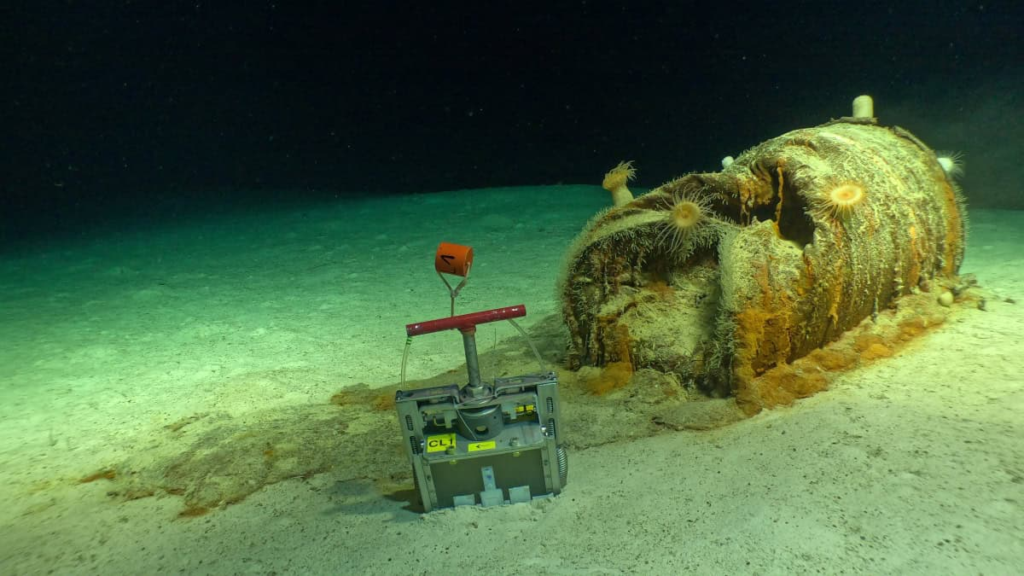
More than 200,000 barrels containing radioactive waste were dumped into the Northeast Atlantic over several decades. Now, scientists are going back to the deep ocean to find out what happened to those containers — and whether radioactive material has entered the surrounding ecosystem.
The research is being conducted under NODSSUM, a French-led scientific project involving the CNRS, Ifremer, France’s nuclear safety authority and international research partners. The project has already completed two major expeditions, in 2025 and 2026, using autonomous robots, sonar and the crewed deep-sea submersible Nautile.
The latest expedition did not simply search for barrels. Scientists descended to nearly 4,700 meters below the surface, directly inspected containers and collected samples from their surroundings to understand how decades of corrosion and leakage may be affecting the deep-sea environment.
Why were radioactive waste barrels dumped into the Atlantic?
The dumping took place during an era when the deep ocean was viewed very differently from today.
From the 1950s through the late 20th century, European countries disposed of large quantities of low-level radioactive waste at sea. The material was placed in metal drums, often encapsulated in substances such as bitumen, concrete or cement, and dumped in designated areas of the Northeast Atlantic.
At the time, the extreme depth and remoteness of the abyssal plains were considered important safeguards.
The dumping locations were thousands of meters below the surface and hundreds of kilometers from land. Scientists knew comparatively little about life at those depths, and the assumption was that the material would remain isolated from humans and most marine ecosystems.
That assumption has not aged well.
Modern oceanography has shown that the deep seafloor is not a lifeless wasteland. It contains complex ecosystems populated by microorganisms, crustaceans, fish and other organisms.
How much radioactive waste is at the bottom of the Atlantic?
The figure most frequently cited by the NODSSUM project is more than 200,000 barrels.
CNRS says the barrels were dumped in the Northeast Atlantic at depths generally between about 3,000 and 5,000 meters. The primary dumping area under investigation covers roughly 14,500 square kilometers.
The barrels did not all necessarily contain the same material or have the same condition.
The waste was generally classified as low-level radioactive waste and was often embedded in materials intended to provide additional containment.
But after decades underwater, some containers have deteriorated substantially.
That is what researchers are now trying to understand.
What did scientists discover on the seafloor?
The first NODSSUM expedition in 2025 used the autonomous underwater vehicle UlyX to map part of the dumping zone.
The robot surveyed approximately 165 square kilometers of seabed — less than 2 percent of the roughly 14,500-square-kilometer area — using high-resolution sonar. More than 3,500 barrels were identified during that survey.
The barrels appeared in patterns corresponding to the routes taken by ships that carried out the dumping operations.
That discovery provides scientists with a much clearer picture of where the containers are concentrated.
It also revealed just how difficult it would be to inspect the entire site.
The 3,500 barrels represent only a fraction of the estimated total, and the mapping covered less than 2 percent of the suspected dumping area.
What happened during the 2026 expedition?
The second campaign took place from May 27 to June 28, 2026.
Around 30 scientists worked aboard the French research vessel Pourquoi Pas? The crewed submersible Nautile conducted 20 dives to depths exceeding 4,700 meters.
This expedition took a different approach from the first.
Instead of primarily mapping the huge dumping area, researchers moved closer to individual barrels and examined their immediate surroundings.
Scientists visually inspected several dozen containers and collected water, sediment and biological samples around selected barrels.
The goal was to determine how radioactive material behaves once the containers begin to deteriorate.
Are the radioactive barrels leaking?
Researchers have observed containers showing significant corrosion and evidence of material escaping onto the surrounding seabed.
A July 2026 report from CNRS described barrels in an advanced state of deterioration, including examples where material had spilled onto the seafloor.
Measurements taken close to some damaged containers also detected stronger radioactive signals than those observed farther away.
That does not mean the entire Atlantic is becoming radioactive.
The important finding is much more localized: scientists have evidence that some waste containers have deteriorated and that radioactive material associated with them can be detected in their immediate environment.
Researchers are now trying to determine how far that material travels and whether organisms are absorbing radionuclides.
Has radioactive material entered marine life?
This is one of the most important questions the NODSSUM project is attempting to answer.
Scientists collected samples of organisms, sediments and seawater from around the barrels.
The purpose is to investigate whether radionuclides have moved from the waste into the surrounding environment and then into organisms living there.
Earlier reporting suggested that radioactive isotopes may have transferred into living organisms, but the scientific team is still analyzing the samples to determine the extent and significance of that transfer.
It would therefore be premature to describe the expedition as proof of widespread radioactive contamination of Atlantic marine life.
The evidence currently points to localized radioactive signatures around some deteriorated barrels, while the broader ecological consequences remain under investigation.
Why are scientists studying the barrels now?
Because removing 200,000 barrels from nearly 5 kilometers below the ocean surface would be an enormous undertaking.
The immediate objective is therefore not to recover the entire waste inventory.
Researchers want to understand what is happening naturally on the seafloor.
That includes studying:
- How quickly the containers corrode
- How radioactive material escapes from damaged barrels
- How radionuclides move through deep-sea sediments
- Whether marine organisms absorb radioactive material
- How ocean currents transport contaminants
- How different containment materials degrade
- Whether the radioactive signatures pose a meaningful ecological risk
These answers could help scientists assess whether the historical dumping represents a localized environmental problem or a larger long-term concern.
Why did scientists once think the deep ocean was safe?
The decision to dump waste at extreme depths was based partly on the scientific understanding of the time.
The abyssal plains were remote, dark and under enormous pressure. They were also poorly explored.
Scientists now know that the deep ocean contains extensive biological communities.
The NODSSUM missions have encountered animals living around the barrels, including organisms attached to or moving across the containers.
That creates a striking contrast between the original thinking behind deep-sea dumping and what modern ocean science has revealed.
The seafloor is not an empty storage space.
It is an ecosystem.
How are scientists finding the barrels?
The scale and depth of the operation make conventional exploration impossible.
Researchers have therefore combined several technologies.
UlyX maps the seafloor
During the 2025 campaign, the autonomous underwater vehicle UlyX traveled approximately 70 meters above the seabed while using high-resolution sonar to identify objects on the ocean floor.
It can dive to depths of up to 6,000 meters and produced detailed maps of the dumping area.
Nautile gets close to individual barrels
The crewed Nautile submersible was used during the 2026 campaign to approach specific containers.
Unlike sonar mapping, this allowed scientists to visually inspect barrels and observe their condition directly.
The submersible also enabled researchers to collect samples from the immediate vicinity of individual containers.
Samples reveal what sonar cannot
Mapping can show where barrels are located.
It cannot determine whether radioactive material has entered nearby sediments or organisms.
That requires laboratory analysis of water, sediment and biological samples.
The combination of mapping, direct observation and laboratory testing gives researchers a much more complete picture.
How deep are the barrels?
Some of the barrels lie approximately 4,700 meters beneath the surface.
That is roughly 4.7 kilometers of water above the seafloor.
At those depths, pressure is enormous, temperatures are extremely low and there is virtually no natural light.
The physical environment makes the investigation exceptionally difficult.
It also means that the barrels cannot simply be retrieved using ordinary ships or remotely operated equipment.
Specialized deep-sea technology is required even to locate and inspect them.
Is this a threat to humans?
There is currently no evidence from the NODSSUM research that the radioactive waste represents an immediate threat to people living on land.
That distinction is important.
The waste is located thousands of meters underwater and far from populated coastlines.
The scientific concern is primarily about understanding the long-term behavior of radionuclides in a deep-ocean ecosystem.
The 2026 expedition also included radiation-protection measures, and researchers reported that their instruments and the Nautile itself were not contaminated during the mission. The measured activity did not create major radiation-protection problems for the scientific team.
The more difficult question is what happens over decades and centuries as more containers deteriorate.
Could the barrels eventually disappear?
The metal containers are not expected to remain intact forever.
Scientists have already observed substantial corrosion in some barrels.
The waste inside them was often immobilized using materials such as bitumen, cement or concrete, but those materials also have long-term behavior that needs to be studied under deep-sea conditions.
The important issue is therefore not whether every barrel will remain perfectly sealed.
It is how radioactive material behaves when containment gradually breaks down.
That is precisely the type of long-term environmental question the NODSSUM project was designed to investigate.
Why is the research important for the future?
The barrels are a legacy of a period when governments viewed the ocean as a convenient place to dispose of materials that were difficult to manage on land.
The practice eventually ended, and international rules governing ocean dumping became significantly stricter.
But the material already placed on the seafloor remains there.
The NODSSUM research can therefore serve as a long-term case study in how environmental decisions made decades ago can persist long after the original policymakers are gone.
It can also help scientists understand the consequences of radioactive contamination in deep-sea environments that remain difficult to access.
Are scientists going to remove the barrels?
The current NODSSUM missions are focused on mapping, monitoring and scientific sampling rather than removing the entire inventory.
Recovering more than 200,000 barrels from thousands of meters below the surface would be a technically difficult, expensive and potentially hazardous undertaking.
Before anyone could seriously consider such an operation, scientists would need much more information about the condition of the containers, the distribution of the waste and the actual environmental risks.
For now, understanding the site is the priority.
What happens next?
The 2025 and 2026 expeditions have produced a large collection of sonar data, images, water samples, sediment samples and biological material.
Scientists now need to analyze that material in laboratories.
The results could reveal which radionuclides are present, how they are distributed and whether they have entered organisms living around the waste.
That evidence will be far more important than simply counting damaged barrels.
It will determine whether the historical dumping has produced measurable ecological consequences and how those effects evolve over time.
The bigger picture
The story of the Atlantic’s radioactive waste barrels is not a story about a sudden nuclear disaster.
It is a story about a decades-old decision whose consequences are only now being studied with modern technology.
More than 200,000 barrels were placed on the Northeast Atlantic seabed between the mid-20th century and the end of the dumping era. Today, scientists are finding containers that have corroded, some with evidence of material escaping into the surrounding environment.
The most important discovery may ultimately be less dramatic than the headline suggests.
Researchers have not found evidence that the Atlantic Ocean is facing a catastrophic radioactive contamination event.
Instead, they have found a much more complicated reality: some containers are deteriorating, localized radioactive signatures exist around certain damaged barrels, and deep-sea organisms live in close proximity to the waste.
The unanswered question is what happens next.
The NODSSUM project is attempting to provide that answer — almost half a century after much of the waste was placed on the ocean floor.