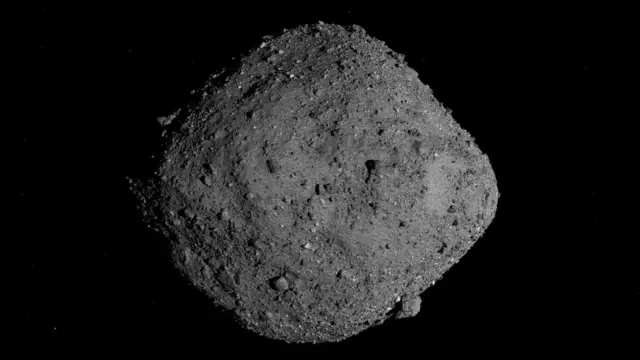
For decades, scientists have theorized that life’s earliest ingredients arrived on Earth aboard ancient asteroids and comets. Now, a new finding from NASA’s analysis of asteroid Bennu adds an unexpected twist: the chemical precursor to serotonin, often called the “happy hormone,” may also have extraterrestrial origins.
This discovery of a tryptophan-like signal in Bennu samples pushes forward our understanding of how the essential molecules that influence human biology, mood, and life itself could have formed far beyond Earth.
What did NASA discover in asteroid Bennu?
Researchers examining material returned from asteroid Bennu have detected hints of tryptophan, an essential amino acid that plays a direct role in producing serotonin. This is the first time tryptophan has ever been detected in an extraterrestrial sample, according to the team from NASA’s Goddard Space Flight Center and the University of Arizona.
Tryptophan is one of nine amino acids that the human body cannot make on its own. It supports:
- Serotonin production, linked to mood and emotional balance
- Melatonin generation, tied to sleep regulation
- Gut function and digestion
- Brain and nervous system stability
The faint signature of tryptophan was unexpected, especially since earlier Bennu studies had identified 14 other amino acids but never this one.
If confirmed, this would be a milestone in prebiotic chemistry, the study of how life’s building blocks could form in space and arrive on Earth ready to spark biology.
How did scientists detect the ‘happy hormone’ precursor?
Testing Bennu samples for amino acids
The research team, led by geochemist Angel Mojarro, analyzed Bennu fragments for all twenty amino acids that form proteins in living organisms. Their high-precision instruments picked up both biological and non-biological amino acids, confirming their extraterrestrial origin.
In addition to tryptophan, the team reaffirmed the presence of amino acids identified in earlier studies, providing stronger evidence that primitive asteroids can naturally create and preserve life’s essential chemistry.
The faint tryptophan signal
The detection was subtle, not a clear spike but a measurable signature that suggests tryptophan may be present in trace amounts. Researchers emphasise that more analysis will be required to confirm the amino acid’s presence beyond doubt.
What does Bennu’s chemistry reveal about the origins of life?
The findings strengthen a long-held hypothesis: Earth may have been seeded with the building blocks of life through asteroid and comet impacts billions of years ago.
The study, published in the Proceedings of the National Academy of Sciences, states that organic molecules “can form within primitive accreting planetary bodies and could have been delivered via impacts to the early Earth.”
Why Bennu matters
Bennu is considered a time capsule of the early solar system. Because it has undergone minimal geological change, its material offers a snapshot of chemical conditions from more than 4.5 billion years ago.
Comparison with Ryugu
Samples from asteroid Ryugu, collected by Japan’s Hayabusa2 mission, contained only one nucleobase. But Bennu samples contain all five nucleobases essential for RNA and DNA formation:
- Adenine (A)
- Guanine (G)
- Cytosine (C)
- Thymine (T)
- Uracil (U)
This contrast suggests that different asteroids may have hosted different chemical environments, each contributing unique ingredients to early Earth.
How were Bennu samples collected?
NASA’s OSIRIS-REx mission reached Bennu in 2018 and in 2020 performed a touch-and-go maneuver, briefly contacting the asteroid to gather a sample. The material was sealed in a return capsule, which landed in September 2023 in the Utah desert.
Since then, labs across the US have been analyzing the material for clues about:
- The solar system’s chemical origins
- Prebiotic molecule formation
- Organic matter transport across space
- The likelihood of life emerging elsewhere
Each discovery brings researchers closer to answering whether life is a cosmic inevitability — or a rare planetary accident.
Why the tryptophan detection matters
The presence of a serotonin-related molecule in space is scientifically profound. It suggests:
1. Complex organic chemistry can occur naturally in space
Asteroids may host chemical reactions previously thought to require Earth-like conditions.
2. Life’s mood-related pathways have ancient origins
Serotonin is essential for mood regulation today, but its chemical operators may predate Earth itself.
3. The genetic toolkit of life may be older than life
Finding all five nucleobases and multiple amino acids implies that life’s molecular language may have been assembled long before biology existed.
4. Prebiotic delivery was likely widespread
Multiple asteroids delivering different chemicals could explain how Earth accumulated a broad range of organic molecules.
This is a good spot for an internal link to a piece on “How amino acids form in space.”
What happens next?
The faint tryptophan signal will undergo more testing, including isotope analysis and deeper molecular mapping. Confirming extraterrestrial tryptophan could reshape our understanding of:
- How early Earth acquired essential biomolecules
- Whether similar chemistry exists on other planets or moons
- The probability of life developing independently elsewhere
Future missions such as Japan’s MMX, NASA’s Dragonfly, and ESA’s Comet Interceptor will expand this work by sampling new bodies rich in organic material.
TL;DR
- NASA scientists found a faint signal indicating tryptophan, a precursor to serotonin, in asteroid Bennu samples.
- This could be the first evidence of tryptophan in any extraterrestrial material.
- Bennu already contains all five nucleobases needed for DNA/RNA.
- The discovery supports theories that asteroids delivered life’s building blocks to Earth.
- OSIRIS-REx samples continue revealing complex organic chemistry from the early solar system.