
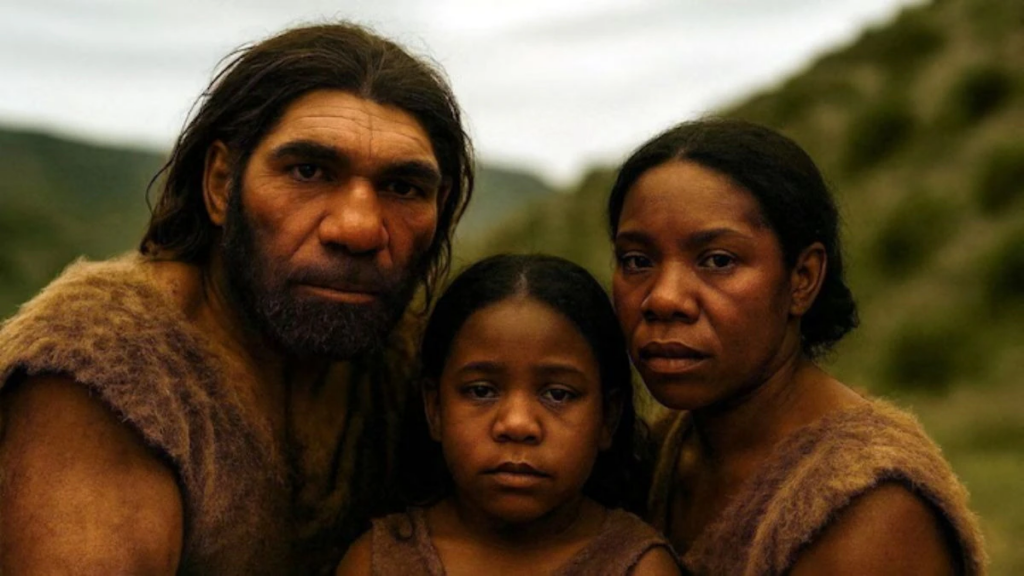
For years, scientists have known that many modern humans carry traces of Neanderthal DNA. If you’re of non-African descent, there’s a strong chance that about 1–2 percent of your genome comes from Neanderthals.
But one question has puzzled researchers for decades: Why is Neanderthal DNA almost missing from parts of the X chromosome?
A new study published in Science proposes a surprising answer. The so-called “Neanderthal deserts” in our genome may not be the result of harmful DNA being eliminated by evolution, but rather the pattern in which Neanderthals and modern humans mated.
Here’s what that means, and why it matters.
What Do We Know About Neanderthal DNA in Humans?
Modern humans, Homo sapiens, and Neanderthal (Homo neanderthalensis) split from a common ancestor roughly 600,000 years ago.
For hundreds of thousands of years, they evolved separately. Then, around 50,000 to 60,000 years ago, they met again in Eurasia.
Genetic research over the past 15 years has shown:
- Most non-African people carry about 2% Neanderthal DNA
- Some African populations carry up to 1–1.5%, largely due to back-migration from Eurasia
- Neanderthal genes appear in small fragments scattered across our genome
These inherited fragments affect traits ranging from immune response to skin biology. But they aren’t evenly distributed.
And that’s where things get interesting.
What Are “Neanderthal Deserts”?
For more than two decades, researchers have used the term “Neanderthal deserts” to describe regions of the modern human genome where Neanderthal DNA is rare or completely absent.
These deserts are especially prominent on the X chromosome, one of the two sex chromosomes (XX in females, XY in males).
In fact, there are stretches of the human X chromosome where no living person has detectable Neanderthal ancestry.
For years, scientists believed this happened because Neanderthal DNA in those regions was biologically incompatible or harmful, essentially “toxic,” and was removed by natural selection.
The theory made intuitive sense:
- The X chromosome plays a critical role in reproduction
- Genetic incompatibilities often show up in sex chromosomes
- Harmful combinations would likely be eliminated over time
But the new study challenges that explanation.
The New Study: Was It About Mate Preference?
In a study published in the journal Science (February 26), researchers analyzed the genomes of 73 women from three African populations with no Neanderthal ancestry. They compared these genomes with Neanderthal genetic material.
The findings suggest something unexpected:
- Neanderthal X chromosomes contained significantly more modern human DNA
- Modern human X chromosomes contain very little Neanderthal DNA
That asymmetry may reveal who was mating with whom.
The Key Hypothesis
The study proposes that interbreeding occurred primarily between:
- Neanderthal men
- Homo sapiens women
If that pattern dominated, it would explain the genetic imbalance on the X chromosome.
Here’s why.
Why the X Chromosome Matters
To understand the theory, we need a quick genetics refresher.
- Females have two X chromosomes (XX)
- Males have one X and one Y (XY)
- Fathers pass their X chromosome only to daughters
- Mothers pass X chromosomes to both sons and daughters
If Neanderthal men mated with modern human women:
- Sons would inherit their X chromosome from their human mother, not their Neanderthal father
- Daughters would inherit one Neanderthal X and one human X
Over generations, Neanderthal X chromosomes could be diluted more rapidly compared to autosomal (non-sex) chromosomes.
In other words, the mating pattern itself could naturally limit how much Neanderthal X DNA survived, without needing the “toxic DNA” explanation.
Does This Disprove Earlier Theories?
Not entirely.
Earlier research suggested that genetic incompatibilities, especially affecting male fertility, may have reduced the survival of certain Neanderthal gene combinations.
It’s still possible that both forces played a role:
- Mate patterns influencing initial genetic flow
- Natural selection removes some incompatible variants
But the new study reframes the debate. Instead of focusing solely on biological incompatibility, it highlights social and demographic dynamics.
And that opens a broader window into how these two human groups interacted.
Did Homo Sapiens Women Prefer Neanderthal Men?
The idea that modern human women “preferred” Neanderthal men has grabbed headlines. But scientists are cautious about interpreting this as a romantic choice in the modern sense.
Several factors could explain the pattern:
- Population size differences
- Power dynamics between groups
- Geographic settlement patterns
- Migration waves
Neanderthals were physically different, generally shorter and more robustly built, but we should avoid projecting modern cultural assumptions onto prehistoric encounters.
What the genetics show is directional interbreeding, not motive.
Why Some People Have No Neanderthal DNA
Another striking fact: some humans today have no detectable Neanderthal ancestry.
This is especially common in sub-Saharan African populations, whose ancestors did not interbreed with Neanderthals before humans dispersed globally.
However, even in Africa, some groups carry small amounts (up to 1.5%) due to later migration from Eurasia back into Africa.
So the presence or absence of Neanderthal DNA largely reflects ancient migration patterns, not superiority, purity, or hierarchy.
Why This Discovery Matters
This isn’t just a niche genetics debate. It changes how we think about human evolution.
1. It Rewrites a Long-Standing Assumption
For 20 years, “Neanderthal deserts” were explained primarily by harmful DNA being purged. Now, mating structure may offer a clearer explanation.
2. It Highlights Social Dynamics
Evolution isn’t just biology. Demography, migration, and social interaction shape genetic outcomes.
3. It Refines Our Understanding of Interbreeding
Humans and Neanderthals didn’t merge into one species, but they didn’t remain fully separate either. The genetic exchange was limited, patterned, and complex.
The Bigger Picture: A Complicated Human Story
Neanderthals went extinct around 40,000 years ago. But they didn’t vanish entirely.
Small fragments of their genome survive in billions of people today.
Those fragments influence:
- Immune responses
- Skin and hair traits
- Metabolism
- Risk factors for certain diseases
Yet the X chromosome remains a genetic puzzle, and this new research may be one of the most compelling pieces so far.
TL;DR
- Most non-African humans carry about 2% Neanderthal DNA.
- Certain parts of the genome, especially the X chromosome, have almost none.
- Scientists long believed that Neanderthal DNA was harmful and removed by evolution.
- A new Science study suggests the real reason may be mating patterns: primarily Neanderthal men with Homo sapiens women.
- That pattern would naturally reduce Neanderthal X chromosome inheritance over time.
The finding doesn’t rewrite human history, but it does refine it.
And as ancient DNA technology improves, we’re likely to uncover even more surprising details about how our species came to be.