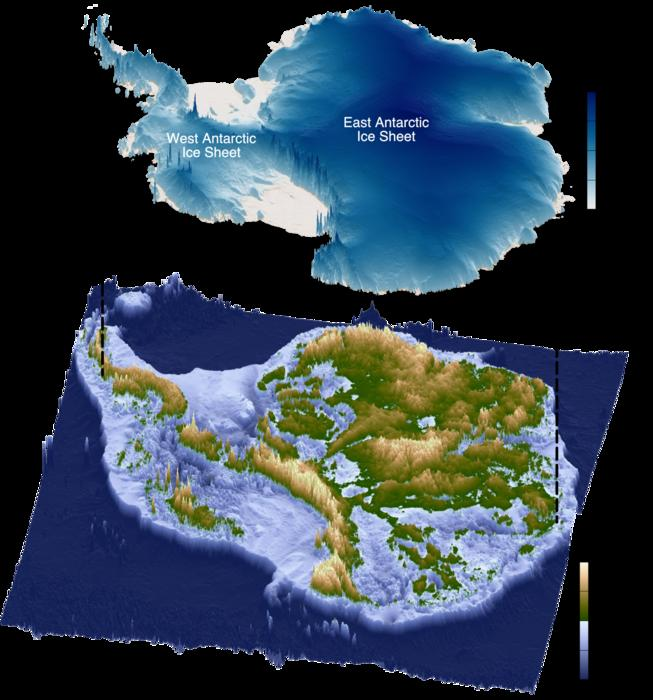
Antarctica still holds some of Earth’s biggest mysteries, despite decades of scientific exploration. Now, researchers have uncovered what could be one of the largest geological structure ever identified beneath the frozen continent, hidden nearly two miles below its massive ice sheet.
The newly discovered formation, called the East Antarctic Fan-shaped Basin Province, links several previously known subglacial features into a single, enormous geological structure according to a study published in the journal Nature. Scientists say the discovery could reshape our understanding of Antarctica’s ancient past and help researchers better predict how the continent’s ice sheets may respond to future climate change.
The findings were published in the journal Nature and are already drawing attention from geologists, glaciologists, and climate researchers worldwide.
What did scientists discover beneath Antarctica?
For decades, researchers have studied individual geological features buried beneath East Antarctica’s ice.
These include:
- The Wilkes Subglacial Basin
- The Aurora Subglacial Basin
- Lake Vostok, the largest known subglacial lake on Earth
Until now, these structures were largely treated as separate geological features.
The new research suggests they are actually connected components of a much larger formation known as the East Antarctic Fan-shaped Basin Province.
If future studies confirm the findings, the structure could rank among the largest geological structures on the planet.
Why is this discovery significant?
The importance of the discovery extends far beyond geology.
Scientists believe the basin system underlies roughly half of the East Antarctic Ice Sheet, making it a critical factor in understanding how ice moves across the continent.
Because Antarctica stores enough frozen water to significantly affect global sea levels, understanding what lies beneath the ice is essential.
The shape and structure of the land hidden below Antarctica influence the following:
- Ice sheet stability
- Glacier movement
- Subglacial water flow
- Long-term landscape evolution
- Future sea-level rise projections
Researchers say these hidden geological features act as a foundation that helps determine how ice behaves over thousands or even millions of years.
How did scientists find a structure buried beneath miles of ice?
Studying Antarctica’s subsurface presents enormous challenges.
Unlike geological surveys conducted in exposed landscapes, researchers cannot directly observe most of the continent’s bedrock because it is covered by vast ice sheets that can exceed two miles in thickness.
To overcome this obstacle, scientists combined multiple datasets from different sources.
Geological observations
Researchers analyzed existing geological information collected from Antarctica over many years.
These records helped identify patterns beneath the ice that were not previously recognized as part of a larger system.
Gravity measurements
Variations in Earth’s gravitational field can reveal hidden structures underground.
Different rock types and geological formations have distinct densities, allowing scientists to infer what lies beneath the surface.
Magnetic data
Magnetic surveys help researchers map buried rock formations by detecting variations in magnetic properties across large regions.
Crustal models
Scientists also used models of Earth’s crust to reconstruct how Antarctica’s hidden landscape evolved over geological time.
Together, these tools created a clearer picture of the continent’s concealed architecture.
How did the giant basin form?
The study suggests the structure developed through a geological process known as distributed rotational extension.
In simple terms, this occurs when continental crust gradually stretches and thins outward from a central region over millions of years.
As the crust expands, large depressions and basin systems can form.
Researchers believe this process helped create the vast fan-shaped network now identified beneath East Antarctica.
A glimpse into Antarctica’s ancient past
The discovery offers clues about a time long before Antarctica became the frozen continent we know today.
Hundreds of millions of years ago, Antarctica was part of the supercontinent Gondwana, alongside present-day Africa, South America, India, Australia, and Antarctica.
Understanding how the newly discovered basin formed could help scientists reconstruct the geological events that shaped the continent before it was covered by ice.
What is Lake Vostok, and why is it important?
One of the most famous features included within the newly identified system is Lake Vostok.
Located beneath nearly 2.5 miles of ice, Lake Vostok is the largest known subglacial lake on Earth.
Scientists are fascinated by the lake because it has remained isolated from the atmosphere for millions of years.
Research into Lake Vostok may provide insights into:
- Ancient microbial life
- Extreme ecosystems
- Climate history
- Conditions that could exist on icy moons such as Europa and Enceladus
The fact that Lake Vostok appears to be part of a much larger geological province adds another layer of scientific significance.
What does this mean for climate change research?
One of the most important implications of the discovery relates to future climate projections.
Understanding ice-sheet behavior
The East Antarctic Ice Sheet contains enough ice to raise global sea levels dramatically if significant portions were to melt.
Scientists need accurate information about the landscape beneath the ice to predict how glaciers may react to warming temperatures.
The newly identified basin system could influence:
- Ice flow speed
- Glacier stability
- Meltwater pathways
- Long-term ice-sheet retreat
Improving climate models
Modern climate models increasingly incorporate geological data to improve predictions.
A more detailed understanding of Antarctica’s hidden topography could help researchers create better simulations of future ice-sheet behavior and sea-level rise.
This is particularly important because East Antarctica has traditionally been viewed as more stable than parts of West Antarctica.
What questions remain unanswered?
Despite the significance of the discovery, researchers caution that more work is needed.
Key questions include:
- How large is the basin system exactly?
- When did it form?
- How does it affect modern ice movement?
- What role has it played in Antarctica’s geological evolution?
- How might it influence future climate-driven changes?
Future radar surveys, seismic studies, and satellite observations will likely provide additional answers.
Why Antarctica still surprises scientists
Although Antarctica is one of the most studied regions on Earth from space, much of what lies beneath its ice remains unexplored.
Scientists estimate that entire mountain ranges, valleys, rivers, and lakes remain hidden beneath the continent’s frozen surface.
The discovery of the East Antarctic Fan-shaped Basin Province serves as a reminder that even in the 21st century, Earth still contains vast unexplored frontiers.
For researchers, the frozen continent remains less like a completed map and more like a geological puzzle whose biggest pieces are still emerging from beneath the ice.
TL;DR
- Scientists have identified a massive geological structure beneath East Antarctica.
- The formation is called the East Antarctic Fan-shaped Basin Province.
- It connects several previously known subglacial features, including Lake Vostok.
- Researchers used gravity, magnetic, geological, and crustal data to map the hidden system.
- The structure may underlie roughly half of the East Antarctic Ice Sheet.
- The discovery could improve understanding of Antarctica’s geological history and future ice-sheet behavior.
- Scientists believe it may help refine climate and sea-level rise predictions.