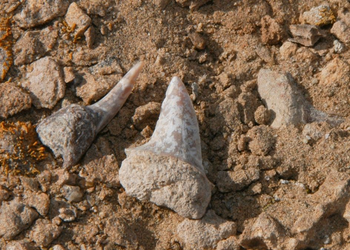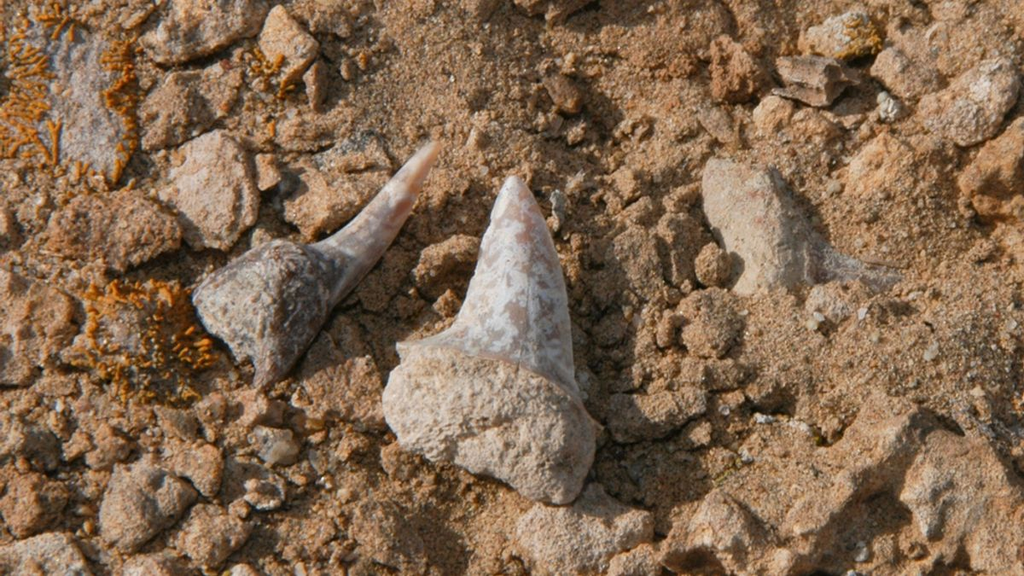
Egypt’s Western Desert, now part of the vast Sahara, was once home to sharks swimming through warm tropical waters. A discovery of 14 fossilized shark teeth on the Abu-Tartur Plateau is offering scientists a closer look at this ancient marine ecosystem, which existed during the Late Cretaceous Period.
The teeth belong to at least five shark species and were recovered from phosphate-rich rocks in the Duwi Formation. The findings, published in the journal Cretaceous Research, add to evidence that the region was once covered by a sea supporting a diverse range of marine animals.
The discovery is particularly revealing because the fossils represent sharks associated with different marine environments. By examining their teeth and comparing them with those of related species, researchers can reconstruct aspects of the ancient ecosystem and understand how marine habitats varied across the region.
Today, the area is arid desert. During the Cretaceous, however, higher global sea levels and warmer climatic conditions allowed shallow seas to extend across parts of the continents, including areas that are now within the Sahara.
Where Were the Ancient Shark Teeth Found?
The fossils were discovered on Egypt’s Abu-Tartur Plateau, located in the Western Desert. They were preserved in the Duwi Formation, a geological unit known for its phosphate-rich deposits and evidence of ancient marine environments.
The teeth date to the Campanian stage of the Late Cretaceous, a geological interval that lasted approximately 84 to 72 million years ago. The reported fossils therefore provide evidence of marine life in the region tens of millions of years before the modern Sahara took shape.
The research team was led by palaeontologist Tarek Yassin of Cairo University. The scientists identified 14 teeth representing at least five shark species, adding to the remains of two other shark species previously reported from the same sites.
Together, these findings indicate that the ancient sea supported a broader variety of sharks than the newly discovered teeth alone would suggest.
Why Are Phosphate Rocks Important?
Phosphate deposits can preserve valuable evidence of ancient marine ecosystems. These rocks form through geological processes involving the accumulation and alteration of materials in marine environments, including biological remains.
The Duwi Formation has yielded fossils of several marine animals, including fish, sea turtles and marine reptiles. The shark teeth add another piece to this record, helping scientists understand the range of animals that inhabited the region.
Fossils preserved in such deposits can also provide information about past environments, although researchers must consider how the remains were transported, accumulated and preserved before drawing conclusions about where individual animals lived.
What Types of Sharks Swam in the Ancient Sahara?
The newly reported teeth belong to at least five species within the order Lamniformes, a group of sharks commonly known as mackerel sharks.
Modern members of this order include great white sharks and mako sharks. The group also includes the goblin shark, although its appearance and ecology differ considerably from those of fast-swimming predators such as great whites and makos.
The fossils from Egypt include representatives of several ancient shark genera, including Scapanorhynchus, Cretalamna, Serratolamna and Squalicorax.
Their presence is important because different shark groups occupied different ecological settings. Comparing the fossil species with what scientists know about their relatives can help researchers infer the conditions that existed in the ancient sea.
What the Different Teeth Reveal
Shark teeth vary considerably in shape, reflecting differences in feeding strategies and prey.
Some of the recovered teeth are narrow and pointed, shapes that can help a predator grip prey. Others are broader, with cutting edges suited to slicing flesh.
These differences suggest that the ancient shark community included animals with different feeding adaptations rather than a single type of predator.
However, tooth shape alone cannot establish a shark’s complete diet or behavior. Scientists typically interpret dental features alongside other fossils, geological evidence and comparisons with living or better-known extinct species.
What Do the Shark Species Reveal About the Ancient Sea?
One of the most useful aspects of the discovery is that the shark genera are associated with different marine habitats.
According to the study’s reported interpretations, Scapanorhynchus is associated with deeper-water environments, while Cretalamna and Serratolamna are linked to more open continental-shelf settings. Squalicorax may have occupied shallower waters.
A continental shelf is the relatively shallow, submerged margin of a continent. It can support a wide variety of marine life because it receives sunlight in its upper waters and often provides habitats for fish and other organisms.
The presence of sharks associated with different settings suggests that the ancient marine environment around Abu-Tartur was ecologically varied.
It does not necessarily mean that every species lived in precisely the same place at the same time. Fossil deposits can combine remains transported from different locations or accumulated over long periods.
Nevertheless, the diversity of the shark fossils, considered alongside other marine remains from the Duwi Formation, supports the interpretation that the region once formed part of a productive marine environment.
Why Was the Sahara Covered by Water Millions of Years Ago?
The Sahara’s present-day landscape can make its marine past difficult to imagine. Yet Earth’s geography and climate have changed substantially over geological time.
During the Late Cretaceous, global sea levels were generally higher than today, and the planet was warmer. These conditions allowed shallow seas to cover extensive areas of continental land.
The arrangement of the continents and the distribution of land and sea were also different from those of the modern world. As coastlines shifted, marine environments extended into places that are now far inland.
Parts of what is now North Africa lay within marine settings, allowing sharks and other sea creatures to inhabit waters over regions that would later become desert.
The discovery does not mean the entire Sahara was permanently submerged. Rather, it provides evidence that the specific area around Abu-Tartur was once part of an ancient marine environment.
Over millions of years, changes in sea level, climate, tectonic activity and sedimentation transformed the landscape. The marine deposits survived as rocks, preserving traces of the animals that once lived there.
Why Do Scientists Study Shark Teeth to Reconstruct Ancient Environments?
Shark teeth are among the most useful fossils for studying ancient shark communities. Sharks continuously replace their teeth throughout their lives, and their mineralized structures can survive long after the rest of the animal has disappeared.
A fossil tooth can therefore provide evidence of a shark’s presence even when its skeleton has not been preserved.
Researchers examine several characteristics, including tooth shape, size, cutting edges and root structure, to identify the likely group to which a specimen belonged.
They then compare those identifications with geological information and other fossils from the same deposits.
This approach can help scientists investigate questions such as:
- Which shark groups inhabited a particular region?
- What kinds of marine habitats existed there?
- Did the environment support predators with different feeding adaptations?
- How did marine communities change over geological time?
The Abu-Tartur discovery illustrates how even a relatively small collection of fossils can contribute to a broader understanding of Earth’s ancient ecosystems.
Does the Abu-Tartur Plateau Deserve Its Reputation as a Shark Graveyard?
The area has been described as a shark graveyard because of the fossil remains recovered from its phosphate deposits. However, the label should not be interpreted as evidence that numerous sharks died together in a single event.
Fossils can accumulate through a variety of processes. Teeth shed during a shark’s lifetime may settle on the seabed, while the remains of dead animals can be transported by currents and incorporated into sediments.
Over time, these materials may become concentrated in deposits that preserve evidence from different periods.
Consequently, the shark teeth found at Abu-Tartur may represent animals that lived hundreds or thousands of years apart, rather than a single population that occupied the area simultaneously.
Understanding this distinction is important when reconstructing ancient ecosystems. A fossil bed can record a long history of marine life, but its contents do not automatically provide a snapshot of one particular moment.
What Does This Discovery Tell Us About Earth’s Changing Landscapes?
The fossilized shark teeth from Egypt offer a reminder that modern landscapes are not permanent features of the planet.
Regions now characterized by extreme dryness can preserve evidence of ancient seas, forests or other environments that existed under very different climatic and geological conditions.
At Abu-Tartur, the shark fossils complement the wider collection of marine remains found in the Duwi Formation. Together, they help scientists reconstruct an ecosystem that existed during a period when the world’s oceans and coastlines differed markedly from those of today.
The discovery also demonstrates the value of studying seemingly small fossils. Fourteen teeth cannot reveal every detail of an ancient sea, but their diversity, combined with geological context and other fossil evidence, can help establish which animals lived there and what their environment may have been like.
For a region now defined by sand and dry conditions, these fossils preserve a very different history: one in which sharks moved through warm marine waters across what is now Egypt’s Western Desert.