
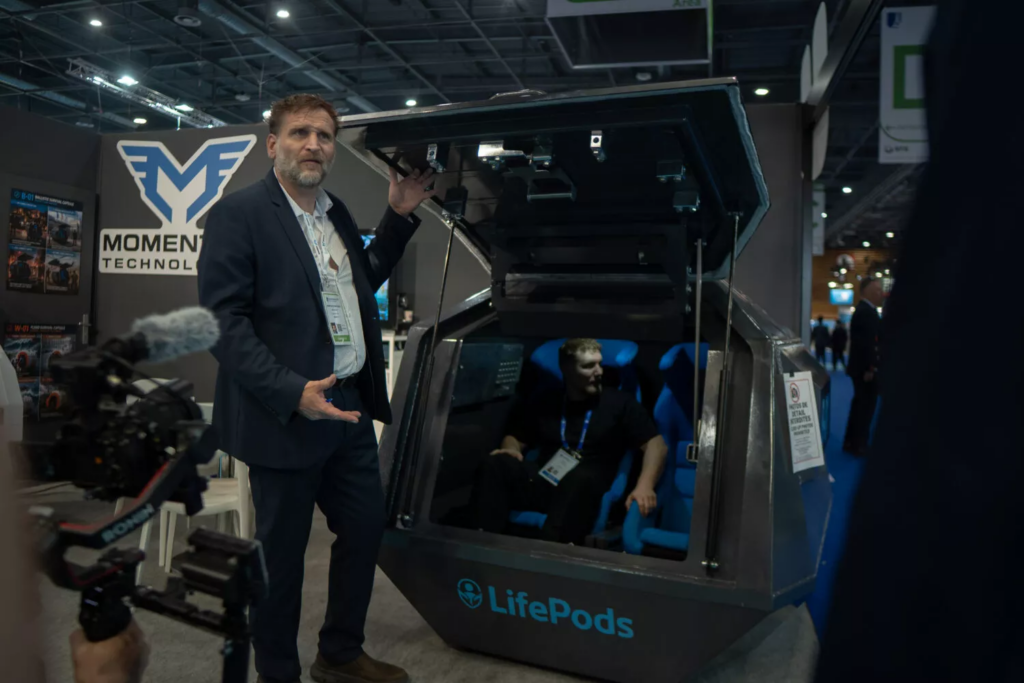
As wars, climate disasters and extreme weather events dominate global headlines, demand for personal emergency shelters is steadily growing. French startup Momentum Technologies is betting that more people, businesses, and governments are willing to invest in compact survival systems designed to withstand catastrophic events.
The company recently unveiled its LifePods at VivaTech and Eurosatory 2026, showcasing portable survival capsules engineered to protect occupants during disasters ranging from explosions to floods. With prices reaching as high as $43,200, the pods target buyers seeking protection against increasingly unpredictable emergencies.
Here’s a closer look at what the LifePods are, how they work, and whether their ambitious claims hold up.
What are LifePods?
LifePods are compact, portable emergency shelters designed to keep occupants alive when conventional infrastructure fails.
Unlike traditional underground bunkers, the units are built to be transportable. They can be shipped like standard cargo containers, relocated when necessary, stacked for storage, and even airlifted into disaster zones.
Momentum Technologies says the shelters are intended for situations where access to electricity, emergency responders, and secure housing is no longer available.
The company introduced the pods at two major European technology and defence exhibitions, highlighting growing interest in personal resilience products amid rising geopolitical tensions and climate-related disasters.
Why is demand for survival pods increasing?
The market for emergency shelters has expanded in recent years for several reasons:
- Rising geopolitical tensions and concerns over armed conflict
- Increasing frequency of floods, wildfires, and severe storms
- Greater awareness of climate-related risks
- Growing interest in emergency preparedness among households and governments
Manufacturers say portable shelters provide an alternative to permanent underground bunkers, particularly for people who need flexible protection that can be relocated.
What versions of the LifePod are available?
Momentum Technologies has introduced two primary models, each designed for different emergency scenarios.
B-01: Protection against blasts and ballistic threats
The B-01 is intended for two occupants and is designed to withstand several human-made hazards.
According to the company, the pod offers protection against:
- Blast waves
- Fire
- Ballistic threats
- Falling debris
The shelter uses multiple protective layers made from high-strength technical steel combined with specialised insulation materials.
Momentum says laboratory testing demonstrated that the protective panels resisted the following:
- 5.56×45 mm ammunition traveling at approximately 950 meters per second
- 7.62×51 mm rounds traveling at roughly 830 meters per second
However, the company notes that these ballistic results currently apply to the tested materials rather than certification of the complete pod system.
W-01: A floating survival pod for floods and tsunamis
The second model, called the W-01, focuses on natural disasters involving water.
Designed to accommodate:
- Up to four adults
- Up to four children
The pod is engineered to float during flooding, storm surges, and tsunamis.
Instead of using motors or active stabilisation systems, the W-01 relies on passive hydrodynamic stability. Its buoyant structure is intended to keep the pod upright even in rough water.
Momentum Technologies says early flotation tests have produced encouraging results, although comprehensive certification is still pending.
Can these pods really survive disasters?
The company’s marketing highlights protection against numerous hazards, including:
- Floods
- Tsunamis
- Fires
- Blast waves
- Ballistic impacts
While the engineering concepts behind these features are well established, prospective buyers should note an important distinction.
Some individual materials have undergone ballistic testing, but both pod models still require complete certification to verify their performance as fully assembled emergency shelters under real-world conditions.
Independent testing will ultimately determine how effectively the complete systems perform during extreme events.
How do LifePods compare with existing survival capsules?
Momentum Technologies is entering a market that already includes several emergency shelter manufacturers.
One notable example is the Survival Capsule, a patented spherical emergency shelter designed for disasters such as:
- Tsunamis
- Hurricanes
- Earthquakes
That product starts at approximately $21,700 for a two-person unit.
Momentum’s approach differs by offering specialised designs tailored for different threats rather than a single universal capsule.
How much will the LifePods cost?
Momentum Technologies estimates the following prices:
| Model | Capacity | Expected Price |
|---|---|---|
| B-01 | Two people | Around $31,300 |
| W-01 | Four adults plus four children | Between $37,800 and $43,200 |
Shipping, installation, and additional customisation costs are not included in these estimates.
Are survival pods becoming a new preparedness trend?
Preparedness experts note that consumer interest in emergency equipment has grown substantially over the past decade.
Events such as major hurricanes, wildfires, earthquakes and ongoing geopolitical conflicts have encouraged more homeowners and institutions to consider protective infrastructure.
Portable survival shelters represent one segment of this broader preparedness market, alongside backup power systems, emergency food supplies and residential safe rooms.
Whether products like LifePods become mainstream will likely depend on independent safety certifications, real-world performance and whether consumers view the significant cost as worthwhile insurance against low-probability but high-impact events.
TL;DR
Momentum Technologies has introduced two portable LifePods designed for different emergency scenarios. The B-01 focuses on protection from blasts, fire and ballistic threats, while the floating W-01 is intended for floods and tsunamis. Prices range from about $31,300 to $43,200, although both products still need full certification before their performance claims can be independently verified. As climate risks and geopolitical uncertainty grow, the company is positioning these shelters as a new generation of portable disaster preparedness systems.