

• Independence Day
  • About BreezyScroll
  • Privacy & Policy
  • Contact Us
Tuesday, October 20, 2026
BreezyScroll
  • Home
  • Breezy Stories
  • Technology
  • Gaming
  • Entertainment
  • Lifestyle
  • World
  • Money
  • Sports
  • Breezy Explainer
  • Dussehra
No Result
View All Result
  • Home
  • Breezy Stories
  • Technology
  • Gaming
  • Entertainment
  • Lifestyle
  • World
  • Money
  • Sports
  • Breezy Explainer
  • Dussehra
No Result
View All Result
BreezyScroll
No Result
View All Result

Home  /  Science  /  Time appears five times slower in the early universe: Study

Time appears five times slower in the early universe: Study

by Jake Hoffman
July 4, 2023
in Science, Space
Reading Time: 3 mins read
Time appears five times slower in the early universe: Study

According to a study published in the journal Nature Astronomy, time appeared to move five times slower just over a billion years after the Big Bang.

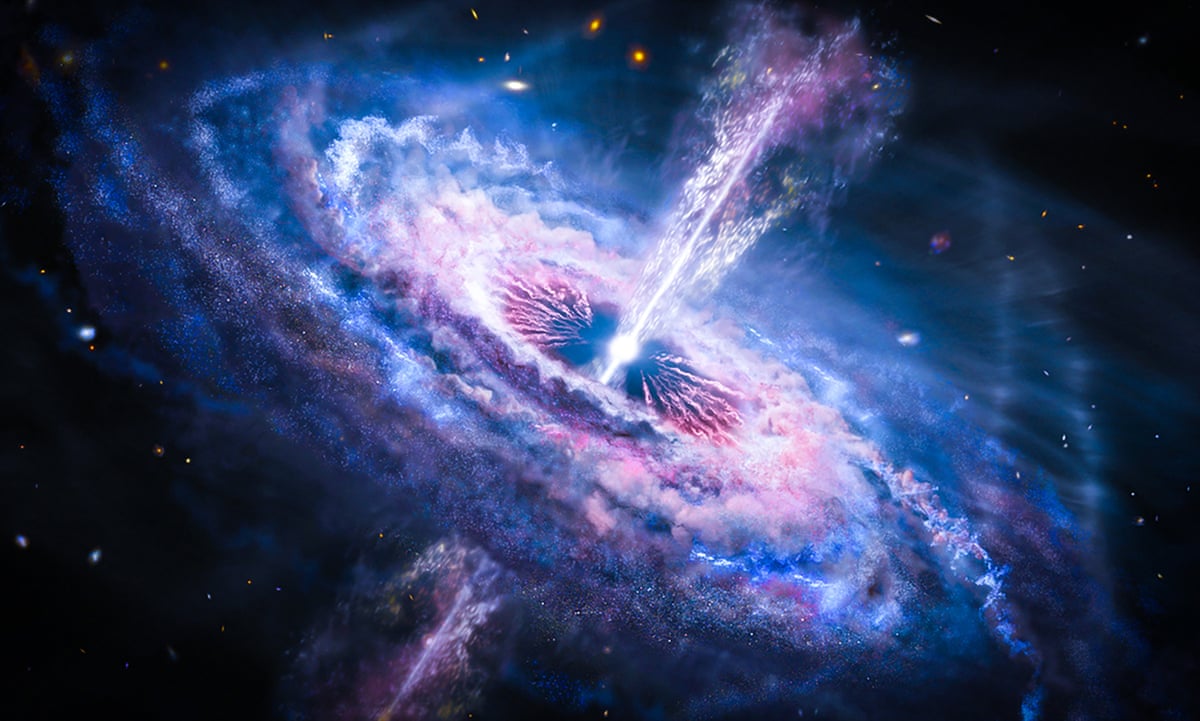
Scientists reported on Monday that time appeared to be five times slower in the early cosmos, for the first time using incredibly luminous cosmic objects called quasars as “clocks” to verify this bizarre phenomenon.

Einstein’s theory of relativity suggests that “we should see the distant universe run in slow motion

Because of the peculiar effect velocity has on the perception of time passing, our observations make it appear as if time moved slower when the Universe was a newborn.

At least, that’s how it appears to us from a distance of about 13 billion years. This is known as time dilation, and astrophysicist Geraint Lewis of the Australia’s University of Sydney and statistician Brendon Brewer of New Zealand discovered it for the first time in the early Universe by studying the fluctuations of bright galaxies known as quasar galaxies during the Cosmic Dawn.

As space is expanding, Einstein’s theory of relativity suggests that “we should see the distant universe run in slow motion,” according to Geraint Lewis, an astronomer at the University of Sydney and the principal author of a new study.

Previously, researchers utilized observations of extraordinarily luminous exploding stars called supernovas as cosmic clocks to demonstrate that time moved twice as slowly when the universe was half its current age.

This is known as the Doppler effect, and it may be felt here on Earth as well

The latest study employed even brighter quasars to look further back in time in the universe’s 13.8 billion-year existence.

They discovered that due to the accelerated expansion of the Universe, we witness those variations unfold at a rate five times slower than if they were occurring nearby.

It’s the most remote time dilation we’ve ever observed in action, and it solves multiple problems. It demonstrates that quasars are consistent with the effect across enormous gulfs of space-time, which indicates that they not only comply with the standard model of cosmology, but we can also account for time dilation in analyses of their behavior.

ADVERTISEMENT

“Looking back to a time when the Universe was just over a billion years old, we see time appearing to flow five times slower,” Lewis said.

“If you were there, in this infant Universe, one second would seem like one second – but from our position, more than 12 billion years into the future, that early time appears to drag.”

Although it is difficult to observe in our daily lives, space and time are closely intertwined in the Universe. This is how we can witness the Universe’s accelerated expansion. Light at far greater distances extends as space expands, moving to longer, redder wavelengths as the source’s distance increases.

This is known as the Doppler effect, and it may be felt here on Earth as well. Consider how an ambulance siren appears to expand out as the ambulance pulls away from you.

The ambulance becomes a distant galaxy in this scenario, and the light is the siren. The emission is normal at the source, but from our perspective, it becomes all stretched out.


Tags: TimeUniverse
ShareTweetShareSend

Recent Articles

219,666…219,669: When Artemis II Commander Feared The Crew Might Never Return From Space

219,666…219,669: When Artemis II Commander Feared The Crew Might Never Return From Space

October 19, 2026
Canadian GeoAI Firm Deepspatial Inks Strategic Pacts with IIT Tirupati & OneIndia

Canadian GeoAI Firm Deepspatial Inks Strategic Pacts with IIT Tirupati & OneIndia

October 18, 2026
China Invites Trump’s Press Secretary Katie Zacharia To visit After ‘Proper Toilets’ Remark

China Invites Trump’s Press Secretary Katie Zacharia To visit After ‘Proper Toilets’ Remark

October 18, 2026
US Lawmakers Urge Marco Rubio To Raise CJP Protest Crackdown Concerns With India

US Lawmakers Urge Marco Rubio To Raise CJP Protest Crackdown Concerns With India

October 18, 2026
BreezyScroll Logo

BreezyScroll is a global content platform that provides a unique experience of enhancing the knowledge quotient for its audience by providing the latest news and updates from various categories such as politics, sports, entertainment, technology, and more.
The platform aims to provide a concise and easy-to-read format for its users. BreezyScroll covers news stories from around the world, majorly the United States. The platform was launched in 2021 and has become one of the fastest-growing content companies in the US.

Follow Us

Browse by Category

  • Africa
  • Alaska
  • Animals
  • Asia
  • Athletics
  • Australia
  • Auto
  • Basketball
  • Bollywood
  • Brand
  • Breezy Explainer
  • Breezy Feature
  • Breezy Soul
  • Business
  • Canada
  • Chess
  • China
  • Cricket
  • DIY
  • Education
  • Entertainment
  • Environment
  • EPL
  • Europe
  • Exclusive Interview
  • Exclusive Review
  • Football
  • Gaming
  • Health
  • Hollywood
  • India
  • International
  • K Pop
  • Law
  • Lifestyle
  • Middle East
  • Money
  • NFL
  • North America
  • OTT
  • Paris Olympics
  • Pets
  • Russia
  • Science
  • South America
  • Space
  • Sports
  • Startup
  • Technology
  • Tennis
  • Tennis
  • The Achievers
  • The US
  • Travel
  • UK
  • UK
  • Uncategorized
  • World
  • WWE

Trending Topics

Afghanistan AI Apple Australia Biden California Canada ChatGPT China Climate Change Donald Trump Elon Musk Featured Florida Google IPL Iran Japan Jeff Bezos Joe Biden Mars Meta Moon NASA NBA Netflix New York North Korea Ohio OpenAI Putin Russia Russia-Ukraine crisis South Korea SpaceX Taliban Tesla Texas TikTok Trump Twitter UFO UK Ukraine Virat Kohli

No Result
View All Result
  • About BreezyScroll
  • Breezy Stories
  • Contact Us
  • Privacy Policy
  • We Believe in You: Showcase Your Potential to the World
  • World News – Latest News Today | BreezyScroll

© 2024 · BreezyScroll.com

No Result
View All Result
  • Home
  • Breezy Stories
  • Technology
  • Gaming
  • Entertainment
  • Lifestyle
  • World
  • Money
  • Sports
  • Breezy Explainer
  • Dussehra

© 2024 · BreezyScroll.com

Go to mobile version