TL;DR
Harvard astrophysicist Avi Loeb has once again sparked debate by suggesting that the newly discovered interstellar comet 3I/ATLAS may not be entirely natural. With its unusual composition, trajectory, and structure, the object’s closest approach to the Sun this week offers a rare chance to uncover whether it is an ordinary comet—or evidence of engineered alien technology.
What is comet 3I/ATLAS, and why are scientists so intrigued?
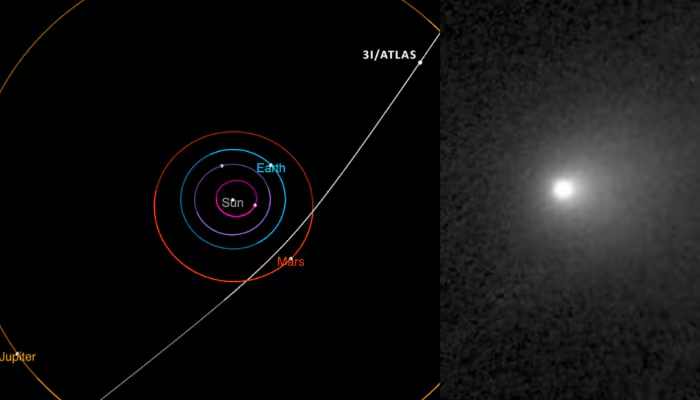
NASA announced the discovery of interstellar comet 3I/ATLAS on July 1, 2025. It is only the third known interstellar object to enter our solar system, following the mysterious Oumuamua in 2017 and Borisov in 2019.
Unlike typical comets formed within the solar system, interstellar objects like 3I/ATLAS originate from distant star systems, making them valuable for studying the chemistry and physics of alien environments.
The comet is now making its closest approach to the Sun, its perihelion, on October 29–30. This moment offers scientists an opportunity to analyze its chemical composition, trajectory, and energy behavior in unprecedented detail.
While most researchers believe 3I/ATLAS is a naturally occurring comet, some, including Harvard’s Avi Loeb, suggest that its characteristics could point toward an artificial origin.
1. Unusual chemical composition
Observations show that 3I/ATLAS emits a steady plume containing roughly four grams of nickel per second—but without any trace of iron. This is highly atypical because nickel and iron almost always occur together in cosmic objects.
Such selective emission of nickel suggests the presence of refined or processed material, which is uncommon in natural comets. Loeb argues that this anomaly raises questions about the comet’s natural origin.
2. Presence of nickel tetracarbonyl
Scientists have identified nickel tetracarbonyl, a compound rarely seen in nature but often associated with industrial metal processing on Earth. Its existence in space could mean one of two things: either the comet formed in an environment with extraordinary chemistry, or its materials were engineered.
This discovery is one of the key reasons why Loeb suspects the object may not be entirely natural.
3. Mysterious anti-solar tail behavior
Early images of 3I/ATLAS revealed an anti-tail—an unusual feature that appeared to point toward the Sun instead of away from it. Later observations showed that the tail reversed direction, now facing away from the Sun.
While solar radiation can cause complex dust dynamics, Loeb speculates that such directional changes might suggest deliberate control or maneuvering—similar to propulsion or orientation systems.
4. Unusual trajectory and speed
3I/ATLAS travels on a hyperbolic trajectory, meaning it is not gravitationally bound to the Sun. This confirms its interstellar origin, but its specific path and acceleration deviate from what would be expected if it were a typical comet influenced only by gravity.
It is traveling at an estimated 130,000 miles per hour (about 58 kilometers per second), faster than most solar system objects of similar size. Loeb points out that the trajectory bears some resemblance to the puzzling motion of Oumuamua, which some researchers also speculated could be an alien probe or fragment of extraterrestrial technology.
5. Massive size compared to previous interstellar visitors
3I/ATLAS is significantly larger than Oumuamua or Borisov, with an estimated diameter of approximately 19 kilometers (12 miles). Such a massive interstellar object is rare, making it an especially intriguing target for astronomers.
The size and mass raise questions about how it managed to travel vast interstellar distances without fragmenting, and whether its structure is more durable than that of typical icy comets.
6. Absence of rocky material
Loeb argues that finding a large interstellar object without any detectable rocky or silicate material is highly improbable. Most natural comets contain a mixture of rock, ice, and dust. The absence of rock in 3I/ATLAS could suggest either an unusual formation environment or artificial engineering designed for durability and reflectivity.
7. Signs of engineered materials
Beyond its composition and motion, Loeb believes the comet’s material properties may hint at intelligent design. The compounds and emission patterns detected in its plume resemble those used in industrial metal refining or coating processes on Earth.
This combination of metallic emissions, unusual chemical ratios, and directional shifts in its tail fuels speculation that 3I/ATLAS might be an artifact—perhaps a fragment of alien technology, a probe, or even debris from an ancient extraterrestrial civilization.
What happens next?
As 3I/ATLAS reaches its closest point to the Sun, observatories across the world are gathering data to better understand its composition and origin. Spacecraft such as NASA’s Psyche mission and the European Space Agency’s JUICE probe are expected to make supplementary observations from advantageous positions in space.
Scientists hope these studies will clarify whether the comet’s peculiar behavior stems from natural processes or something far more unusual.
For astronomers, every interstellar visitor is a scientific treasure, revealing how matter forms and behaves beyond the solar system. For thinkers like Avi Loeb, it is also a reminder to keep an open mind about what might be traveling through our cosmic neighborhood.