TL;DR
Interstellar comet 3I/ATLAS has sparked online speculation after NASA data showed unexplained changes in its motion and color. While Harvard astrophysicist Avi Loeb suggests a possible “technological signature,” most scientists caution that natural forces could still explain the phenomenon. Here’s what we know, and what we don’t, about one of space’s newest enigmas.
What is 3I/ATLAS, and why is it significant?
Comet 3I/ATLAS, roughly the size of Manhattan, entered the solar system earlier this year from interstellar space, making it only the third known interstellar object ever observed after ‘Oumuamua (2017) and 2I/Borisov (2019).
Detected by the Asteroid Terrestrial-impact Last Alert System (ATLAS) in Hawaii, the comet immediately intrigued astronomers for two reasons:
- Its trajectory didn’t match the typical path expected from a natural comet.
- Its brightness and color changed unpredictably as it neared the Sun.
What NASA data revealed about its “unusual maneuver”
According to NASA’s Jet Propulsion Laboratory (JPL), 3I/ATLAS displayed what scientists call non-gravitational acceleration, meaning it sped up in ways that couldn’t be explained solely by the Sun’s gravity.
Usually, comets accelerate slightly due to the “rocket effect,” the release of gas and dust as ice vaporizes under sunlight. But 3I/ATLAS appeared to move much faster and in multiple directions, including sideways, which defied simple physical models.
This anomaly prompted Avi Loeb, a Harvard astrophysicist known for unconventional hypotheses, to suggest that ATLAS might exhibit a “technological signature” — an engineered behavior rather than a purely natural one.
“The comet’s movement suggests propulsion beyond what sublimation can explain,” Loeb said, hinting that an internal energy source could be at play.
Why scientists are skeptical of the “alien spacecraft” theory
Despite the intrigue, most astrophysicists remain cautious. There are several natural explanations for ATLAS’s movement that don’t require extraterrestrial intervention:
- Uneven outgassing:
Jets of vaporized ice could produce uneven thrust, pushing the comet in unpredictable directions. - Fragmentation:
If ATLAS broke apart, the shifting mass distribution could alter its acceleration and trajectory. - Optical effects:
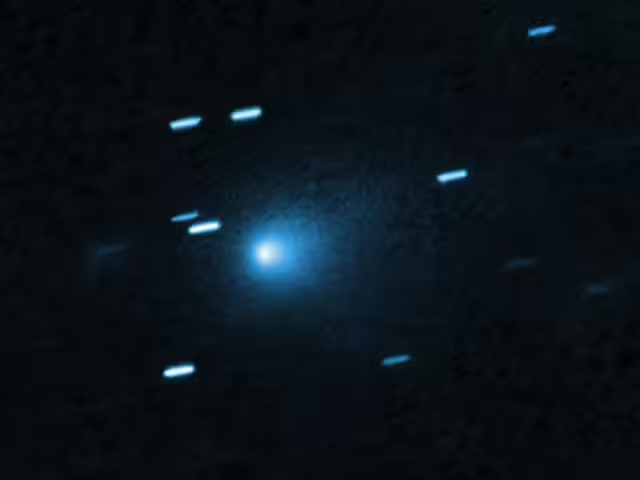
The perceived change in brightness and color, from red to bright blue, might be due to ionized carbon monoxide and other volatiles interacting with solar radiation.
Dr. Karen Meech, an astronomer at the University of Hawaii who also studied ‘Oumuamua, noted that such behaviors, while unusual, “don’t automatically imply technology — they tell us we don’t fully understand interstellar ice composition yet.”
Why Avi Loeb’s views still matter
Avi Loeb has long challenged traditional thinking in astrophysics. He gained global attention for arguing that ‘Oumuamua, another interstellar visitor, could have been an alien probe due to its reflective surface and unexplained acceleration.
While his claims draw skepticism, they have had an important scientific effect: they push researchers to develop better models for interstellar phenomena. Loeb’s recent statements about 3I/ATLAS continue this trend, forcing the community to confront the limits of current explanations.
The “anti-tail” phenomenon: another strange clue
Adding to the mystery, 3I/ATLAS has shown an “anti-tail,” a dust stream pointing toward the Sun instead of away from it. This optical illusion can occur when sunlight scatters particles in a specific direction relative to Earth’s viewpoint, but in ATLAS’s case, the effect was unusually pronounced.
Combined with its shifting color and erratic path, these features make ATLAS one of the most complex interstellar bodies ever studied.
Could 3I/ATLAS really be an alien probe?
While the phrase “alien spacecraft” grabs headlines, the scientific community stresses that extraordinary claims require extraordinary evidence. So far, ATLAS’s signals, light curves, and trajectory don’t confirm any artificial origin.
However, Loeb argues that dismissing the possibility outright is also unscientific. “We should collect data before forming conclusions,” he says, calling for future missions to directly observe or intercept interstellar objects.
That idea isn’t far-fetched. NASA and the European Space Agency are already exploring “rapid-response missions” capable of launching probes to study such visitors before they exit the solar system.
Why 3I/ATLAS matters for future space exploration
Whether or not 3I/ATLAS is natural, its arrival is a scientific goldmine. Studying its composition could help astronomers:
- Understand the building blocks of other solar systems.
- Identify new chemical signatures not seen in local comets.
- Refine models predicting how interstellar objects behave near stars.
If Loeb’s theory turns out to be even partially correct, it could revolutionize how humanity looks for technological life beyond Earth, shifting the focus from distant exoplanets to the debris that occasionally visits our neighborhood.
The bottom line
3I/ATLAS has reignited the debate over alien technology, but the evidence remains inconclusive. What’s clear is that this object, with its glowing blue hue and mysterious movement, is expanding the boundaries of what astronomers thought possible.
Whether it’s a cosmic anomaly or something more intentional, ATLAS reminds us of one simple truth: the universe still holds secrets we barely understand.