
As NASA’s Artemis II continues its 10-day journey around the Moon and back, the mission is delivering more than just scientific milestones—it’s producing some of the most striking images of Earth ever captured.
But it’s not just the visuals that have people talking. It’s how they were taken.
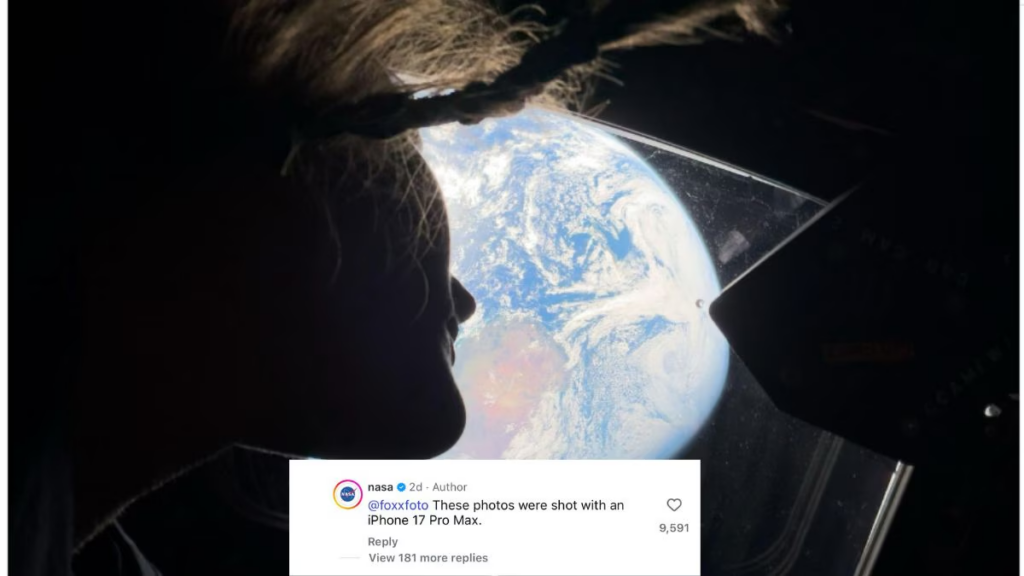
Photos released on April 4 showing astronauts silhouetted against a glowing Earth have gone viral, largely because they were shot on something surprisingly familiar: an iPhone.
What Makes the Artemis II iPhone Photos So Remarkable?
The images show astronauts Christina Koch and Reid Wiseman inside the Orion spacecraft, gazing out at a fully illuminated Earth.
Also onboard are Victor Glover and Jeremy Hansen, making this a multinational crew representing both the U.S. and Canada.
What stands out in these photos:
- The composition: Dark silhouettes against a radiant planet create a near-cinematic contrast
- The scale: Earth appears as a complete, glowing sphere—something few humans have witnessed firsthand
- The perspective: A deeply human moment set against the vastness of space
And then there’s the twist: the photos were taken using an iPhone.
Why the “Shot on iPhone” Detail Is Turning Heads
The phrase “shot on iPhone” has long been a marketing staple for Apple Inc.. But Artemis II may have just redefined it.
Social media reactions ranged from awe to disbelief:
- Tech commentators called it the “best shot on iPhone of all time”
- Users joked the image would end up on billboards for decades
- Others marvelled that a device similar to the one in their pocket captured Earth from deep space
The fascination isn’t just hype—it reflects how far consumer technology has come.
A Consumer Device in Deep Space
While NASA missions rely on highly specialised imaging equipment, astronauts often carry modified consumer devices for practical use.
These devices are typically:
- Hardened for space conditions (temperature, radiation, pressure)
- Adapted for usability in microgravity
- Used for documentation and communication, not just science
The result? Images that feel more personal and immediate than those captured by large scientific instruments.
How an iPhone Can Capture Space-Quality Images
At first glance, it seems improbable. Space photography has traditionally required:
- Large sensors
- Specialized lenses
- Complex calibration systems
But modern smartphones have narrowed that gap significantly.
Computational Photography Does the Heavy Lifting
Today’s iPhones rely heavily on software to enhance images:
- HDR (High Dynamic Range) balances bright and dark areas—perfect for scenes like Earth against space
- Image stacking improves clarity and reduces noise
- AI-driven adjustments refine exposure and colour in real time
In the Orion capsule, where lighting conditions are extreme, these features become especially valuable.
Space Is a Surprisingly Ideal Studio
Ironically, space offers some advantages for photography:
- No atmospheric distortion
- Consistent, unfiltered sunlight
- Deep contrast between light and dark
These conditions help even small camera sensors capture dramatic, high-quality images.
The Bigger Picture: Why These Images Matter
Beyond the viral appeal, these photos represent a shift in how space missions are documented and shared.
Making Space Exploration More Relatable
For decades, space imagery has felt distant—both literally and emotionally.
But when images are captured on everyday devices:
- They feel more accessible
- They bridge the gap between astronauts and the public
- They reinforce the idea that space exploration belongs to everyone
A New Era of Real-Time Storytelling
Missions like Artemis II aren’t just about exploration—they’re also about engagement.
NASA is increasingly focused on:
- Sharing high-quality visuals quickly
- Leveraging social media to reach global audiences
- Humanising astronauts and their experiences
Artemis II by the Numbers
While the photos are grabbing attention, the mission itself is historic.
Key details:
- Total यात्रा distance: ~685,000 miles
- Mission duration: ~10 days
- Trajectory: Two Earth orbits followed by a figure-eight loop around the Moon
- Objective: Test systems for future crewed lunar landings
This builds on Artemis I, an uncrewed test flight, and sets the stage for future missions like Artemis V, which aims to land astronauts on the lunar surface later this decade.
The Viral “Full Disk” Earth Photo and Meme Culture
The iPhone images weren’t the only viral moment.
NASA also released a “full disk” image of Earth—showing the entire planet in a single frame—which quickly turned into meme material.
Users jokingly referred to it as:
- A “group photo” of humanity
- Earth’s “profile picture update”
- The ultimate long-distance selfie
This blend of science and humour highlights how modern audiences engage with space content: seriously impressed, but also ready to remix it.
What This Means for the Future of Space Imaging
The Artemis II iPhone photos signal something bigger than a viral moment.
They point to a future where:
- Consumer technology plays a larger role in space missions
- Astronauts act as real-time storytellers
- The line between professional and personal photography continues to blur
And perhaps most importantly, they remind us that even as technology advances, the emotional impact of seeing Earth from afar remains unchanged.
TL;DR
- NASA’s Artemis II crew released stunning Earth photos taken on an iPhone
- The images show astronauts silhouetted against a fully lit Earth
- Social media is stunned by the use of consumer tech in deep space
- Advances in smartphone cameras and space conditions make such shots possible
- The photos mark a new era of relatable, real-time space storytelling