
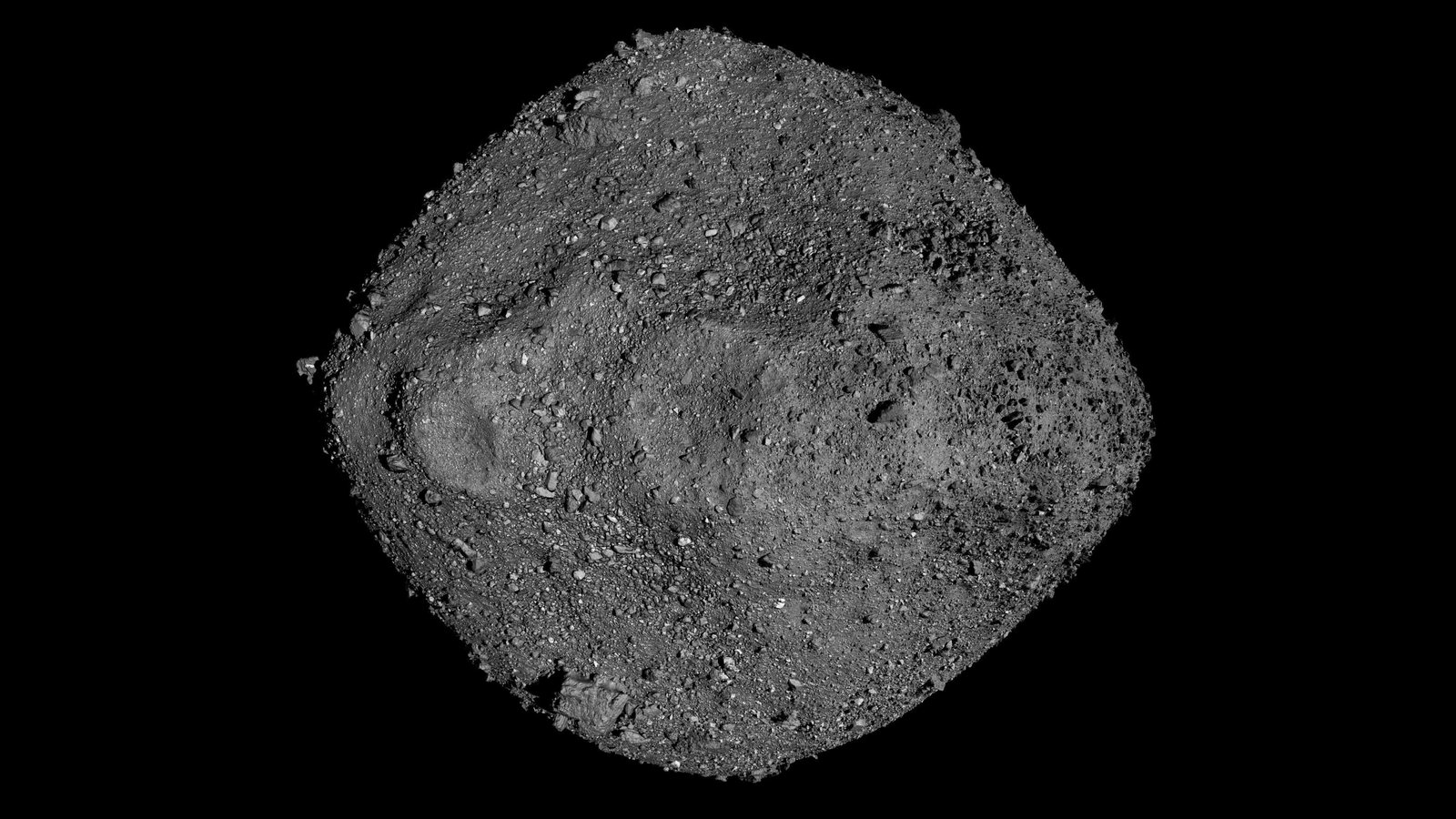

Earth has picked up a temporary passenger. The Minor Planet Center has classed the small asteroid mini-moon 2026 QQ8 as a “Temporarily Captured Object.” NASA JPL’s orbit shows it has been loosely bound to Earth since spring and will slip away in December.
Calling it a “new moon” stretches the word. The object is a rock roughly 3 to 10 feet across, and it never comes as close to us as the Moon does. What makes it interesting is its very Earth-like orbit, and how close it came to being written off as space junk.
Spotted from Hungary, held since late April
The first sighting came from the GINOP-KHK station at Piszkéstető Observatory in Hungary. It was logged at 22:07 UTC on Aug. 19, just after midnight local time. That is according to the MPEC Watch record of the Oct. 29 circular, MPEC 2026-U95.
EarthSky credits the find to Hungarian astronomer Krisztián Sárneczky. Nine stations reported 36 positions in all, the last on Oct. 9.
NASA JPL’s Small-Body Database entry, solved on Oct. 29, tells the story of the capture. The rock passed about 1 million kilometers from the Moon on April 19. On May 1 it passed about 1.16 million kilometers from Earth.
For that pass, JPL lists the rock’s escape speed from Earth as zero. In other words, it was bound. EarthSky dates the capture to late April.
The closest pass came on Aug. 18, a day before discovery. The rock was about 537,000 kilometers away, roughly 1.4 times the Moon’s average distance. JPL then lists lunar flybys on Aug. 20, Sept. 1, Oct. 3 and Dec. 4.
Leaving in December, back near Earth in 2058
The visit ends with an Earth pass on Dec. 13 at about 1.35 million kilometers. This time JPL gives a small positive escape speed. So by mid-December the rock is free and back on its own orbit around the Sun.
Counting from late April, that is a stay of about seven and a half months.
It has been close before. JPL’s table shows a pass on April 16, 1965, at about 1.8 million kilometers. That time it was moving too fast for Earth to hold it. The same thing happens again on Dec. 19, 2058, at about 1.9 million kilometers.
EarthSky, which reported both encounters, says the rock comes near Earth roughly once a decade. The reason is its orbit.
JPL lists a 359-day path around the Sun that is almost circular. It is tilted only about half a degree from Earth’s. The rock and Earth are running nearly the same lap at nearly the same pace, so now and then they meet slowly. That slow meeting, not a near miss, is what lets Earth hold on.
Natural rock or old rocket stage?
A tiny object in an Earth-like orbit is exactly what a spent rocket stage looks like. So the first question was whether 2026 QQ8 was hardware.
According to EarthSky, follow-up from two telescopes let the Minor Planet Center rule out space junk. They were the University of Hawaii 2.2-meter telescope and the Lowell Discovery Telescope. Both appear among the nine stations in the MPEC record.
The test is the push from sunlight. “Human-made debris is usually relatively light and gets pushed around by the pressure of sunlight,” JPL’s Oscar Fuentes-Muñoz told EarthSky about an earlier mini-moon. An empty stage is a big, thin-walled can. A solid rock of the same width barely feels the push.
Both JPL’s orbit and the Minor Planet Center’s own orbit include a fitted sunlight-pressure term for 2026 QQ8. The center’s website refused our connections, so we could not read the circular’s own reasoning.
How big is 2026 QQ8, really?
Nobody has measured it directly. EarthSky gives “about 3 feet (1 meter).” The only hard number is brightness: JPL lists an absolute magnitude of 31.4.
Turning brightness into size depends on how reflective the surface is, and that is unknown. We used the formula behind NASA’s asteroid size estimator. A fairly bright surface, at 30% reflectivity, gives about 1.3 meters. A dark one, at 5%, gives about 3.2 meters.
So “a meter” is the low end of a range that runs to about 10 feet. Either way it is no threat. JPL does not list it as potentially hazardous, and EarthSky says a rock this size would only make “a fiery show” in the atmosphere.
Where it came from is still open
We found no paper or preprint on 2026 QQ8 on arXiv or in the AAS Research Notes. We also found no published idea of where it came from.
Its orbit invites the question, because the last well-studied mini-moon was special. 2024 PT5 was found by the ATLAS survey on Aug. 7, 2024. It was about 10 meters wide and loosely held from Sept. 29 to Nov. 25 that year, EarthSky reported.
A team led by Lowell Observatory’s Teddy Kareta argued in The Astrophysical Journal Letters that it is probably a piece of the Moon. A team including Carlos and Raúl de la Fuente Marcos found its spectrum consistent with lunar-like silicates. For 2026 QQ8, the same test needs a spectrum of a far fainter rock.
Captures like this are rare but not new. The Catalina Sky Survey found 2020 CD3 in February 2020. It was 1.9 to 3.5 meters wide and had been bound for about three years.
Quasi-moons such as 2025 PN7 are different. They never orbit Earth at all. They circle the Sun so close to our path that they seem to travel with us for decades.
Deep surveys like the one behind Rubin Observatory’s possible new dwarf planet should find more short visitors. For scale, this whole capture plays out within 1.4 million kilometers of Earth. Voyager 1 reaches one light-day away on Nov. 18.
The next date to watch is the rock’s Moon flyby on Dec. 4. Nine days later it makes its last close pass and leaves.