
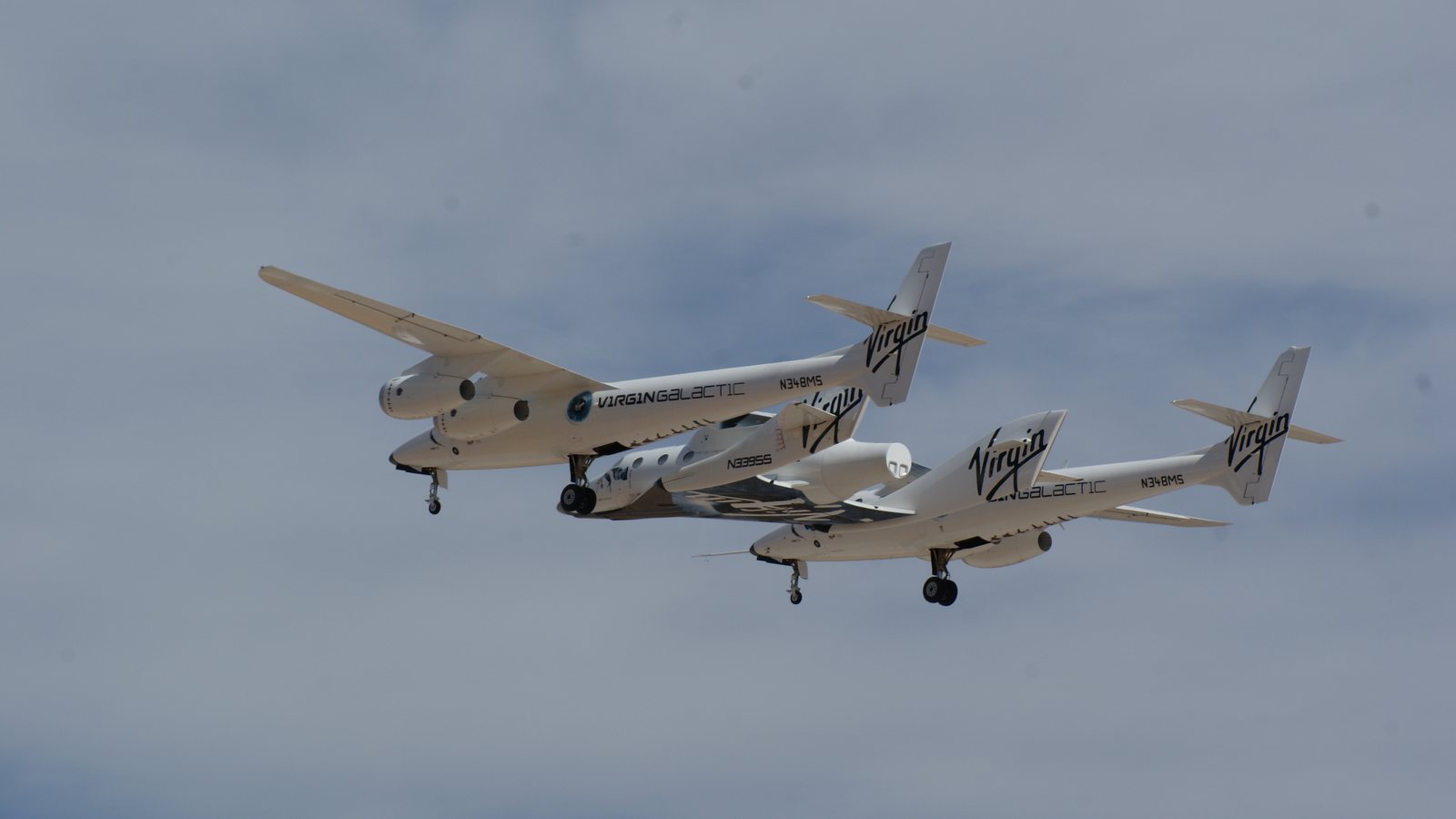

Virgin Galactic’s new spaceship has a name and a home. The company named its first Delta-class vehicle Apeiron on the morning of Wednesday, Oct. 28, then flew it under its carrier aircraft from Arizona to Spaceport America in New Mexico that afternoon.
The same announcement moved the date that matters most to customers. Virgin Galactic Apeiron is now expected to start commercial flights in “early Q2 2027,” according to the company’s release. It is the second time since August that the start of passenger service has slipped. Hundreds of people who have already paid for seats are still waiting, and Virgin Galactic hasn’t flown anyone since June 2024.
A name in the morning, a ferry flight by lunch
Virgin Galactic announced the name first. The company says Apeiron is pronounced “App-Err-On” and takes its meaning from the ancient Greek idea of the boundless. It won a public vote that drew thousands of responses from 83 countries across six continents, the company said.
The vote began in August with four finalists: Horizon, Explorer, Ascend and Apeiron. Virgin Galactic employees and ticket holders submitted 276 names to start, collectSPACE reported.
Hours later the spaceship left Phoenix-Mesa Gateway Airport, near the company’s factory in Mesa, attached beneath the twin-fuselage carrier aircraft Eve. Takeoff came at 10:29 local time and touchdown at Spaceport America at 12:59 New Mexico time, about an hour and a half later once the time zones are counted.
Pilots Michael Masucci and Dan Alix flew Eve, with flight test engineer Tori Crichton aboard. Colglazier called it “a moment years in the making” and told staff and customers, “your Spaceship has arrived.”
“This morning, we gave Apeiron a name. This afternoon, Apeiron came home,” CEO Michael Colglazier said in the release. A crowd at the spaceport cheered the landing, according to the Albuquerque Journal, citing the company’s social media.
Two delays since August, both blamed on avionics
The ferry flight was not a spaceflight. Apeiron hasn’t flown on its own yet. Engineers at the spaceport will now finish “avionics software integration and validation” and prepare for flight tests, the company said. Paying customers fly only after that test program is complete.
The target has moved steadily later. In November 2025, Colglazier said commercial flights could begin as early as October 2026. The company’s March 30 results release still said Q4 2026 was on track.
By mid-August, the second-quarter release had moved it to February 2027. That release also said flight testing would start in October. This week, the date became early Q2 2027, and flight testing was still at the preparation stage.
The second Delta ship has slipped by about the same amount. In March the company expected it between late Q4 2026 and early Q1 2027. In August it was March 2027, and now it is late Q2 or early Q3 2027.
The company blamed both delays on the same work, installing and validating avionics. That points to the ship’s software and electronics, not its airframe, as the bottleneck. Assembly of the second ship and a static test article is underway in Arizona, the company said.
What Delta is supposed to fix
Virgin Galactic’s model is air launch. Eve carries the spaceship to altitude and releases it, and the spaceship’s rocket motor takes it on a suborbital arc before it glides back to a runway landing. Its old ship, VSS Unity, flew that profile about once a month before its final flight, Galactic 07, on June 8, 2024.
That low rate is why the company retired Unity to build Delta. The company says each new ship can fly twice a week and last more than 500 missions. Each carries six passengers, two more than Unity, Gadget Review reported. The plan is to start at about one flight a week and build toward 12 a month from Spaceport America, the Albuquerque Journal reported last year.
Virgin Galactic hasn’t demonstrated any of those figures. They are design goals for a vehicle that hasn’t yet made a powered flight.
Tickets at $750,000 and a shrinking cash pile
Demand has held up through the delays. In August, Colglazier said the latest tranche, priced at $750,000, was “oversubscribed and booked out ahead of schedule.” The company said it would release the next one “at higher price points this fall.”
The harder problem is money. Virgin Galactic had $286 million in cash, cash equivalents and marketable securities on June 30. It burned $91 million in free cash flow in the second quarter and guided to $95 million to $100 million in the third and $80 million to $90 million in the fourth.
Put those numbers together and, before any new capital the company may have raised since June, the balance would fall to roughly $100 million by the end of 2026. That is still months before Apeiron is due to earn ticket revenue. The company says it expects positive quarterly cash flow “within 2027,” a goal that depends on both ships flying often and on schedule.
New Mexico has a stake too
Spaceport America is a state agency that receives about $4 million a year in taxpayer money, and Virgin Galactic is its anchor tenant. Spaceport director Scott McLaughlin told lawmakers in August that the company’s monthly user fees had fallen 73.5%, from $188,888 to $50,000, according to the Albuquerque Journal. Virgin Galactic still pays about $3 million a year in lease payments.
The last Virgin Galactic flight from the spaceport was more than two years ago. A steady flight rate would bring tourists, crews and jobs back to a facility the state built for exactly this.
The space business elsewhere isn’t standing still. Governments are flying their own reusable craft, such as China’s secretive spaceplane, and startups are pitching heavy rockets for orbital AI data centers. Virgin Galactic’s narrower bet is that wealthy customers will keep paying for a few minutes of weightlessness.
When to expect the next update
Virgin Galactic says it will give more program details on its third-quarter 2026 earnings call in November. The questions to watch there are whether flight testing has a start date, how much cash is left, and what the next ticket tranche costs.