
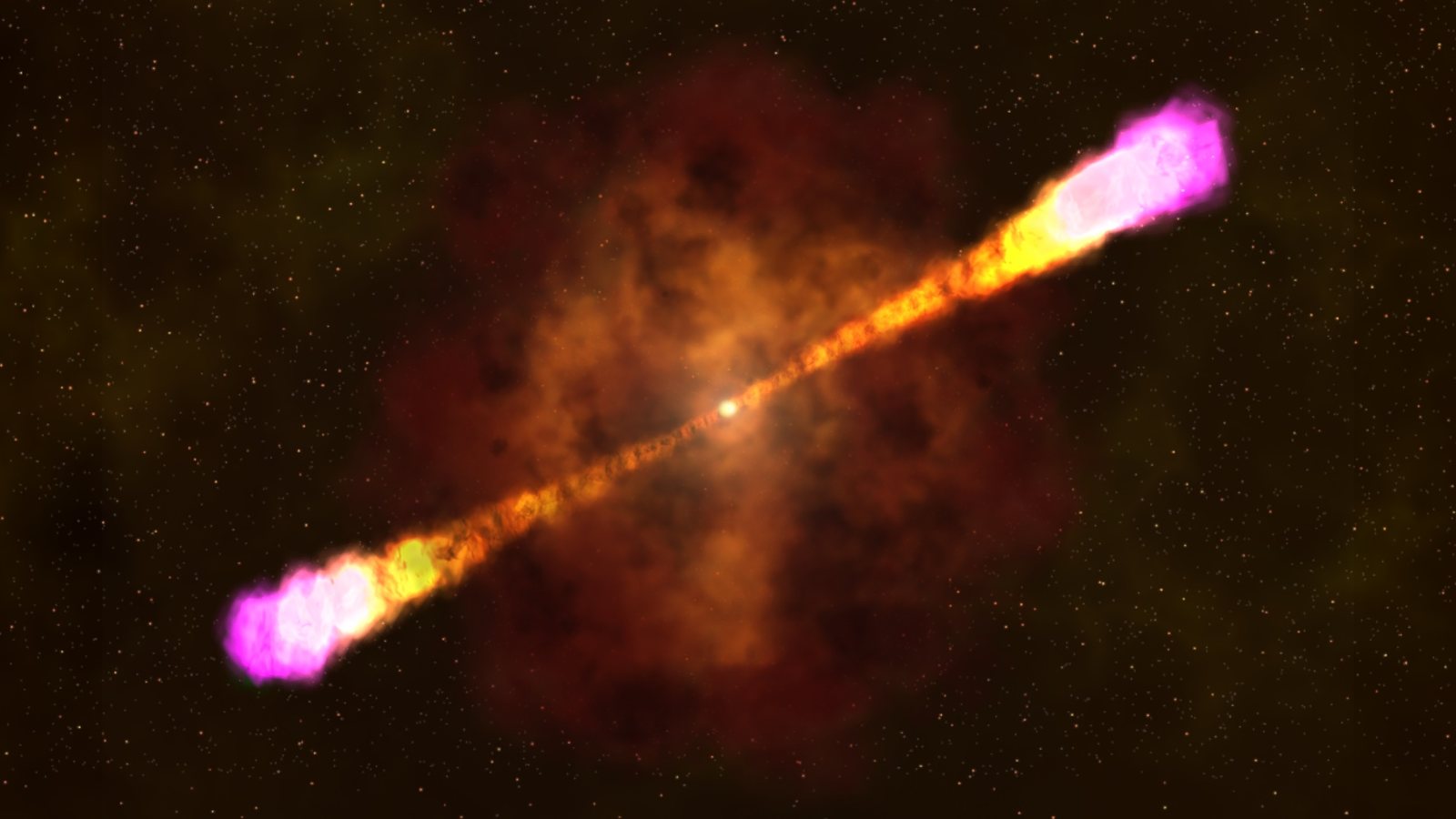

A gamma-ray burst first caught by NASA’s Swift observatory in 2022 kept flaring in X-rays for 27 days after it exploded. That is about 20 days later than any flaring seen before, measured in the burst’s own time frame. A team of 33 astronomers reported it in a preprint posted Sept. 18.
The flash itself, GRB 220706A, lasted only about a minute and a half in gamma rays. The record is for how long something at its heart stayed active afterward. The researchers can’t yet say what that something was.
The paper has not been peer reviewed.
Phys.org wrote it up on Oct. 6. Lead author Benjamin Gompertz of the University of Birmingham in England then explained the work to Space.com on Oct. 26.
It is also one of the last records tied to Swift. NASA retired the observatory last week, ahead of its fall back to Earth.
What a gamma-ray burst is, and what an “engine” means
NASA describes gamma-ray bursts as “short-lived outbursts of the highest-energy light.” Its explainer splits them into two kinds. Short bursts, under two seconds, mostly come from colliding neutron stars. Long bursts come from the collapse of a massive star.
Either way, the collapse leaves a newborn black hole or a fast-spinning neutron star. Astronomers call that object the central engine. It fires jets of matter outward at nearly the speed of light. We only see a burst when one of those jets points almost straight at Earth.
After the flash comes a fading afterglow in X-rays, visible light and radio waves. That glow is the jet plowing into surrounding gas, and it dims smoothly. A sudden flare on top of it usually means the engine has kicked back into life.
That is what makes GRB 220706A unusual. Its afterglow behaved normally, but the flares kept coming for weeks.
How Swift, NICER and Chandra tracked the late flares
Swift’s Burst Alert Telescope picked up the burst on July 6, 2022, at 16:09 UT. Swift pointed its X-ray telescope at it 103 seconds later, according to the first alert circular.
NASA’s NICER instrument on the International Space Station then caught an X-ray flare more than a day after the trigger. That alone was late, since the paper notes that most X-ray flares show up within about 1,000 seconds.
The team kept watching. It requested extra Swift observations from Aug. 7 to Oct. 3, 2022.
NASA’s Chandra X-ray Observatory looked once, on Aug. 16. The last flares turned up about 51 days after the burst.
So why 27 days? The burst’s galaxy sits at a redshift of 0.8577, so far away that the universe’s expansion stretches time as seen from Earth. Events there appear to run 1.86 times slower, which turns 51 days on our clocks into about 27 at the source.
“In a nutshell, GRB 220706A is an extremely late X-ray flare. X-ray flaring is common following GRBs, but previously it has always come within the first few days after we detect the burst,” Gompertz told Space.com.
The old record was six days, and the new one rests on thin data
“The previous record for delayed flaring was about six days after the GRB,” Gompertz added. That mark belongs to GRB 210204A. Its optical flares came 6.71 days after the burst in its own frame, another team reported in 2022. The new paper puts GRB 220706A ahead by about 20.6 days.
The paper is open about how thin the latest data are. The late X-rays came from just two Swift observations. The team checked them by hand for hot pixels and stray sources. It found none and reported “no reason to doubt” the point.
This is not the longest gamma-ray burst ever, though some coverage has called it that. NASA says GRB 250702B “set a new record when it continued for days.” That burst set off NASA’s Fermi telescope three separate times over several hours on July 2, 2025.
China’s Einstein Probe had picked up X-rays from the same spot a day earlier, a team led by Andrew Levan reported. Levan is also a co-author of the new paper.
GRB 220706A’s flash was ordinary by comparison. Its record is for how late the activity ran, not how long the gamma rays lasted.
On a broader measure of engine activity, the team ranks it 8th of 550 bursts in the UK Swift Science Data Centre archive. That still makes it one of the rare “ultra-long” bursts. It even edges out the best-known example, GRB 111209A.
A bright supernova points to a magnetar, or a giant star
The team also found a likely supernova from the same explosion. Corrected for dust in the host galaxy, it was bright enough to match the rare class of superluminous supernovas. That would be the first such supernova seen alongside a gamma-ray burst, the paper says.
There is a catch. The supernova’s rise came during a gap in X-ray coverage. So the light could instead be the visible glow of the flaring.
“We don’t know what the central engine driving this outburst is, and that’s what makes this such a compelling event,” Gompertz told Space.com. Each candidate in the paper solves one problem and creates another.
A magnetar is the first. It is a neutron star with an extreme magnetic field, which in the team’s fits spins at least 500 times a second. A magnetar worked for GRB 111209A, whose supernova looks similar.
“Our supernova looks a lot like that one, so a magnetar might be present here,” Gompertz said. But the paper calls the magnetar fits “fine tuned” to hide that model’s usual signature.
A much bigger star is the second. “A bigger star would take longer to fall in on itself and so provide a longer-lived source of energy to power the jet,” Gompertz said. The paper estimates it would take a swollen supergiant of about 10 times the sun’s mass.
Gas shells and black holes are also on the table
A third option is shells of gas the star shed before it died. If the jet slammed into them, the burst would not need a month-long engine at all. But the late flares are too brief for a jet hitting a simple jump in gas density, the authors calculate.
The fourth is a star shredded by a black hole, since the burst appears to sit at its galaxy’s center. The team leans against this. The X-rays look like other gamma-ray bursts, not like known jetted star-shredding events.
The authors still favor a collapsing star, mainly because of the supernova. One event can’t settle it. Physicists face the same problem with a single record-energy neutrino that has no second example.
Why bursts like this are hard to catch, now that Swift is gone
Gompertz said the hunt for more is limited by where the telescopes sit. “GRBs this long are hard to detect because most of the satellites we use to find them are in low Earth orbit, which means the target is periodically blocked every 90 minutes or so,” he told Space.com.
He also said long bursts seem more active in X-rays than in gamma rays. That favors X-ray sky monitors such as the Einstein Probe, which launched in January 2024. The Chinese Academy of Sciences leads it, with ESA, Germany’s Max Planck Institute for Extraterrestrial Physics and France’s CNES.
The follow-up side is thinner now. Swift spent 22 years chasing bursts and, according to NASA, observed more than 2,000 of them. NASA announced the end of its mission on Oct. 23, and no replacement is waiting.
“With any luck, we’ll get a few more of these to chase so that we can start trying to understand the incredible power sources that drive them,” Gompertz said. The paper’s next step is peer review, and it lists no journal yet.