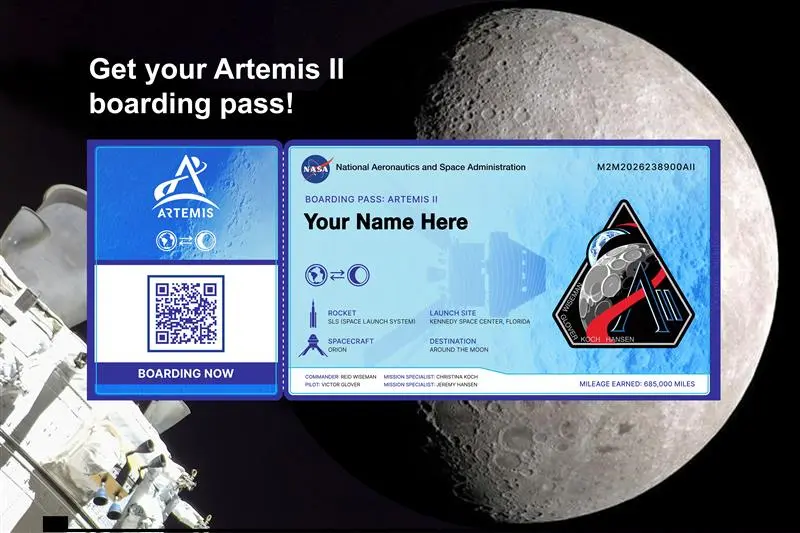
NASA’s Artemis II mission is shaping up to be one of the most symbolic spaceflights of the decade. Scheduled to carry astronauts farther from Earth than any human mission since 1972, it will also carry something more personal: the names of people from around the world who choose to be part of the journey.
If you have ever wanted a small but meaningful connection to a historic Moon mission, this is your chance. Here’s how the “Send Your Name with Artemis” program works, what Artemis II will actually do in space, and why this mission is a critical step in humanity’s return to the Moon.
What is the Artemis II mission?
Artemis II is NASA’s first crewed mission under its Artemis program, a long-term effort to return humans to the Moon and eventually send astronauts to Mars.
The mission will send four astronauts on a roughly 10-day journey around the Moon aboard NASA’s Orion spacecraft. Unlike Artemis I, which flew without a crew, Artemis II will test how Orion performs with humans on board in deep space.
The launch window opens on February 6, with NASA expected to confirm the final launch date closer to liftoff.
Who is part of the Artemis II crew?
The Artemis II crew brings together experienced astronauts from both the United States and Canada:
- Reid Wiseman, NASA astronaut and mission commander
- Victor Glover, NASA astronaut and pilot
- Christina Koch, NASA astronaut and mission specialist
- Jeremy Hansen, Canadian Space Agency astronaut and mission specialist
Hansen’s participation marks the first time a Canadian astronaut will travel to the Moon, highlighting the international nature of the Artemis program.
How does the “send your name to the Moon” program work?
NASA has a long tradition of inviting the public to symbolically join its missions. For Artemis II, the agency is continuing that tradition by storing names digitally on an SD card that will fly aboard Orion.
This initiative allows people to feel personally connected to a mission that represents a new chapter in human space exploration.
The names are not etched onto hardware or displayed externally. Instead, they are stored digitally and travel around the Moon with the crew before returning to Earth.
Public participation campaigns serve several purposes:
- They build global interest in space exploration
- They help inspire students and young scientists
- They reinforce the idea that space exploration is a shared human effort
From a strategic standpoint, public engagement also strengthens support for long-term programs like Artemis, which require years of funding and international cooperation.
How to register your name for the Artemis II mission
Registering your name is straightforward and takes less than five minutes. NASA has kept the process simple to encourage broad participation.
Step-by-step registration process
- Visit NASA’s official “Send Your Name with Artemis” website
- Enter your first and last name
- Create a 4- to 7-digit personal identification number (PIN)
- Submit your information
Once registered, you can download a customized digital boarding pass that serves as a keepsake of your symbolic trip to the Moon.
NASA will accept registrations until January 21, after which the names will be finalized and uploaded to the SD card.
What exactly will Artemis II do in space?
A historic lunar flyby
Artemis II will not land on the Moon. Instead, Orion will perform a lunar flyby, looping around the Moon and returning to Earth. This trajectory allows NASA to test critical systems without the added risks of landing.
During the mission, astronauts will evaluate:
- Life support systems in deep space
- Navigation and communication far from Earth
- Orion’s heat shield during high-speed reentry
The mission marks humanity’s first crewed journey beyond low Earth orbit since Apollo 17 in 1972.
Why Artemis II is a big deal for future Moon missions
A stepping stone to Artemis III
Artemis II sits between two major milestones:
- Artemis I, the successful uncrewed test flight
- Artemis III, planned to land astronauts on the Moon as early as 2027
Without Artemis II, NASA cannot confidently move forward with a lunar landing. The mission’s data will directly inform how astronauts operate, live, and work in deep space.
Preparing for a long-term lunar presence
NASA’s Artemis campaign is not about a single flag-planting moment. The agency’s long-term goal is to establish a sustained human presence on and around the Moon.
That includes:
- Regular crewed missions
- A future lunar space station known as Gateway
- Surface infrastructure that supports science and exploration
Artemis II helps validate the transportation system that will make all of this possible.
How Artemis II fits into the bigger picture of space exploration
The Moon is increasingly viewed as a testing ground for Mars. The Artemis II mission allows NASA to study how humans handle long-duration spaceflight beyond Earth’s protective magnetic field.
Key lessons from Artemis II will influence:
- Radiation protection strategies
- Crew health and performance
- Mission planning for even longer journeys
What happens after the Artemis II mission?
If Artemis II succeeds, NASA will move closer to executing Artemis III, which aims to return astronauts to the lunar surface for the first time in more than half a century.
Beyond that, Artemis missions will gradually increase in complexity, laying the groundwork for international partnerships and commercial involvement in lunar exploration.
For the public, the ability to send a name to the Moon is a reminder that these missions are not just technical achievements. They are cultural moments that invite people on Earth to feel invested in humanity’s future in space.
TL;DR
- Artemis II is NASA’s first crewed mission around the Moon since 1972.
- The mission will carry four astronauts on a 10-day lunar flyby.
- NASA is allowing the public to send their names to the Moon on an SD card aboard Orion.
- Registration is free, quick, and open until January 21.
- Artemis II is a critical step toward future lunar landings and eventual Mars missions.