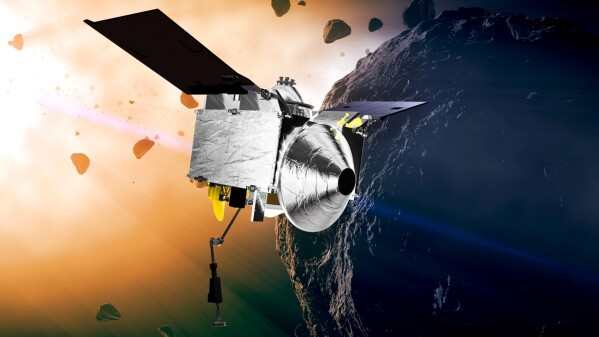
Asteroid sample is made of the ‘original components of the solar system’ and are regarded as relics of the early solar system, according to an AFP article.
These materials are approximately 4.5 billion years old, have remained substantially intact, and, according to Osiris-REx program supervisor Melissa Morris, “can give us clues about how the solar system formed and evolved.”
“It’s our own origin story,” she said, as quoted by AFP.
According to NASA scientist Amy Simon, “we do believe asteroids and comets delivered organic material, potentially water, that helped life flourish here on Earth.”
The celestial samples were obtained from Bennu, a tiny, carbon-rich asteroid discovered in 1999
The celestial samples were obtained from Bennu, a tiny, carbon-rich asteroid discovered in 1999. Bennu is classified as a “near-Earth object” since it comes relatively close to Earth every six years.
The asteroid is composed of a loose collection of rocks and is high in carbon, the building block of life on Earth. Scientists believe it contains water molecules trapped in minerals.
Bennu is about 500 meters (1,640 feet) in diameter, making it insignificant in comparison to the Chicxulub asteroid, which struck Earth 66 million years ago and wiped out the dinosaurs.
Despite the fact that Bennu passes Earth every few years, the chances of an impact are deemed remote, but not zero.
The asteroid could hit Earth in a disastrous way. They believe that the disaster, which has a one in 2,700 probability of occurring, will not occur until the year 2182. Another reason why understanding Bennu’s makeup is beneficial according to scientists.
NASA’s OSIRIS-REx spacecraft gathered samples from Bennu three years ago, in 2020. The probe had arrived at Bennu four years after its launch in 2016.
Bennu had shocked biologists at the time. The OSIRIS-REx probe plummeted through Bennu’s surface after making a brief contact with the asteroid. This revealed to scientists that the asteroid had an unusually low density, similar to a children’s pool filled with plastic balls.
Dangerous voyage
The valuable samples traveled around 67,000 miles (107,826 kilometers) to land on Earth. As the mother-ship approached our planet, Osiris-Rex released its gumdrop-shaped capsule.
According to AFP, the final 13 minutes of the descent were a violent phase in which the capsule catapulted at more than 27,000 miles per hour. Temperatures reached up to 5,000 degrees Fahrenheit (2,760 degrees Celsius) during the descent. Meanwhile, according to NASA, Osiris-Rex has moved on and is “on its way” to collide with another asteroid.
Tears, hope, and thousands of miles
Dante Lauretta, the Osiris-Rex mission’s chief investigator, stated at a news briefing that they had high hopes for the material. She remembered how emotional she was when the capsule detonated.
“We heard ‘main chute detected,” she said, adding, “I literally broke into tears.”
“That was the moment I knew we made it home… For me, the real science is just beginning.”
NASA has collected around nine ounces (250 grams) of dust samples from Bennu’s surface. By far the largest asteroid sample ever obtained.
Previously, in 2020, Japan’s Hayabusa-2 mission obtained a five-gram sample from Ryugu, an asteroid. Ten years earlier, in 2010, Japan returned a minuscule sample from the asteroid Itokawa.
NASA had received a few grains from Ryugu from Japan. According to Reuters, the samples included two organic molecules, lending weight to the theory that cosmic objects like comets, asteroids, and meteorites that blasted early Earth seeded the newborn planet with the basic components for life.
How will the sample be put to use?
The sample will be sent to the Johnson Space Center in Houston for further examination. NASA is planning to reveal preliminary data on October 11 at a press conference according to AFP. The space agency will conduct studies on around one-fourth of the asteroid sample right away. Small amounts of asteroid dust will also be shared with mission partners Japan and Canada.
NASA, on the other hand, will save the majority of it for future generations. It will be a “treasure for scientific analysis for years and years and years to come, to our kids and grandkids and people who haven’t even been born yet,” according to Lori Glaze, director of NASA’s Planetary Sciences division.