
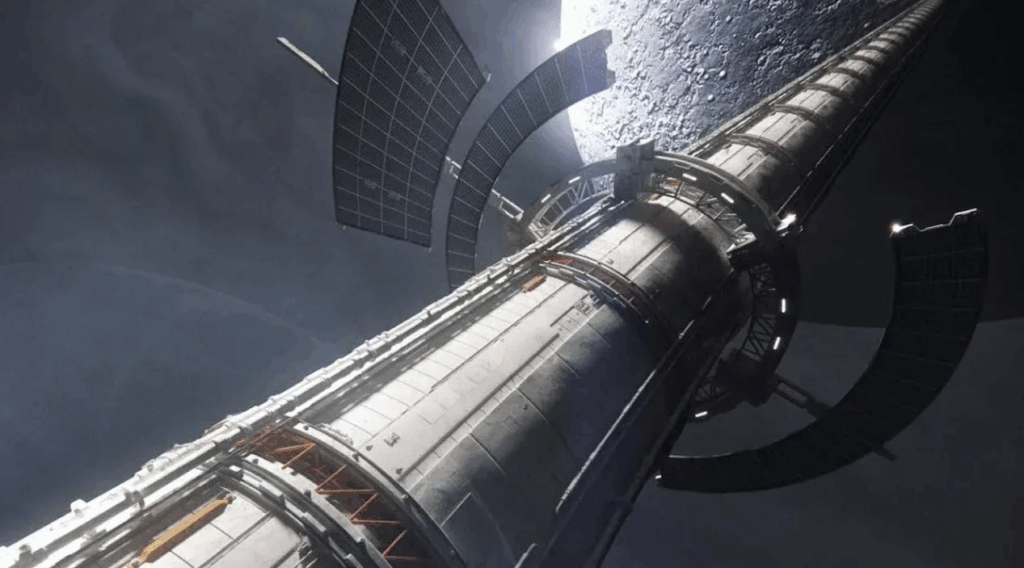
Ceres, the largest object in the asteroid belt, has long fascinated scientists with its vast reserves of water ice—a resource that could sustain future space missions and even serve as rocket fuel. Now, a new study proposes an ambitious solution to harness this potential: a 30,000-kilometer space elevator that could make Ceres a critical hub for deep-space exploration.
Why Ceres?
Ceres isn’t just another dwarf planet—it’s a water-rich world with an estimated 25% water content, much of it locked beneath its surface. NASA’s Dawn mission confirmed these findings, sparking interest in Ceres as a potential refueling station for missions to Mars and beyond.
But extracting water from Ceres comes with a major challenge: escaping its gravity. Traditional rocket launches would require enormous fuel expenditure, making the process inefficient. That’s where the space elevator concept comes in.
How Would a Space Elevator on Ceres Work?
Researchers from the University of Colorado, Colorado Springs, and Industrial CNT outline a design for a 30,000 km-long tether anchored to Ceres’ surface. Here’s how it would function:
- Carbon Nanotube Cable: The elevator would use ultra-strong carbon nanotubes to transport payloads (up to 6,534 kg) to a rotating station at the top.
- Slingshot Effect: Once at the station, payloads could be flung into space, leveraging Ceres’ rotation (once every nine hours) to reduce energy costs.
- Fuel Efficiency: This method could cut energy requirements by 60% and save 15% in fuel compared to traditional launches.
The Water-to-Fuel Advantage
Ceres’ water isn’t just for drinking—it could power spacecraft. The study highlights two propulsion methods:
- Microwave Electrothermal Thrusters (METs): These use water as propellant, heated into plasma for thrust.
- Water Electrolysis Propulsion: Splitting water into hydrogen and oxygen for combustion.
This makes Ceres a self-sustaining pit stop for deep-space missions.
The Challenges
While the concept is promising, major hurdles remain:
- Power Supply: Ceres receives far less sunlight than Earth, making solar energy unreliable. Alternative power sources (nuclear, beamed energy) would be needed.
- Communication Delays: With a 25-minute lag in signals between Earth and Ceres, the elevator would need advanced automation to operate without real-time human control.
What’s Next?
The study lays a theoretical foundation, but real-world implementation is still far off. Advances in material science (stronger nanotubes) and autonomous robotics will be crucial before construction begins.
If successful, a Ceres space elevator could transform space logistics, turning the dwarf planet into a gateway for interplanetary travel.