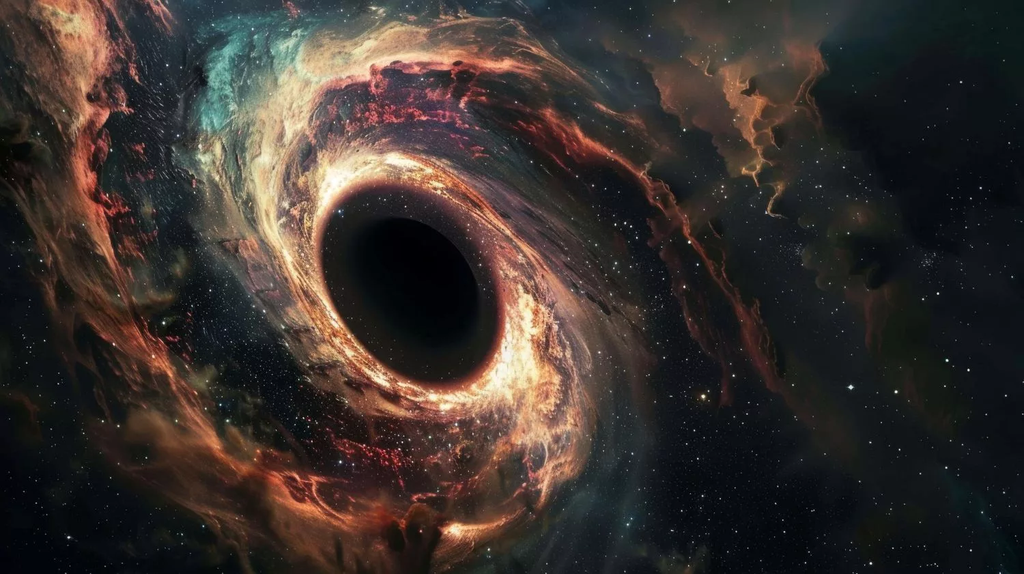
A record-breaking neutrino detected by an underwater telescope has prompted a new theory involving primordial black holes, cosmic strings and a hypothetical fifth dimension. Researchers say the idea could help explain one of the most puzzling signals observed in particle astrophysics, although its origin remains unconfirmed.
The event, designated KM3-230213A, was detected in February 2023 by the KM3NeT neutrino observatory in the Mediterranean Sea. Its extraordinary energy has challenged conventional explanations and prompted scientists to investigate whether it originated from an exotic cosmic object.
The mysterious neutrino that stunned scientists
Neutrinos are subatomic particles often called “ghost particles” because they interact so weakly with matter that they can travel through enormous amounts of material without being absorbed. Trillions pass through the human body every second without causing noticeable effects.
Despite their elusive nature, neutrinos can carry information about some of the universe’s most energetic processes. Detecting them can help scientists investigate distant cosmic environments that are difficult to study using light alone.
The KM3-230213A event was particularly remarkable because its estimated energy was around 220 petaelectronvolts, or 220 PeV. That is roughly 30,000 times the maximum collision energy of individual protons in the Large Hadron Collider at CERN.
Scientists have considered several possible explanations for the signal, including extreme astrophysical sources and the evaporation of primordial black holes. However, no definitive origin has been established.
A black hole born from cosmic strings
A study published in Physical Review D on September 28, 2026, explores how primordial black holes could form within a theoretical framework involving an extra dimension.
The research, titled “Primordial black holes are five dimensional,” was authored by Luis A. Anchordoqui, Alek Bedroya and Dieter Lüst. It examines how quantum-gravity constraints affect different proposed mechanisms for producing primordial black holes, including cosmic strings.
Cosmic strings are hypothetical, extremely thin structures that may have formed during the early universe. If they exist, some could develop loops that eventually collapse under their own gravity.
According to the researchers, these processes could produce black holes that extend into a fifth dimension rather than behaving like the familiar black holes described in ordinary four-dimensional spacetime.
The paper suggests that primordial black holes formed from cosmic strings could have lifetimes comparable to the age of the universe. Such objects might therefore survive long enough to influence the cosmos today.
What is the hypothetical fifth dimension?
In everyday experience, the universe has three spatial dimensions and one dimension of time. Some theories of fundamental physics, including string theory, propose additional dimensions that are not directly apparent to us.
The “dark dimension” framework explored in the research proposes an additional spatial dimension associated with gravity and the underlying structure of the universe. It remains a theoretical model, not an experimentally confirmed discovery.
Within this framework, black holes could behave differently from conventional black holes. Their interaction with ordinary matter and radiation could also differ, potentially helping explain why a powerful neutrino signal might not have an obvious accompanying signal in other forms of radiation.
The researchers argue that quantum-gravity considerations favour five-dimensional primordial black holes under the assumptions of their framework. This is a theoretical conclusion within the model, not evidence that scientists have detected a fifth dimension.
Why the absence of gamma rays matters
One challenge in identifying the source of KM3-230213A is the lack of a convincing accompanying high-energy gamma-ray signal.
Many conventional astrophysical processes that produce energetic neutrinos are also expected to generate electromagnetic radiation. Searching for these accompanying signals helps researchers test competing explanations for an event.
A black hole operating within an extra-dimensional framework could, in principle, produce a different pattern of radiation from an ordinary black hole. This offers a possible way to investigate why the neutrino event has proved so difficult to explain.
However, the absence of a detected gamma-ray counterpart does not, by itself, demonstrate that an extra dimension or a five-dimensional black hole exists. Scientists must assess the proposal against observations from multiple telescopes and competing physical models.
A possible explanation, not a confirmed discovery
The new study adds to a growing body of research examining whether primordial black holes could account for unusually energetic neutrinos. Other researchers have also investigated black-hole evaporation and alternative mechanisms that might explain the KM3-230213A event.
The fifth-dimension proposal is intriguing because it connects an unexplained astronomical observation with questions about quantum gravity and the fundamental structure of spacetime.
But the central mystery remains unresolved. Researchers have not identified the neutrino’s source conclusively, and there is no direct evidence that a black hole hidden in an extra dimension produced it.
Future observations of ultra-high-energy neutrinos, alongside searches for gamma rays and other cosmic signals, could help determine which explanation best fits the evidence.